ROME — Two centuries have passed, but the shadows are the same.
Tehran finds itself once again caught in the middle of the game of two ancient imperial powers.
For the latest news & views from every corner of the world, Worldcrunch Today is the only truly international newsletter. Sign up here.
Echoes of the 19th-century Qajar dynasty can be heard in the streets of Iranian politics: the clatter of Russian diplomatic boots coming from the north and the sly smile of England arriving from the west. History seems to be repeating itself, no longer with cannons and rifles, but with media lobbies, energy contracts and diplomatic revelations.
Today, Iran, like two centuries ago, is caught between two poles of power: Vladimir Putin’s Russia and the West, led by London and Washington. Both wield their influence with calculation and subtlety. Even the regime’s internal factions are now satellites of these blocs: on one side, Hassan Rouhani and Mohammad Javad Zarif, supported by Western and British circles; on the other, Supreme Leader Ali Khamenei and the conservatives, anchored in Moscow.
Zarif and Lavrov’s revelations: The war of narratives
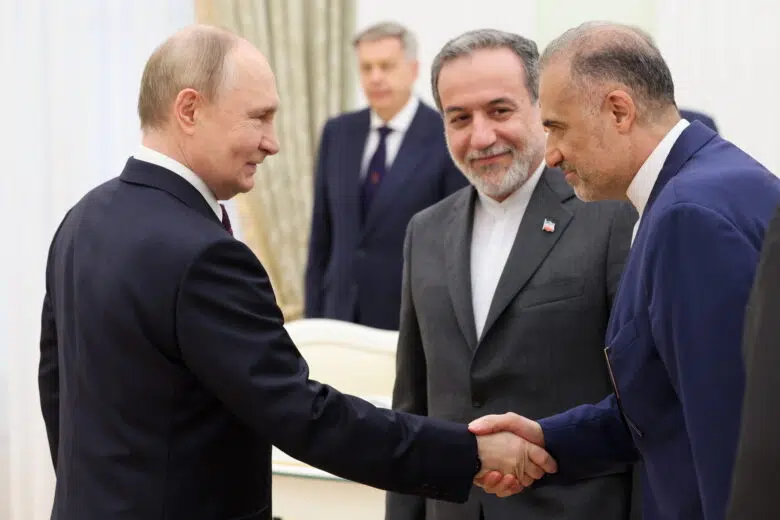
In recent days, the verbal clash between former Iranian Foreign Minister Mohammad Javad Zarif and Russia’s longtime Foreign Minister Sergei Lavrov has revealed how intertwined Iranian politics are with the maneuvers of foreign powers. In an unprecedented interview, Zarif admitted that Russia had hindered Iran’s attempts to normalize relations with the world since the start of nuclear negotiations in 2015.
“Russia has two red lines: first, Iran must never have normal relations with the world,” he said. “Second, it must not enter into direct conflict with the world.”
Dangerous game
And then he added that the Russians told Tehran that if they produce the fuel for the Bushehr nuclear plant themselves: “We will no longer guarantee its safety.”
These words clearly revealed traces of Moscow’s influence on Tehran’s politics — and Lavrov didn’t wait long to respond. “Russia has never departed from the nuclear agreement, and the final decisions have always been made between Tehran and Washington.”
Cannons and rifles have been replaced by diplomacy, energy contracts, and information warfare.
He then called the reintroduction of UN sanctions against Iran an “illegal move” and “a dangerous game by the West.”
This verbal duel is not just a conflict between two ministers: it is a war of narratives between two empires trying to keep Iran in their orbit, one to the east, the other to the west.
Today Tehran resembles more than ever the capital of Qajar times: the same prudent courtiers, the same embassies that make decisions in the shadows, the same people tired of being spectators of power games.

Russian and British empires
In the 19th century, Persia was divided between the spheres of influence of the Russian and British Empires. Today, the same actors are back on the scene, only the tools have changed: cannons and rifles have been replaced by diplomacy, energy contracts, and information warfare.
And the people? Always the same. Bitter slogans and whispered ironies circulate in the streets:
“In this country, you either die in the swimming pool or in your sleep!” A sarcasm that hides collective fear: that of sudden deaths, silent eliminations, and hidden purges. Worn down by decades of factionalism, Iranians are now watching with suspicion.
Yet behind this bitterness, lies a silent anger: that of a generation tired of the games of power and the immobility of the “reformists.”
On the other hand, the West is moving its pawns cautiously. Donald Trump, on the one hand, threatens Iran, on the other, speaks of “peace and dialogue.”
A total collapse of the system could set the entire region ablaze.
Reuters reported last week that Tehran called the negotiation proposal “contradictory” as Washington was simultaneously imposing new sanctions on Iranian banks.
In London, think tanks and British diplomatic circles believe that the best way to contain Iran is not war, but through negotiations with “acceptable” faces within the regime. Thus, reformists are once again seen as tools for rebalancing power.
After the 12-Day War with Israel, the West knows well that a total collapse of the system could set the entire region ablaze. Better, therefore, to focus on a “soft change” in Tehran.

Rotten structure
But the truth is that this “reform from within” is nothing more than a way to prolong the life of a rotten structure, a structure from which both Russia and the West, each in their own way, have profited for 46 years.
In Tehran, death is now an integral part of political language. Politicians drown in swimming pools, generals die in their sleep, officials suddenly disappear. The reformists know that the net is closing: in circles close to the Supreme Leader, there is already talk of possible trials against Rouhani and Zarif for “high treason.”
The reformists’ supporters, former civil servants, urban intellectuals, technocrats, live in a tense silence. Many fear that the complete elimination of this faction could bring the country to the brink of social revolt.
It is the battle for the fate of Iran itself.
The opposition-in-exile, meanwhile, hopes that the regime will finally show itself for what it is: a monolithic and discredited power. If this happens, Iran will once again be the crossroads of history: on one side a hungry and enraged populace, on the other an exhausted and divided power structure — and above them all, the shadows of foreign powers pulling the strings.
The war between Moscow and London, between reformists and conservatives, between East and West, is not just a diplomatic dispute: it is the battle for the fate of Iran itself. If history truly repeats itself, perhaps this time it will be up to a people to rise from the ashes of these foreign machinations.
Because, at the end of every game, only one truth remains: Iran must never be a land of pawns. Iran must return to being a player.