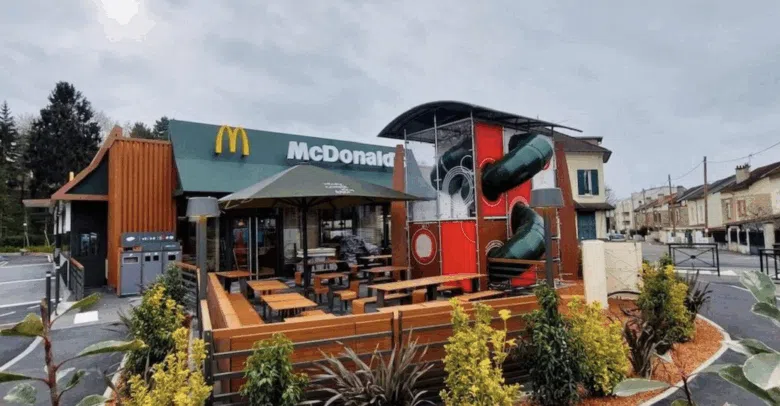
TESSANCOURT-SUR-AUBETTE — If you’re in Tessancourt-sur-Aubette, you’re probably just passing through. Cars and trucks line the local D28 road before entering a roundabout heading towards Meulan, Les Mureaux, Cergy-Pontoise or the gas station. Some park in the parking lot of the Auchan supermarket and fill their shopping carts. Others turn toward the McDrive. It smells of asphalt, fries and the boredom of a rainy Wednesday afternoon.
For the latest news & views from every corner of the world, Worldcrunch Today is the only truly international newsletter. Sign up here.
It’s here, right next to this small village of 971 souls, that McDonald’s decided to set up shop in March 2024. After expanding into peri-urban areas, the fast-food chain has set its sights on conquering rural areas. The goal is for “every French person to be able to find a McDonald’s within 20 minutes of their home,” Jean-Guillaume Bertola, head of innovation and marketing, explained to Le Figaro.
Bertola then announced the opening of around 50 restaurants in France. Since the “golden arches” first lit up at the Aubette roundabout, this town in the Yvelines region near Paris isn’t quite the same: in just one year, the fast-food empire has won the heart of a small French village. And the Golden Arches intend to do the same with other French towns.
A prime location for Happy Meals
The McDonald’s at Tessancourt-sur-Aubette has become a meeting place. The main clientele wears braces, Eastpak backpacks and orders Happy Meals. Smaller than the one in Les Mureaux (only a 22-minute drive away, according to the road signs), the restaurant was built at the intersection of three secondary schools. The Collège de la Montcient in Gaillon-sur-Montcient is located 1.6 km from the fast food restaurant, just like the Collège Henri IV, on the other side of the departmental road, in Meulan-en-Yvelines. And finally, the Collège Mercier-Saint-Paul Middle School in Meulan-en-Yvelines is just 850 meters away.
Théo* comes here twice a week with his classmates. “Look at all the food we can get for 4 euros ($4.7)!” he tells us, his eyes shining as if looking at a treasure. In front of him are spread out cheeseburgers, chicken nuggets, trays of oozing fries, yellow, black, and amber sodas, a McFish and a few sliced apples. “In a normal café, for 4 euros, we could just have a coffee…” That is, if there was any café to go to in the first place: “Here, there’s nothing,” the teenager says, sighing. His statement gets immediately approved by the ironic laughter of his friends.
On Wednesday afternoons, they sometimes wander around the Auchan supermarket before soccer training time. They buy a few sweets for dessert before returning to the warmth of McDonald’s. “At least here, we can stay as long as we want, without getting kicked out if we stop ordering,” the young man says. One of his friends joins him, holding a steaming plastic bag. The waitress comes by, serves a few more burgers — and doesn’t seem particularly bothered to see this young customer seated at a table, with a taco in his mouth.
“It’s a prime location for McDonald’s, since there are not only schools, but also, and more importantly, a roundabout and a shopping area,” explains Jérôme Fourquet, director of the opinion and corporate strategies department at Ifop, emphasizing that the American company “always thinks in terms of traffic flow and axes.”
For its part, McDonald’s says that the presence of nearby schools was not a criterion for their establishment: “Several key points convinced us of the location’s potential: being along several busy roads, benefiting from relatively little competition and the combined attraction we could generate next to a supermarket.”
It’s the artisans and vegetable producers who will pay the price.
Théo is right: there isn’t much around the McDonald’s restaurant, except a “café-tabac-brasserie-billiards” with “furnished rooms” upstairs and the train station café. The only “family-friendly” offering is a restaurant serving French cuisine, called Le Convivial. “Eggs baked with goat cheese cream… Free-range chicken supreme… Foie gras… Beef cut and traditional mashed potatoes… Fresh chanterelles…” Nourdine opens his pantry with a gluttonous eye. Here, everything is homemade. The 50-year-old set up shop 18 years ago.
“At first, I wanted to open a wine cellar. Then I toured the region and saw nothing but kebab shops. Not a single French restaurant. So I said to myself: let’s make real French cuisine.”
Nourdine defends this “French heritage” in the face of the “snackification,” he says, of France. “If we don’t preserve this, we’re screwed. It’s the artisans and vegetable producers who will pay the price. The art of dining is all about education. I think it’s a shame that we no longer educate our children’s palates.”

Creator of jobs
In office for two terms, Paulette Favrou has inaugurated the Tessancourt McDonald’s. The elected official praises the restaurant as a friendly place. Tessancourt was sorely lacking a space where young people could meet around a table, even late at night — but without paying too high a bill. “Opening a McDonald’s seemed to me to be a great alternative to the kebab shops that have proliferated in Meulan,” explains the mayor.
Jérôme Fourquet sees it as a testament to what he calls “hydroponic France” — typical, he says, of peripheral France. “In certain areas, particularly those that have been deserted, kebab shops, shisha bars or halal restaurants are integrating into a traditional or Americanized commercial fabric,” he explains, drawing a parallel with hydroponic farming.
“The old rock is leveled and new, standardized layers are laid down: kebabs all have the same names from one end of France to the other, some French people know the McDonald’s menus by heart… On the other hand, the starter-main course-dessert formula with quiche Lorraine or beef bourguignon and a pitcher of red wine doesn’t appeal to many people anymore.”
It’s certainly an opportunity for our young people.
The arrival of the American giant in Tessancourt has primarily led to job creation. A few young people from the village have found part-time work there. Alongside her studies in Cergy, Claire drains fries, pours ice cream and says “order 64.” At first, she was a little ashamed to work there. But “there’s a good atmosphere.”
Hélène Weber also worked at McDonald’s for two years to pay for her studies. She even found her husband there. She wrote a book about this experience, Ketchup in the Veins (Éditions Érès, 2011). In it, she quotes Jean-Pierre Petit, general manager of McDonald’s France in 2003, who believes that “for unskilled young people, working at McDonald’s remains a chance to get started in life.”
“It’s certainly an opportunity for our young people,” says the mayor of Tessancourt, “it makes Tessancourt a little more dynamic.”

Maintaining control
And demand continues to grow, according to McDonald’s, for whom France represents the second largest market in the world. This is especially true since the arrival of the Golden Arches in rural areas is based on a “win-win” situation: other businesses would benefit from the traffic brought by McDonald’s, the American company says. It goes on to emphasize that its establishments “contribute significantly to the dynamism of an area and offer a friendly living space open 7 days a week.” This is a significant advantage for these small rural towns, where finding a place to dine after 9 p.m. is often a challenge.
“The establishment of McDonald’s in Tessancourt-sur-Aubette is part of the brand’s expansion strategy, which continues to extend its territorial coverage,” with 1,600 restaurants already present in France, explains pollster Jérôme Fourquet. This strategy is part of both a desire to “beat the competition” and to expand the areas covered by home delivery. “Once you’re established, you leave your mark on the landscape,” says Jérôme Fourquet, who describes it as a “flag strategy.” “It’s about raising your banner before the competition.”
While the Tessancourt McDonald’s is managed by a franchisee — like 90% of McDonald’s restaurants in France —, among the restaurants opened this year, “a good proportion are McDonald’s-headquarters, that is, non-franchisees,” says Jérôme Fourquet. “It’s a way to maintain control over territories and quickly gain market share,” continues the author of French Metamorphoses.
But other competitors could appear en masse in the Yvelines, predicts Jérôme Fourquet: bakery chains such as Marie Blachère or Ange — which are also setting up shop at roundabouts and offering menus adjusted to meal vouchers — could soon overshadow McDonald’s.
*Name has been changed