ROME — Several years ago I wrote an article arguing that the only way to contain the ambitions of regional powers in the Middle East was the creation of a mechanism similar to the European Economic Community (EEC), the forerunner of the European Union.
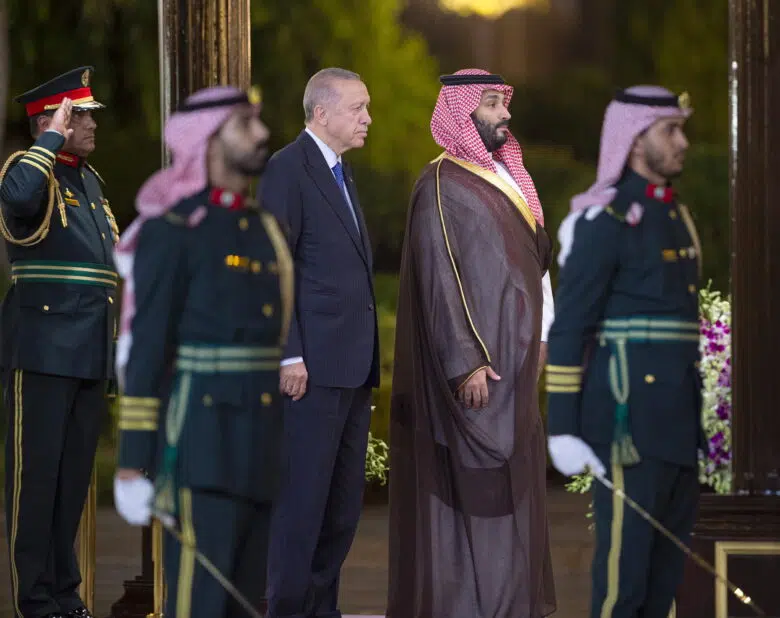
Forging a common political and economic framework, this model would be capable of bringing together key countries in the region, such as Iran, Turkey, Saudi Arabia and Egypt, with the aim of limiting the political and military ambitions of each.
For the latest news & views from every corner of the world, Worldcrunch Today is the only truly international newsletter. Sign up here.
Europe took this path after the end of World War II when France, Germany, Italy and the United Kingdom were progressively integrated into an economic and political union that ended centuries of bloody wars and destructive rivalries on the continent.
The logic behind this proposal is simple, but deeply rooted in history: regional powers, driven by the structure of their economies and the need for growth, inevitably tend to try to expand their sphere of influence and, in many cases, their territory. In the absence of an institutional framework to manage this competition, this dynamic inevitably leads to direct confrontation and ultimately war.
It is the same pattern that Europe has known for centuries, until the 1957 birth of the EEC with the Treaty of Rome — and later of the European Union — made war not only morally unacceptable, but also economically and politically too costly.
In the first article, I argued that the form of government or the dominant ideology — be it a republic, a monarchy, or a theocratic regime — has a marginal impact on this underlying dynamic.
Ideologies, in fact, mostly function as a narrative veil that masks the true motivations of conflicts.
The wars that are bloodying the Middle East today, and which often take on a religious guise, are nothing more than geopolitical conflicts for the control of resources, markets and strategic zones, exactly as occurred in Europe during the centuries of rivalry between empires and nation-states.
What is needed is a common institutional framework.
In other words, the religious wars in the Middle East are above all a “narrative,” a tool to mobilize the masses and legitimize the geopolitical ambitions of political elites. Behind this facade, a cold logic of political-economy operates: each regional power, to ensure its survival and sustain economic growth, must access new resources and markets, a process that inevitably leads to conflict.

If the goal is to end the endless cycle of war and instability that characterizes the Middle East, we cannot rely solely on regime change or ideological reform. What is needed is a common institutional framework, similar to the European one, capable of creating shared economic interests and mechanisms for peaceful conflict resolution. Only through this approach will it be possible to transform war from a natural instrument of politics into an excessively costly and risky option.
Iran and geopolitics
Today, it is more crucial than ever to understand Tehran’s role in regional power dynamics. Iranian competition for hegemony is not exclusively an ideological project, nor does it depend solely on the nature of the regime in power. Rather, it is the structural result of the country’s geographical position, its natural resources, its population and its function as a crossroads of major energy and trade transit corridors.
Religion has functioned as fuel for the machine of geopolitical competition.
Interpreting current conflicts as a religious clash between Judaism and Islam, or an ongoing Shiite-Sunni war is reductive and misleading: religion and ideology are primarily instruments, not causes.
This approach can be summarized in the concept of “Instrumental Religion,” that is, religion understood as a political tool. Historically, in the Middle East, religion has been used by regional and global powers to consolidate their power and manipulate the political reality. From the time of the Safavids to the present day, religion has functioned as fuel for the machine of geopolitical competition.
Israel factor
In recent years, new factors have made competition even more complex.
Among these, two elements stand out. First is Israel’s military power, and its role as an independent actor and strategic partner of the United States.
But beyond that is the “Southern Corridor,” an infrastructure network connecting the Middle East, Eurasia, Europe and Africa.
These corridors have enormous economic value, but they also represent a key geopolitical tool: whoever controls them gains a strategic advantage in terms of trade, security and political influence.
Iran, located at the heart of these routes, is inevitably at the center of competition between regional and global powers. This increases the pressure on Tehran and makes its drive for a hegemonic role appear even more urgent, well beyond the religious component.

Indeed, the political use of religion in Iran and across the Middle East has deep roots. Looking back at the Safavid Era (1501–1736), where Shia was adopted as their state ideology to consolidate power. The rivalry with the Ottoman Empire, officially based on religious differences between Shiites and Sunnis, was in reality a struggle for control of trade routes, such as the Silk Road, and strategic territories in the Caucasus and Mesopotamia.
Rules of the game
More recently, in the 20th century, while mostly secular, the Shah also used the Shiite network in Lebanon and Iraq to increase Iran’s influence, while Saudi Arabia and Egypt have exploited Sunni networks to oppose Iran. Add to that Israel’s having constructed its narrative as a “refuge for the Jewish people” to bolster its international legitimacy.
Today’s conflicts are not ultimately religious wars, but struggles for power and control of resources.
As always, today’s conflicts are not ultimately religious wars, but struggles for power and control of resources. Religion provides a useful narrative to mobilize the masses, but the root of the conflicts remain economic-strategic.
But recent world history also offers a recipe regional stability: an EEC-like structure capable of economically integrating the major Middle Eastern powers. Without such administrative and economic architecture, any internal political change — whether its regime change or simple reform — will merely replace players without changing the rules of the game.
Only by building a system of shared interests will it be possible to transform the Middle East from a theater of cyclical wars to a space of cooperation and prosperity.