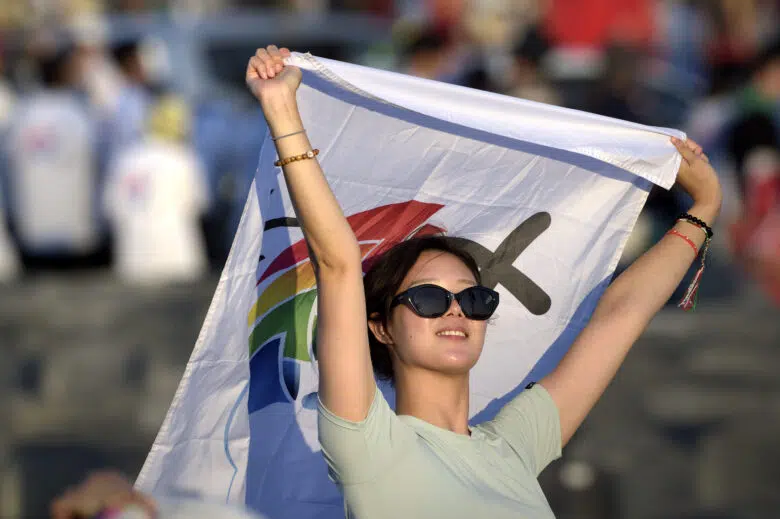
PARIS — Is youth reviving a Catholicism in disarray? The hypothesis is almost provocative, given that all the indicators point to the inevitable decline of this centuries-old religion in France. The case is obvious: the number of baptisms – four outa of five newborns were baptized in 1961, a quarter in 2018 – and ordinations, among other factors, have plummeted in the space of a few decades. But on closer inspection, several signs point to a parallel, not necessarily contradictory trend: a religious revival among millennials.
For the latest news & views from every corner of the world, Worldcrunch Today is the only truly international newsletter. Sign up here.
A recent poll by France’s Ifop polling agency for the Observatoire français du catholicisme (French Catholicism Observatory) takes stock of the state of religious practice in France. According to the study, only 41% of those questioned claim to believe in God in 2025, compared with 56% in 2011.
“We have moved from a traditional or conformist Catholicism, with a very broad base within the population, to a chosen Catholicism, embodied by a restricted hard core, but lived more intensely. Those who remain, especially the younger ones, have integrated their minority status, and are therefore more involved,” says Jérôme Fourquet, director of Ifop’s opinion department.
This year’s record 19,000 registrations for the Pentecost pilgrimage organized by the Notre-Dame de Chrétienté association, with an average age of 21, and the Lourdes FRAT pilgrimage, which attracted a record 13,500 public and private high school students in April, illustrate young people’s new-found interest in the Church. Adult baptisms are also exploding, rising from 4,000 in 2022 to 10,000 on Easter night in 2025, with a clear rejuvenation year on year. The COVID-19 pandemic and its attendant confinements have shaken people’s bearings, generating a thirst for meaning, as the bishops of France have pointed out.
Less materialistic than their elders?
Now members of Generation Z are asking for the first sacrament of Christian initiation, unlike their parents, who were baptized at birth but are now strangers to the pews. Matthieu, 28, lives in Melun (Seine-et-Marne) where he works as a cabinetmaker. He comes from a family of non-believers, and it’s not least because he’s heard so much about Christian freedom that he’s started thinking about baptism in recent months.
“I have a special bond with my maternal grandmother, who often talks to me about her faith,” he says. “Three years ago, I fell into a depression that I associate with my chronic indecision. I couldn’t make up my mind any more; our age offers us such a wide range of options, in every field.” In the course of discussions with her, he gradually came to understand that the God of the Christians gave mankind freedom, but that this freedom was “contained within a path that is supposed to lead to heaven, the antithesis of the illusory freedom offered by consumerist society.”
Despite the unprecedented comforts they enjoy, today’s young people are perhaps less materialistic than those of yesteryear. “There’s a paradox. On the one hand, they have an uninhibited relationship with money and success, revere self-entrepreneurship and watch videos teaching them how to make a million in a month. On the other hand, their thirst for meaning drives them to take refuge in framed practices, as if the overflow of freedom generated a need for norms that could regulate life. I see in this an unspoken reconciliation with constraint,” says essayist Pierre Valentin, a keen observer of wokism and its generational dynamics, and founder of the YouTube channel Transmission. “What’s more, they don’t separate the public and private spheres like their elders. They are converted to the idea that each person can build his or her own life as he or she sees fit, and most of them defend the freedom to wear a headscarf, or more generally to display religious symbols.”
The Church’s massive retreat over the past 60 years has led to a general lack of understanding of its mission.
This Anglo-Saxon conception of secularism leads them to discuss religious issues without reserve. Agathe, 20, a literature student in Toulouse, says, “With my friends, many of whom come from non-believing families, we discuss everything without any hang-ups. Even among those furthest from the faith, I don’t perceive any hostility toward the Church. Having talked to my parents about it, the context was nothing like it was when they were my age. We no longer have their modesty or their preconceptions.” It has to be said that the Church’s massive retreat over the past 60 years has led to a general lack of understanding of its mission.

Atheists disappear in favor of agnostics
Some will regret the bygone era when the Gospel served, if not as a guideline, then at least as general culture. But optimism is not out of the question: by ridding our gaze of all prejudice, distance from religion provides a fertile breeding ground for its discovery. “Our era is completely ignorant of religion, so much so that there’s been a cultural reset. This is an opportunity: the untainted eyes of our contemporaries, especially the youngest among us, can once again be struck by the divine experience,” notes Camille Riquier, dean of the Faculty of Philosophy at the Institut Catholique de Paris (Catholic Institute of Paris) and author of Nous ne savons plus croire (“We No Longer Know How to Believe”).
Atheists, resolute adversaries of the Church when it held a central position, have lost some of their vigour as the institution has become weaker. “The Church is weakened; the same goes mechanically for the atheist, who disappears in favour of the agnostic. Those who don’t believe almost bemoan their situation, as if they lack the means to open up to spiritual things.”
According to the aforementioned Ifop study, 47% of 18- to 24-year-olds say they are on a spiritual quest, compared to just 30% of 50- to 64-year-olds. This quest, which is very much alive among Gen Z, is proving to be clumsy and tentative, lacking any reference points. One example is the astounding success of books on personal development: Once confined to the margins of publishing, esoteric books now have a dedicated collection in some of the biggest houses, such as Hachette. From yoga to shamanism, mystical rituals free of dogma are flourishing.
The attraction of young neophytes to beautiful liturgies is perhaps indicative of a generational break, even if the spiritual quest of young people is reflected in heterogeneous approaches: “It’s either the full menu or à la carte. Either you take it all – some need it all, and are part of an ecosystem that includes not only liturgy, but also chaplaincies, scouting, etc. — or you pick and choose — which is what followers of new age spirituality do,” Fourquet says.
Not put off by abuses, questioned by Islam
Riquier evokes another sign of a cultural reset: Young people don’t seem put off by the sexual abuse cases documented by the CIASE (Independent Commission on Sexual Abuse in the Church) report in 2021. “If my non-Catholic friends sometimes express criticism of the Church, they never mention this issue. Instead, they talk to me about historical failings, for example,” says Agathe, from Toulouse. The Ifop survey shows that, while 41% of the over-65s consider sexual abuse to be the factor most influencing their opinion of the Church, this is the case for only a quarter of 18- to 24-year-olds.
According to Fourquet, “Two factors come together. First, most of these crimes were committed in the 1950s and 1960s. Second, awareness of the systemic nature of this violence is all the more destabilizing for the older generations, because they grew up in a world where the word of the Church carried immense weight. For younger people, these revelations – as we saw with Abbé Pierre – resonate less with their personal trajectory.” Out of sight, out of mind, as the saying goes.
While abuses have led to a loss of confidence in the Church among baby boomers, another phenomenon seems to be acting as a spur to their children and grandchildren: The rise of Islam as a result of immigration from North Africa. The proliferation of militant Islam is a mirror image of the population of Catholic descent, particularly teenagers who rub shoulders at school with Muslim classmates who are increasingly proud to make their views known.
A return to Christianity as a way of returning to the origins of civilization.
“A mimetic reflex pushes them to adopt Muslim codes, to the point where we observe an inversion of the cultural norm when they define Lent as the Ramadan of Christians,” says Valentin. For some, this provokes a return to Christianity as a way of returning to the origins of civilization. It remains to be seen whether this approach can produce lasting conversions. It’s possible, but only time will tell.
Jean-Pierre Denis believes that, alongside this temptation to identify, a similar attitude is developing more widely among young Catholics. For the former director of the weekly La Vie, the prism of identity is not the most relevant for grasping today’s reality in a fresh way. In his book Un catholique s’est échappé (“A Catholic escaped”), Denis has developed the theory of an “attesting Catholicism,” unafraid to assert itself, uncomplicated in this respect by the Muslim model but devoid of a spirit of revenge.

“The ‘soixante-huitards’ [1968ers] were protesters, their grandchildren are attesters. Back then, the Church was part of the protest against the established order; today, young attesting Catholics are, in a way, protesting against society. But on the other hand, starting from the spiritual question. They want to reappropriate a heritage that has not been passed on,” Denis says. Their elders used to compartmentalize their private sphere and their social commitments — more or less directly — by virtue of the theology of burial, a post-war movement inviting Christians to conceal their faith so as not to offend others. Half a century and a “Be not afraid” (Pope John Paul II in 1978) later, God has quietly returned to the conversation.
Stocks at half-mast, flows on the rise but low-intensity
This raises a crucial question, one that is difficult to objectify. Has our society reached a religious floor, a spiritual threshold below which all human communities inevitably wither away? “It’s a real question,” Fourquet says. “But at this stage, the seeds of a possible rebound are concentrated in certain sociological segments — to put it more bluntly, the large families of western Paris. For this hypothesis to be confirmed, we need to observe these elements of a rebound in other social milieus.”
Denis suggests distinguishing between the stock, i.e. the total number of baptized, and the flow, i.e. the newly baptized. “If we reason in terms of stock, it appears that the number of Catholics will continue to decline inexorably. On the other hand, in terms of flow, the curve of requested baptisms is increasing,” although the latter are, at least in part, merely making up for the collapse in baptisms at birth.
The progression of people declaring their atheism is slowing down.
“Secularization can be interpreted as a massive erosion of the stock coupled with the drying up of natural inflows, and requests for baptisms as new flows, albeit of very low intensity,” Fourquet says. While two dynamics may well coexist, the pollster sees the collapse of the old Catholic matrix as the major tectonic movement. “An old expression used to describe the pairing of the Church and the army as ‘the sword and the butterfly.’ Previously, each prefecture or diocesan capital had its own regimental barracks and seminary. Now, in all these provincial towns, we explain that the barracks have been converted into social housing, and we show you the site of the former seminary. This year, 90 priests will be ordained in France — that’s less than one per diocese!” The crowds that flock to Chartres, to the holy water font or to Rome for the Youth Jubilee in August may be growing, but they remain marginal in numerical terms.
When it comes to social change, anyone wishing to save time would be well advised to take a look at the United States. In an article titled “The West has stopped losing its religion,” the weekly magazine The Economist pointed out at the beginning of June, with studies from the Pew Research Center to back it up, that the progression of people declaring their atheism was slowing down across the Atlantic and even in several European countries. The number of American adults identifying themselves as Christians, down from 78% in 2007 to 63% in 2019, has remained stable since then.
“Are we witnessing a reenchantment of the world?” asked The New York Times.
Above all, the magazine noted that this slowdown owes nothing to Islam, and that Generation Z is rediscovering a love of God. Deceptive tremor or real seed? Whether this revival stands the test of time remains to be seen.