-Analysis-
PARIS — At the Sharm El Sheikh Summit on Egypt’s Red Sea coast, the agenda is ambitious: officially, it’s about “ending the war” and “turning a new page for regional security and stability.” In other words, moving on to the hard part of the “Trump plan,” once a ceasefire is in place, hostages are freed and humanitarian aid is flowing again.
Donald Trump and more than 20 European and Middle Eastern leaders are making the trip, but not everyone has the same agenda or the same goal in mind.
For the latest news & views from every corner of the world, Worldcrunch Today is the only truly international newsletter. Sign up here.
The presence of certain European leaders, including Emmanuel Macron, is worth explaining. One might have expected the Americans and Israelis to keep Europe at arm’s length, given their strong opposition to the Franco-Saudi initiative at the UN — an effort to revive the two-state solution that both Washington and Jerusalem are keen to avoid.
But Arab countries, especially Egypt, the summit host, are reluctant to deal with the U.S. on their own at such a sensitive time. Despite their limited influence, the Europeans are seen as a necessary counterbalance to help ensure that the post-war future of Gaza respects shared principles.
Trump’s plan falls short on at least three points. First comes the question of who will govern Gaza once the war ends — and who will be responsible for disarming Hamas. This is the central issue. Then there is the matter of the West Bank, which is notably absent from Trump’s plan.
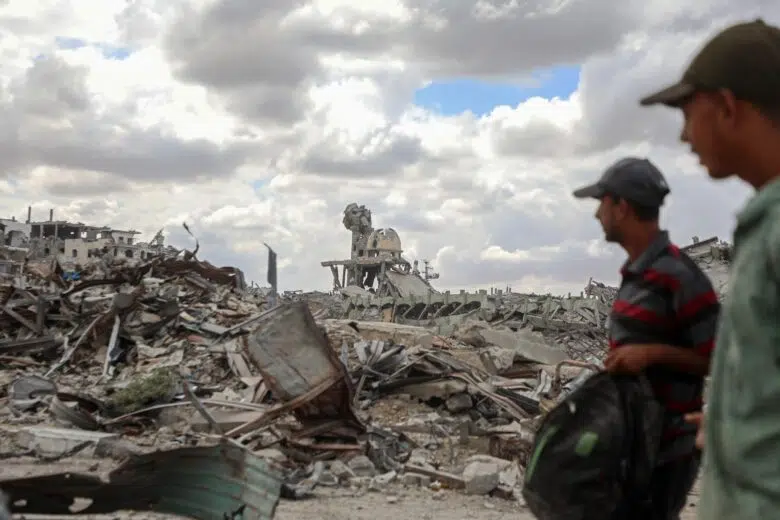
The most difficult challenge, however, is ensuring security in a territory devastated by two years of conflict. On Sunday, a Palestinian journalist was killed by armed militias, while Hamas fighters, newly reemerged, were reportedly hunting suspected Israeli collaborators. Without the rapid deployment of the international stabilization force envisioned in the plan, chaos seems inevitable.

But what will the mandate of this international presence be? To support a Palestinian force that does not yet exist, or to impose order itself? And who will disarm Hamas, which has announced that it refuses to surrender its weapons as long as Israel occupies part of Gaza? As we can see, it is incredibly complex.
Path to a Palestinian state?
France and its Arab partners hope to revive the UN plan adopted this summer, which sets out a path toward a Palestinian state. But that vision clashes with American priorities — and even more so with those of Benjamin Netanyahu’s government in Israel.
A ceasefire without a real peace process is a recipe for future disaster.
For the past two weeks, Paris has been praising Trump’s plan, hoping to nudge it closer to the Franco-Saudi vision — especially by restoring the Palestinian Authority, which, even weakened, represents a link between Gaza and the West Bank. Israel opposes this, and the U.S. has its own approach, involving the appointment of Tony Blair to help oversee implementation.
The danger is that these quiet tensions, along with Israeli resistance to anything resembling a potential Palestinian state, could produce a ceasefire without a real peace process — this is a recipe for future disaster. Once the initial relief of a war-free period and the release of hostages fades, the region’s underlying complexity is almost sure to rear its head again.