-Analysis-
PARIS — When you’ve followed the Israeli-Palestinian conflict for as long as I have — my first visit to Gaza dates back to 1981 — you develop a kind of sixth sense that guards you against excessive optimism. That instinct has kicked in once again since yesterday’s agreement between Israel and Hamas, brokered under the initiative of Donald Trump.
For the latest news & views from every corner of the world, Worldcrunch Today is the only truly international newsletter. Sign up here.
This sixth sense allows me to be cautiously optimistic in the short term — about the release of hostages and prisoners, the delivery of aid to civilians in Gaza, and the ceasefire itself. But it also keeps me from believing that this initial phase will lead to something more lasting, to the beginning of a political solution.
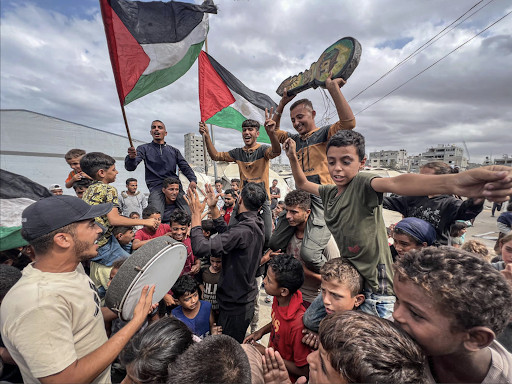
Given the tragedy of the past two years, that is already no small thing. We should genuinely rejoice at the end of the ordeal for the Israeli hostages, the release of some 2,000 Palestinian prisoners, and the halt to the bombing and destruction of what remains of Gaza. For once, Israelis and Palestinians are taking to the streets in shared celebration — a rare moment of joy, however fragile.
This first phase is decisive. It closes the chapter that began with the October 7 massacre. Then will come negotiations for the second phase, to determine Gaza’s governance, security, and reconstruction; in a word, the aftermath. And that part will be far more complicated.

Political obstacles ahead
The real difficulty lies with the dominant political forces. On the Palestinian side, Hamas may have signed the agreement, but it clearly has no intention of going anywhere, either militarily or politically, as the plan ultimately envisions. Its radical vision remains intact. The other Palestinian faction, led by Mahmoud Abbas and the Palestinian Authority, is more open to compromise, but has been sidelined by both the Americans and the Israelis.
Israel remains fiercely opposed to any outcome that hints at the creation of a Palestinian state.
As for Israel’s ruling coalition, it remains fiercely opposed to any outcome that even hints at the creation of a Palestinian state. The constrast with 1993 could not be starker: back then, the Oslo Accords — the only genuine attempt at peace in a century — were signed by leaders who, however imperfectly, were still willing to take political risks for compromise.
External pressure could, in theory, make a difference. But one recent decision casts serious doubt on that prospect. U.S. envoy Steve Witkoff had initially approved the inclusion of Marwan Barghouti, who has been imprisoned for over 20 years and is often described as the “Palestinian Mandela,” on the list of prisoners to be released. Israel objected, had his name removed, and Washington accepted the veto.
Why does that matter? Because Barghouti, if freed, could embody a Palestinian leadership capable of negotiating a political agreement with broad popular support, according to all opinion polls. Benjamin Netanyahu, however, prefers to face Hamas, discredited by violence, and Mahmoud Abbas, weakened by powerlessness. That combination remains the surest way to block any real progress toward a two-state solution.