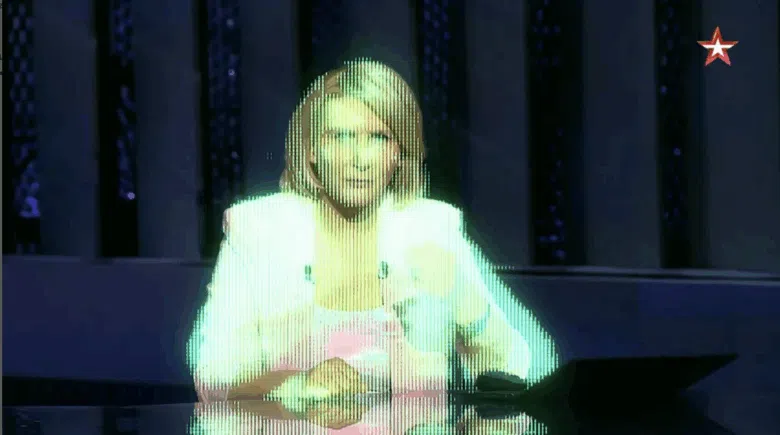
PARIS — The host sets the tone from the outset: “The show I’m presenting is created, from the first to the last frame, by a neural network. The task is very simple: to filter out all the political absurdities spread by the West over the past week.” Natalia Metlina, known for hosting talk shows, also sits in the Duma for United Russia, Vladimir Putin’s party. This time, however, she is not the one speaking, we are told, but her avatar — even though there is nothing to help viewers understand that the elegant blonde onscreen is purely virtual.
For the latest news & views from every corner of the world, Worldcrunch Today is the only truly international newsletter. Sign up here.
Now ubiquitous, AI makes it possible to conduct disinformation and opinion-manipulation campaigns, in particular by generating fake videos or audio recordings of public figures in an effort to lend credibility to false information. Moscow and its media arms have eagerly embraced this instrument.
As legislative elections were held recently in Moldova — a country bordering Ukraine that could veer away from its pro-European course toward Moscow — the Moldovan government and the EU denounced “unprecedented interference” by Russia, notably through such increasingly sophisticated techniques. The show hosted by the “fake” Natalia Metlina, broadcast weekly since last August, is one example, though aimed mainly at a Russian audience.
Titled PolitUkladchik, “the Political Box,” the show is a first of its kind, given that it is entirely generated by generative artificial intelligence. Unprecedented, too, for its openly stated objective: to wage an informational war against the West amid the confrontation intensified by the war in Ukraine. Also without precedent is the fact that the show airs not on some obscure internet channel but on Zvezda, the state-run network operated by the Russian army — a federal television channel with a wide national audience.
Western leaders as prime targets
The targets are clearly identified: the most prominent Western leaders, especially Europeans. “Boris Johnson, why does England always piss off the whole world?” attacks the host Natalia Metlina — or rather, her virtual likeness — at the start of an interview.
“Ha, ha, ha, that’s an excellent question, Russian and direct,” replies an AI-generated version of the former British prime minister (2019–2022), hair wilder than ever. “We don’t piss off the world — we fertilize global politics. Without our historic fertilizer, Europe would dry up like bacon without marmalade. They envy us because, on the Continent, they have neither pudding, nor humor, nor real politicians…”

The tone is as crude as the technology is sophisticated: viewers could easily believe they are seeing the real “BoJo.” He speaks in Russian, however, with an exaggerated English accent that renders the character comical. The objective is plainly to discredit him — and, through him, the entire European political class.
A Macron avatar
Also in the crosshairs of PolitUkladchik are, among others, Finnish President Alexander Stubb, German Chancellor Friedrich Merz, Polish Prime Minister Donald Tusk, and — unsurprisingly — Emmanuel Macron, often mocked on Russian social media.
Here, the French president appears dressed in a pink tutu, helping Volodymyr Zelensky get dressed as if he were a child, under the watchful gaze of Brigitte Macron. Once ready, the Ukrainian president is shown heading to the Kremlin, passing through the grand ceremonial halls to Vladimir Putin’s office, where he is ordered to capitulate.
In another segment, the host’s image claims that the French president recently acknowledged NATO’s responsibility for starting the war in Ukraine.
The alleged exchange supposedly took place during a private meeting at the Élysée with economist Jeffrey Sachs, who was receiving a decoration. Macron appears on screen speaking Russian, with an implausible French accent.
“Sometimes, you have to say something unexpected so that everyone stops talking and thinks about what Macron just said,” declares the president in this fictional interview designed to invite ridicule.
“Like in chess, sometimes you must make a move that seems stupid, so that ten moves later everyone understands it was a brilliant maneuver.”
— “Are your European partners surprised?”
— “They are always surprised. When I say NATO is brain-dead, they are surprised. The only time they’re not surprised is when my wife beats me.”
— “So you deliberately said something foolish?”
— “Well yes, I started a discussion — otherwise, what would we be talking about now? The weather? My dreary family life?” concludes the French president’s avatar, made to look thoroughly ridiculous.
Trump’s casino on Red Square
Donald Trump is not spared either. The host announces an exclusive interview with the U.S. president. “Zelensky has said that Ukraine is winning against Russia because the latter hasn’t deprived Kyiv’s regime of control over the whole country,” the fake Natalia Metlina tells him.
A lifelike Trump replies in self-parody: “The Ukrainians could have won if they’d listened to me. They should’ve hit Moscow with something really big. Not missiles. I would’ve built the biggest and most beautiful casino in the world on the Red Square — with golden toilets. The oligarchs would all be inside, with all their money. Problem solved. They’d play poker and forget the war…”
Then, Trump’s avatar announces he’ll call Vladimir Putin to propose a “deal” — cue in laughter from Russian viewers.
“AI reduces the cost of producing and disseminating information — or disinformation.”
“Moscow thinks of information as a resource that can be used as a weapon in a hostile process,” explains Maxime Audinet, a researcher at France’s Institute for Strategic Research of the Military Academy (Irsem) and a specialist in Russian foreign policy. “It’s a highly relativist approach, corresponding to a post-reality in which there’s no hierarchy between information, opinion, and rumor — and that’s very deliberate.”
Indeed, Russia’s uninhibited use of AI on a prominent television network marks a new stage in the normalization of disinformation operations. The phenomenon also follows an economic logic, notes Audinet: “AI reduces the cost of producing and disseminating information — or disinformation.”
Last October, Margarita Simonyan, head of Russia Today (RT, a media outlet closely linked to the Kremlin) revealed that several of her network’s presenters were entirely AI-generated. AI, she added, is also widely used to select and generate images, “which avoids having to employ editors and drastically reduces production costs,” conceded the RT chief, known as one of the Kremlin’s most active mouthpieces.