–OpEd–
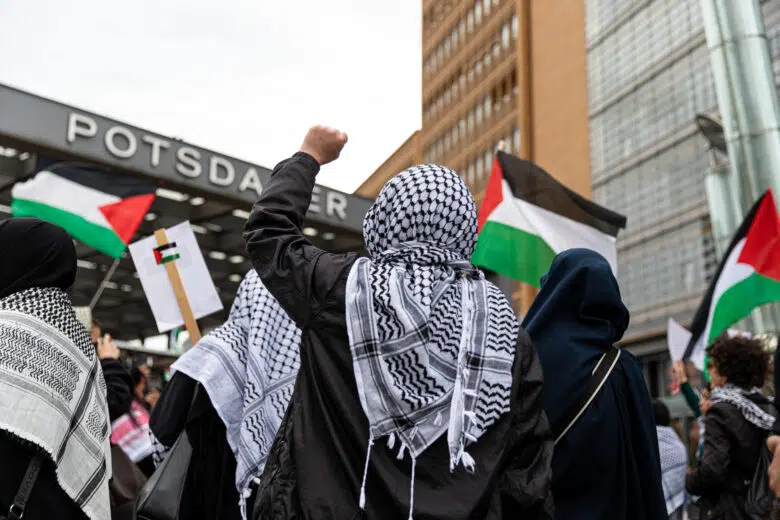
HAMBURG — In September, France and Canada plan to recognize a Palestinian state. Yet what is conspicuously absent from the political stage are its citizens, their rights, and their claims to land. A Palestinian nation speaking with its own voice still fails to capture public attention.
For the latest news & views from every corner of the world, Worldcrunch Today is the only truly international newsletter. Sign up here.
When Germans talk about the Middle East, many see a nation seeking to free itself from the guilt of the Holocaust by supporting Israel at all costs. When Palestinians appear in German awareness, it is almost always within a double stereotype described by Palestinian writer Mohammed El-Kurd in his book Perfect Victims: Palestinians “exist in a false but strict dichotomy: We are either victims or terrorists.”
Seen as terrorists, Palestinians are denied a right to exist and must be fought militarily. Seen as victims, they may receive humanitarian aid but no further recognition, remaining completely passive.
Whatever one’s position on the conflict, there is a blind spot that is hard to ignore: Palestinians are rarely regarded as political subjects who could legitimately act as a community. They are, in philosopher Jacques Rancière’s terms, “participants without a share,” excluded from the “common community,” whose voices register only as “noise” rather than logos, meaningful speech. What would it mean to allow Palestinians to step onto the shared stage of politics and hear their voices as carrying real weight?
Palestinians’ political demands
The scope of action for those without a stake is always narrow. The questions one asks of a people with a state and national self-determination (which parties exist, which leaders, which institutions, what kind of civil society) apply only in limited ways to Palestinians. Their political space is curtailed by violence and the burden of Israeli occupation. Politicians and activists who could point a way forward sit in prison, like Fatah leader Marwan Barghouthi. Many others have been killed. NGOs face legal restrictions. The ongoing fragmentation of Palestinian territory makes political organization ever harder.
On top of this come decades of missteps and strategic errors
Added to this are decades of missteps and strategic errors by the elected Palestinian leadership. Added to this is the Arab world’s persistent indifference to a political solution. Added to this is the violence of Hamas, which since the 1990s has repeatedly sought to block diplomatic agreements with suicide attacks, fueling the radicalization of the Israeli electorate. The restriction of political space, on one side, and the use of violence, on the other, have almost completely eclipsed the political field.

Against that backdrop, it is worth recalling the Palestinians’ own political demands. Three recur consistently across the differing positions of NGOs, parties, activists and scholars: first, full equality between Palestinians and Israeli Jews. Second, the right to political self-determination and an end to the occupation of the West Bank and East Jerusalem. Third, the right of return, claimed by all those expelled during the founding of Israel during the Nakba, Arabic for catastrophe.
Europeans‘ futile efforts
None of these demands have yet been fulfilled. Neither Palestinians with Israeli citizenship nor those in the occupied territories enjoy legal, economic or social equality with Jewish Israelis. The right to self-determination has receded ever further since the collapse of the false hopes raised by the Oslo peace process. And the right of return, written into UN Resolution 194 in 1948, is flatly rejected by Israel. By international standards it would involve either actual return or compensation, and would require a binding legal framework to be workable. Given the millions of Palestinians on one side and more than 600,000 Jewish settlers on the other, such regulation is anything but simple.
Yet Palestinians have pressed these demands for as long as they have been a people. Individual acts continue to highlight them. In Justice for Some, law professor Noura Erakat recalls how on Nov. 15, 2011, six Palestinians boarded bus line 148, which links West Bank settlements to Jerusalem and is normally reserved for Jewish settlers. They called themselves Freedom Riders, after the U.S. civil rights activists who defied segregated buses under Jim Crow. Their protest targeted not only the segregated transport system in the West Bank but also Israel’s illegal settlement policy and the denial of equality between Jews and Palestinians.
The wider history of Palestinian politics can be read as an attempt to give these three demands structure, procedures, and institutions able to enforce them. For many years, Yasser Arafat’s Fatah party and the Palestinian Liberation Organization (PLO) embodied that hope. The largely non-violent First Intifada of the late 1980s was widely seen as a success. But the Palestinian Authority (PA), born out of Oslo and dominated by Fatah, is no longer considered by many Palestinians a legitimate representative of those demands. They see it as an Israeli subcontractor, run by the self-serving autocrat Mahmoud Abbas and sustained by corruption and the enforcement of Israel’s security priorities.

This demonstrates the ineffectiveness of current European efforts to recognize a Palestinian state: There is currently no legitimate political entity capable of establishing such a state, not least because, under international law, an end to the Israeli occupation would be a precondition for a genuine state. A legitimate political sphere is essentially nonexistent, and it cannot be brought into being through unilateral recognition resolutions and over the heads of the Palestinians.
This makes clear why current European initiatives to recognize a Palestinian state are ineffective. There is no legitimate political entity capable of establishing such a state, not least because under international law an end to Israeli occupation would be the precondition for a genuine state. A legitimate political sphere simply does not exist, and it cannot be conjured by recognition over the heads of the Palestinians.
The depoliticization of Palestine has only deepened
From 1988 onward, the erosion of Fatah and the PA went hand in hand with the rise of Hamas, designated by the EU as a terrorist organization in 2001. In his book Hamas Contained, Tareq Baconi, president of the board of Al-Shabaka think tank, writes: The Palestinian Policy Network, explains that Hamas gained ground partly because it held onto the three demands while the PLO abandoned them. Whereas the PLO arose from a global wave of anti-colonial movements, Hamas grew out of a regional revival of Islamism. Its founders, Baconi writes, “expressed the principles of Palestinian nationalism in an Islamist framework, giving them religious logic. This narrowed the ideological room for maneuver.”
The extent to which Hamas represents Palestinians has varied over time. Neither Hamas nor Fatah can claim to speak for them all. A survey by the Palestinian Center for Policy and Survey Research found that 50% favored imprisoned Fatah figure Marwan Barghouti, followed by Hamas leader Khaled Mashaal and PA leader Abbas. Hamas’s support nevertheless remains strong, above all because it is seen as the only force still fighting Israeli occupation.
For decades, Palestinians have tried to use international law to advance their demands, but legal victories have rarely carried weight in practice. In 2004, for instance, the International Court of Justice ruled that the barriers Israel built between the West Bank and Israel during the Second Intifada violated international law and must be removed. The wall still stands.
Skepticism about coexistence with Israel is strong among Palestinians — as it is among Israelis.
Palestinians’ scope for political agency is thus vanishingly small. History shows that if they resort to violence, they are condemned and crushed. If they join peace talks, they are strung along for decades while their situation deteriorates. If they appeal to international law, they are ignored. If they mobilize civil society, they are smeared as antisemitic. As Columbia University anthropologist Nadia Abu El-Haj asks bluntly: “Is there any Palestinian resistance movement you have ever recognized, or ever will, as legitimate?”
Since Oct. 7, 2023, Palestine’s depoliticization has entered a new phase. Hamas’s atrocities in its attacks on Israel have made the chances of peace even slimmer. In On Perpetual Peace, Immanuel Kant warned that in war no one may allow themselves “hostilities which must make mutual trust in a future peace impossible.” Otherwise, he wrote, war risks turning into “extermination.”
A new vision for the Middle East
To preserve the possibility of peace in the face of that danger, Palestinians’ demands have shifted. Skepticism about coexistence with Israel, as neighbors or within a shared state, is strong among Palestinians — as it is among Israelis. Today Palestinian voices mainly call for an end to Israel’s devastating assault on Gaza.

Writing in the London Review of Books, Baconi set out their current demands: “End military assistance. Suspend arms exports to Israel and stop buying Israeli weapons… Impose sanctions: end financial and economic cooperation… Support the International Criminal Court and the International Court of Justice and meet third-party obligations under international law. Bring criminal investigations against dual nationals who have committed war crimes in Gaza.”
Focusing on Gaza and finding political possibilities there is not easy. In his Theses on the Philosophy of History, German-Jewish thinker Walter Benjamin wrote: “Even the dead will not be safe from the victorious enemy.” That dictum finds a grim echo in reports from The New York Times and CNN that Israeli bulldozers have repeatedly damaged cemeteries in Gaza.
A Germany that had truly learned from its Holocaust guilt would act in the name of universal equality.
To capture this, Nadera Shalhoub-Kevorkian, until recently one of the few Palestinian women professors at Hebrew University, uses the Arabic term ashlaa’, meaning scattered body parts. “Gaza’s politics of life,” she argues, consists of “Gazans resisting physical and social mutilation and instead choosing literal and epistemic reunification through the gathering and uniting of the ashlaa’.” Collecting body parts, she insists, is a deeply political act: even amid destruction, it asserts togetherness and mourning, preconditions of politics itself.
Despite the deepening depoliticization, there are still fragile openings for a political future. Beyond nationalism, whether secular or Islamist, lie other possibilities. In her prophetic 1944 essay “Zionism from a Modern Perspective,” philosopher Hannah Arendt pointed toward a radically new path. She spoke of the “catastrophic decline of the nation-state system in our time” and suggested “federations” as an alternative to imperial politics. On the horizon, one could imagine a federation of an Israeli and a Palestinian state, just as the European Union once seemed a fantasy in 1945. Such a vision would demand new political imagination, for as Arendt noted of her own century, “Saving both the Jews and Palestine will not be easy in the 20th century; to achieve the goal with the categories and methods of the 19th century seems, to say the least, very improbable.”
And Germany? A Germany that had truly learned from its Holocaust guilt would act in the name of universal equality. Or as philosopher Omri Boehm put it in the speech he was prevented from giving on the 80th anniversary of Buchenwald’s liberation: “‘Never again’ is only valid in its universal form.”