-OpEd-
ROME — Something is happening. Behind the scenes of Western diplomacy, a quiet but increasingly determined front is taking shape. After Norway, Ireland and Spain, now France, the United Kingdom and Canada have lined up: At the UN General Assembly in September, they will vote to formally recognize the State of Palestine. They’ve announced it. And it looks like they really will. But why now?
For the latest news & views from every corner of the world, Worldcrunch Today is the only truly international newsletter. Sign up here.
The question is less rhetorical than it sounds. Why are these countries, three pillars of the Atlantic order, deciding to break a balance they’ve helped maintain for decades? The answer, perhaps, is not only in the tragedy of Gaza, nor in the will — however genuine — to restore a minimum of dignity to the Palestinians.
No, there’s also a bigger game at play: a game played at the table between Israeli Prime Minister Benjamin Netanyahu and U.S. President Donald Trump. And in this scenario, the recognition of the State of Palestine becomes not so much a goal as a tool. A way to force Trump, now back in the White House for a second term, to take a stand.
To each his agenda
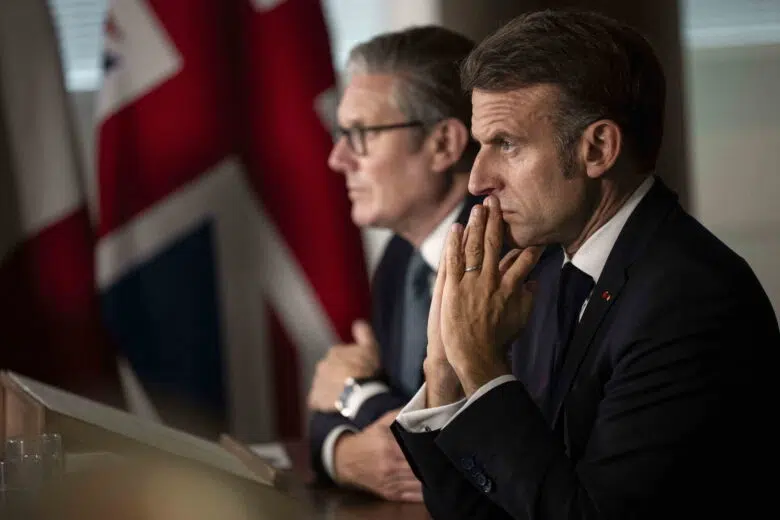
Let’s start with France. President Emmanuel Macron needs to rebuild his credibility, both at home and abroad. The protests against the pension reform, the surge in far-right votes and the widespread discontent are all pushing him to find a cause that gives his mandate some moral direction. Palestine, now a global symbol of injustice, becomes that cause.
Then there’s the UK’s new prime minister, Keir Starmer. After the troubled era of Boris Johnson and the end of the Conservative reign, Starmer needs to give his Labour party a new soul and stop former Labour leader Jeremy Corbyn’s new party from luring away MPs. So Starmer can no longer ignore the Palestinian issue, especially now that significant parts of his base are openly demanding it.
A Palestinian state will not actually come into being in September.
Sure, the recognition will be “conditional,” as Downing Street has already hinted: security for Israel, democratic reforms within the PA, and above all, removing Hamas from any political power in a future Palestinian government. But the political signal will be clear.
Finally, Canada, which also has a new prime minister. Mark Carney, who has succeeded Justin Trudeau, has presented himself as a pragmatic and progressive leader. But he’s also the most exposed to U.S. retaliation. Trump has already threatened, not exactly subtly, new tariffs on Canadian steel and cars if Ottawa recognizes Palestine. And yet, the Canadian government seems intent on moving forward.

The real target
At the center of it all, however, remains Netanyahu. Isolated, arrogant, resistant to any compromise proposal, not even the joint diplomatic offensive by Egypt, Qatar, and the United States has managed to sway him. The attack on Rafah, carried out amid international protests and UN condemnation, is the latest example of a political line that allows for neither ceasefire nor negotiation.
This is where Trump enters. While his personal and ideological bond with Netanyahu is strong, the U.S. president is also under pressure. Within his own party, among moderate Republicans, discontent is growing. Within the military and diplomatic apparatus, frustration is palpable.
So the recognition of Palestine by six Western democracies is aimed precisely at this: forcing Trump to choose. Either he remains stuck to Netanyahu and risks global isolation, or he pressures his ally into a ceasefire. Maybe not out of conviction but out of convenience.

A symbolic moment
Let’s be clear. In September, a Palestinian state will not actually come into being. The conditions aren’t there. There’s no unified territory, no single government, no real economic or military independence.
But formal recognition, voted by countries with seats on the UN Security Council and weight on the international stage, would change the picture; it would give Palestinians, and above all the Palestinian Authority, a new kind of political legitimacy. And it would force Israel out of the diplomatic bubble of impunity it has taken refuge in.
But in diplomacy, symbols matter.
Even in Europe, the mood has shifted. Images from Gaza, university occupations, movements for a ceasefire — these all had an impact. Macron can’t ignore the public square. Starmer can’t ignore the young and progressive vote. Carney must hold together an increasingly polarized Canada. And behind the rhetoric of “two peoples, two states,” there is — for once — a genuine attempt to disrupt the wall of silence.
Recognition serves that purpose, too: to signal that something is changing. That we can no longer pretend Palestine is just a “problem.” It’s a people. It’s an identity. And it’s a responsibility. September will be a symbolic moment. But in diplomacy, symbols matter. Maybe they won’t immediately change the facts on the ground. But they can change the language used to describe those facts.
And in times like these, when truth is manipulated and justice is weaponized, even changing the language can be a powerful political act.