-Analysis-
TURIN — October 13, 2025 will remain in Israel’s collective memory. Families wept with relief, flags waved in the streetlights, prayers and songs rose together. Everything felt like a celebration, a shared embrace, a deep exhale after two years of holding a collective breath: what many on Monday dared to hope was the possibility of a return to normal.
For the latest news & views from every corner of the world, Worldcrunch Today is the only truly international newsletter. Sign up here.
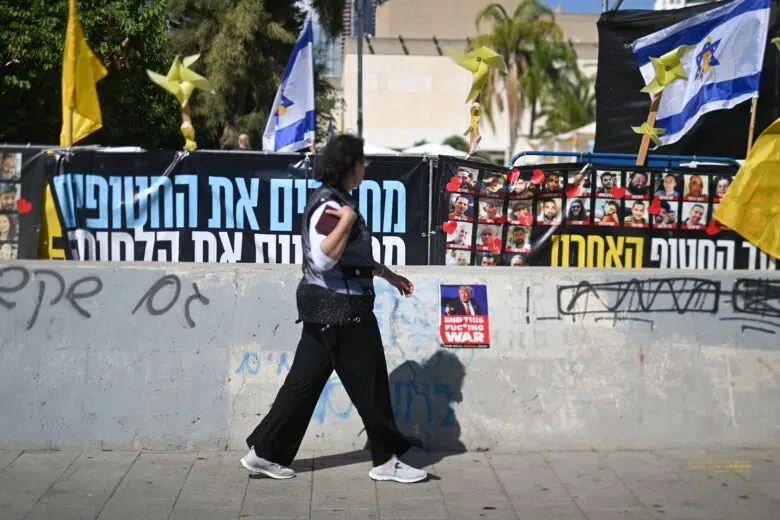
There is a question that has to be asked today, and it cannot wait. It is the question that follows relief. What do we mean when we speak of normality? In recent months, Israeli public life has revolved around two movements at once. The duty to remember the abducted and demand the hostages’ release, and the systematic removal of everything else. This was the core theme of most Israeli protests, the ones that filled Tel Aviv’s streets every Saturday, calling for a ceasefire to help bring the hostages home.
Those same squares and streets had been packed for 40 weeks before October 7 with citizens opposing the judicial overhaul of an extremist government, while pushing everything else out of view. Everything else meant the occupation. Everything else meant normality.
Under constant threat
For 24 months, Gaza was laid waste, Palestinian civilians remained nameless. They were reduced to background noise, a shadow seen as inevitable but irrelevant in most Israeli squares. This closing off comes from a society that built a grammar of survival, where denying the suffering of others has become part of the language.
In this defensive identity, war is not an episode but a permanent state, a context that even makes moral suspension acceptable.
The sense of being a democracy under constant threat has shaped the narrative on which Israel built its identity. In this defensive identity, war is not an episode but a permanent state, a context that even makes moral suspension acceptable.

It is what allowed the streets to ignore what was happening in Gaza. The massacres, the famine, the systematic destruction, the engineering of forced displacement, accompanied by a dehumanized language that dehumanizes people.
The challenge now, in these days after the hostages came home alive, is to make personal grief, which becomes fragments of a shared destiny, an opening to question the causes that led here. So today we need to start turning the hostages’ release into a political act, not merely a moment of relief. Only by making these two years into a political act can we reconsider the conflict rather than freeze it in the drama we lived through. Only then can we grasp it in historical terms, not only in the eternal present of pain.
The Israeli government built much of its legitimacy on security rhetoric, on the centrality of threat, on the military management of civilian life. Everything rests on the belief that trauma is eternal and that any attempt to probe the conflict’s origins is, in the end, an act of betrayal. In that frame, even the joy of the hostages’ return is not a moment of pacification, but of rallying. It serves to tighten consensus around the idea of an unavoidable war and a people forced to defend itself. A return to normal that is a return to the status quo.
So, again, what does a return to normal look like? What counts as normal? The normal that for decades has meant segregation, injustice, and systematic oppression. The normal in which millions of Palestinian lives are squeezed every day within fences, while the world looks on with indifference or worse, complicit silence. To speak of a return to normal now, to invoke peace while emptying the word of meaning, is to legitimize a return to that status quo, to what has been allowed to happen across generations.
Fragile ground
For decades, Israel lived with the notion that normal could coexist with occupation, that a democracy could stand while denying rights to millions of Palestinians, that security could be guaranteed at the price of permanent inequality.
It was a refined form of collective repression. The belief that one could live in peace without confronting the causes of war. That was normal. That illusion is gone.

The release of the hostages and the pause in bombing are not an end point, they are proof of how fragile the ground is beneath Israel’s feet. The joy in Hostage Square was real, but it was not decisive. Behind the singing you could sense the void of a political system that cannot say the word peace without fearing what it implies. In that void another word insists on being heard, the one that follows ceasefire and comes before peace. Responsibility.
To cheer a peace that is only a fragile truce is to risk turning a pause into an unforgivable absolution.
So that relief for the hostages does not turn into absolution, as Donald Trump joked in the Knesset, half jokingly urging that everything now be forgiven of Benjamin Netanyahu. The day after the ceasefire and the return of the hostages must be a day of justice, of trials, of law enforced. For the grave accusations against the government and the armed forces that fall within the scope of the 1948 Genocide Convention, and that can no longer be dismissed as hostile propaganda.
Unforgivable absolution
This is why settling for relief is risky and profoundly dangerous. To cheer a peace that is only a fragile truce is to risk turning a pause into an unforgivable absolution. Not only for the Israeli military and government, but also for their international allies. The release of the hostages must not and cannot become a moral anesthetic.
If a ceasefire is treated as peace, if the status quo is once again accepted as normal, Israel will only postpone its own trauma. The most urgent task is not to celebrate an end but to imagine a beginning. Peace can no longer be a noun, a diplomatic trophy, a destination. It has to become a verb again, a movement, a daily practice of recognizing the other. It means understanding coexistence not as a concession but as a moral and political necessity. If Israel keeps calling peace what is merely suspension, if the world accepts injustice as a form of stability, then October 13 will remain a closed chapter, not the opening of a new book.
The real danger now is that Israeli society will once more sweep the dust of its contradictions under the rug. That it will settle for relief instead of facing the truth. Because a peace built by erasing injustice and the pain of others is a truce with oneself, not with others. And like any truce, sooner or later, it ends.

