-Analysis-
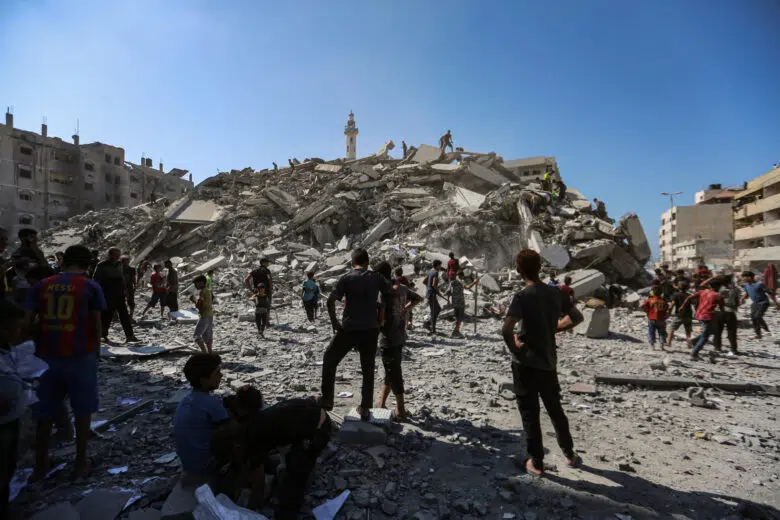
PARIS — As has been the case every day since the Israeli army launched its offensive on Gaza City, an evacuation order was issued Monday to residents of certain buildings. This time it was Gaza’s tallest residential tower, Al Ghafri, which was destroyed a few hours later. Videos of the tower collapsing under Israeli missiles circulated on social media, with panicked residents trying to save their belongings and their lives.
For the latest news & views from every corner of the world, Worldcrunch Today is the only truly international newsletter. Sign up here.
The Israeli military justifies each such operation by claiming Hamas was using the building as an operational center or observation post. But no evidence has been provided, and it is worth recalling that international journalists have been barred from entering the Gaza Strip for nearly two years, while more than 200 Palestinian journalists have been killed.
In this context, a word has resurfaced that deserves explanation: “urbicide,” literally “killing the city,” a neologism formed from the Latin roots for “city” and “to kill.” The term does not appear in international law, unlike genocide, which emerged during the Nuremberg trials at the end of World War II. But it has both a history and a meaning.
Sarajevo roots
The word first appeared in 1963 under the pen of British science-fiction writer Michael Moorcock. Its political usage, however, came later from Bogdan Bogdanović, the former mayor of Belgrade and an opponent of Slobodan Milošević in the former Yugoslavia.

He used it to describe the urban battles waged by the Serbian army in Sarajevo, Mostar and Vukovar in the 1990s. During the long siege of Sarajevo in particular, Serbian forces shelled the Bosnian capital from surrounding hills, killing its residents but also the city itself, which was plunged into terror and deprivation.
The term has also been applied to Phnom Penh under the Khmer Rouge, when the Cambodian capital was emptied of its inhabitants, and to the urban battles in Aleppo and Homs during Syria’s civil war.
In Gaza, the word takes on a more literal and more sinister meaning, since the destruction is systematic and deliberate — not the byproduct of battles or collateral damage. Without saying it outright, Israel is making life impossible in Gaza, city after city, through the destruction of residential towers, schools, hospitals and infrastructure.
For now, the Israeli army is moving residents from destroyed areas toward the south of the territory, already completely overcrowded and facing disastrous humanitarian conditions.
Ethnic cleansing?
What comes next? The Israeli government has repeatedly floated the idea of “voluntary” transfers of Palestinians to other destinations — though none has been found. South Sudan and Somaliland have been mentioned, but neighboring Egypt fears the displaced will end up on its soil, which it refuses to accept.
The corollary of “urbicide,” if that is what ultimately happens, is ethnic cleansing. Israel risks being accused of several serious violations of international law, for even if “urbicide” itself does not appear in legal texts, destroying civilian infrastructure and carrying out forcible displacement are considered war crimes.
Officially, the goal remains to destroy Hamas, responsible for the Oct. 7, 2023, massacre in Israel. But the targeting of civilian infrastructure makes this war, which will soon reach two years, a collective punishment that increasingly isolates Israel, despite continued U.S. support, reaffirmed by Secretary of State Marco Rubio‘s Monday visit.
For now, the urbicide of Gaza continues unchecked.