-Analysis-
TURIN — Qatar is one of the richest countries on the planet, but its strategic value goes well beyond money. It hosts the largest U.S. base in the Middle East, just a few kilometers from Doha, as well as a significant Turkish military presence, it runs a massive shared gas field with Iran, runs the most powerful soft power in the Arab world — the Al-Jazeera network — and wields a bottomless treasury to buy sports franchises and influence business worldwide.
Thus for years, while missiles flew overhead in a conflict-plagued Middle East, Qatar sat in the middle of the Gulf in a tower of ivory and steel, able to expand its interests and influence with utter serenity.
For the latest news & views from every corner of the world, Worldcrunch Today is the only truly international newsletter. Sign up here.
Three months ago, the spell was already broken. On June 23, the war between Israel and Iran broke this precious neutrality, as Tehran targeted the U.S. base at Al-Udeid, though not without first notifying the Qatari authorities and the White House.
Qatar has become a new battlefield in an endless proxy war.
A mostly symbolic warning, but still the end of immunity.
The end of neutrality
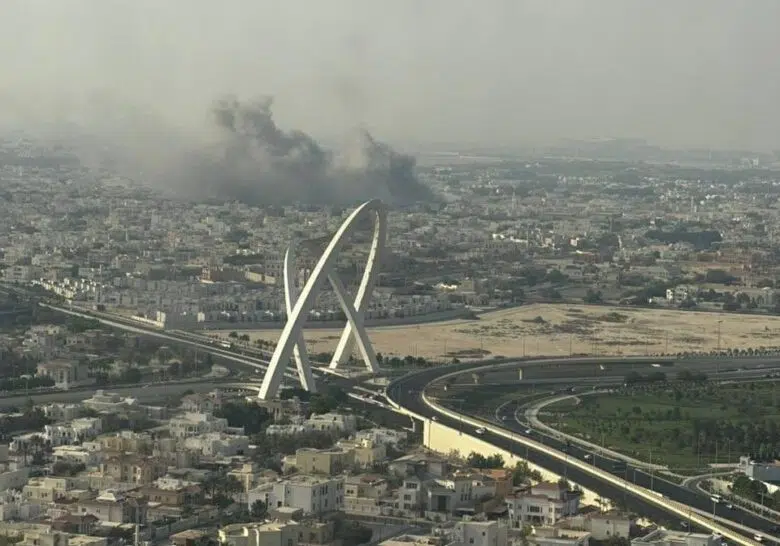
On Tuesday, Doha itself was struck by the Israelis — and not just as a pretense. Qatar has become a new battlefield in an endless proxy war: the stage for the dismantling of Hamas, a direct attack on the mediators and on the peace negotiations themselves. It can only be seen as the final word erasing the possibility of a truce.
But behind the explicit and immediate message there is a deeper one. The end of immunity means the end of ambiguity. The Jewish state has been working against the “Axis of Evil” for some 20 years. And it has in fact dismantled it, almost completely. The list of states to be “taken down” — literally — was given more than two decades ago by U.S. General Wesley Clark in a famous interview about the “Wolfowitz plan.”
It was 2002, President George W. Bush was preparing to attack Iraq, but did not want to stop there. The list also included “Syria, Lebanon, Libya, Somalia, Sudan and, finishing off, Iran.” We’ve seen almost all of them fall, or in any case be reduced to rubble.
Qatar was not on the list, nor could it have been, as with any other country allied with Washington. This gave the Qatari emirs, including current ruler Tamim bin Hamad bin Khalifa Al Thani, significant room to maneuver.

For example, their hosting the spiritual leader of the Muslim Brotherhood, Yusuf al-Qaradawi, and giving refuge to Hamas leaders in the name of the Palestinian cause. Their veteran political leader Ismail Haniyeh had his home there, traveling between Doha, Istanbul, and Tehran — and Benjamin Netanyahu waited until he was visiting the Iranian capital to eliminate him.
Netanyahu’s new leverage
Now the margins have narrowed completely. With the Trump Administration rock-solid in its support, “King Bibi” can do what he could not do in Bush’s time: annex more territories, expand the security zones in Lebanon and Syria — a de facto shifting of borders — strike his enemies “anywhere in the world,” on the very malleable grounds of ‘terrorism’. Either way, that seems to be the message.
The next phase in the showdown with Iran approaches. Everything suggests it will be on a much larger scale than the 12-day war in June.
The direct strike in Doha sends shockwaves all the way to Riyadh, Abu Dhabi, and Cairo. There are no more sanctuaries for anyone as the next phase in the showdown with Iran approaches. Everything suggests it will be on a much larger scale than the 12-day war in June.
And this time, the Gulf countries will have to take sides, as will Lebanon and Syria. The elimination of Hamas leadership is part of a broader program. The June conflict highlighted certain vulnerabilities that the Israeli General Staff now wants to eliminate.
Frontlines redrawn
The chain of U.S. bases along the Gulf coast — too close to thousands of Iranian missiles —have become a liability. They must either serve as a forward base against the enemy, which requires a decisive political move by the emirs, or remain a point of vulnerability. Lebanon and Syria must be firmly brought into the Western camp.
In Damascus, the fall of Bashar al-Assad’s regime wasn’t enough. Assad was Iran’s man, but the new leader, Ahmed al-Sharaa, is aligned with the Muslim Brotherhood. He must put ambiguity behind him, or risk the country fragmenting, with Druze and Kurds ready to carve out autonomous or independent states.
The destruction of Hamas, Gaza City and perhaps parts of the West Bank is merely a preliminary step to a much larger war.
In Beirut, Hezbollah and its Shiite ally Amal are still part of a government that is supposed to oversee their disarmament. That won’t be easy. Meanwhile, the White House has ordered the end of the UNIFIL mission within a year. If the Lebanese army doesn’t act, the Israeli military will take care of it — without interference.
By then, the idea of a land corridor along what was once the Shiite Crescent will no longer seem utopian. Positioning commandos, special forces and possibly more, right on Iran’s border is seen as crucial to bringing Supreme Leader Ali Khamenei to his knees — if he hasn’t already been eliminated. In this context, the destruction of Hamas, Gaza City and perhaps parts of the West Bank is merely a preliminary step to a much larger war.