-Analysis-
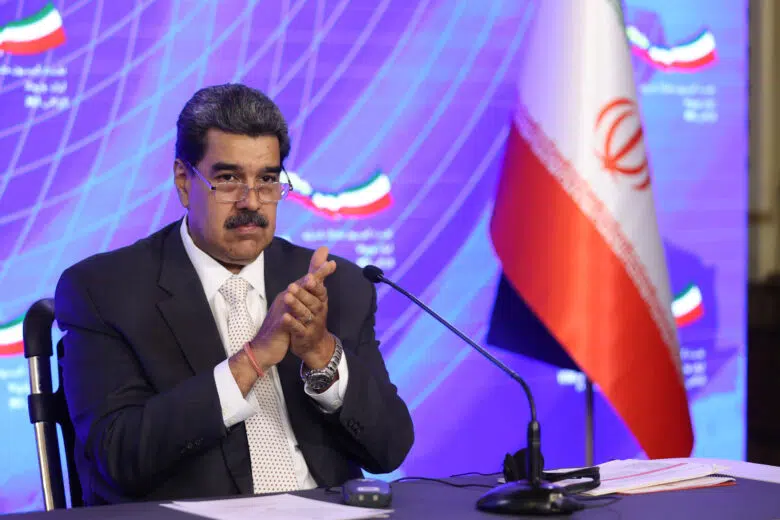
BOGOTÁ — Venezuela’s leftist regime, led by President Nicolás Maduro, recently awarded two Iranian journalists who’d covered Iran’s June war with Israel with its National Journalism Prize. This was no isolated incident, but a symbolic epilogue to 12 days of propaganda, mobilizations and media coverage (in Venezuela) to openly and aggressively support Iran’s theocratic regime.
For the latest news & views from every corner of the world, Worldcrunch Today is the only truly international newsletter. Sign up here.
Venezuela is yet again assuming its role as the regional beachhead of an international coalition that openly challenges the values of liberal democracy and the Western order.
While Israel and Iran were bombarding each other, Maduro’s propaganda machine set to work with discipline: there were marches, forums, “special” coverage and public declarations. At one of the demonstrations, the Speaker of Parliament Jorge Rodríguez, bluntly declared: “Iran gave the Zionist entity a punch in the mouth after it attacked Iran’s peace and sovereignty … it only took 12 days for the world to realize that Israel was just another paper tiger.”
This rhetoric, typical of the darkest years of the Cold War, sets the tone for an international alliance that has become more than symbolic: it is operational, structural and deeply ideological.
Tehran in Latin America
Once considered a vague hypothesis, Iranian penetration into Latin America has now become a systematic reality. Beyond occasional commercial exchanges with regional powers like Brazil and Mexico — two states where pragmatic interests prevail — Iran has consolidated a network of strategic affinities with the far-left regimes of Venezuela, Nicaragua, Bolivia and Cuba. It is in these countries, characterized by institutionalized authoritarianism, that Tehran has found fertile ground to expand its ideological, operational and military influence.
Iran has turned these Latin American countries into strategic nodes of its alternative foreign policy.
What we see on the continent is not a collection of scattered diplomatic agreements, but rather an architecture of alliances that functions as part of the anti-Western axis. This structure is evident in technology transfers, security cooperation, media exploitation and, in cases, facilitation of illicit networks. Far from being a passive presence, Iran acts as a deliberate actor that has turned these Latin American countries into strategic nodes of its alternative foreign policy.
While the hemisphere’s democracies struggle between polarization and institutional weakness, this authoritarian bloc has learned to exploit the loopholes in the system to project power. Latin America, for its political fragmentation and historical vulnerability to redemptive or ‘liberation’ narratives, is risking becoming a testing ground for agendas that contradict its democratic vocation.

Bolivian revolutionary guards
One of the most telling cases is Bolivia, where in 2023 the government signed a security and defense cooperation agreement with Tehran. The agreement included supplying military equipment and creating an ideological training center for revolutionary militiamen. At the same time, the Abya Yala channel, broadcasting from Bolivian territory, is a communication platform that systematically reproduces the narrative of political Islamism and explicitly supports the line coming out of Caracas, Havana and Managua.
Farther south are other worries. In Colombia, various intelligence sources have warned of a Hezbollah cell operating in Bogotá, while in the tri-border area between Brazil, Paraguay and Argentina, clandestine structures associated with illegal financing and smuggling persist. These enclaves operate under the shadow of institutional apathy or the veiled complicity of local actors, and connect directly with global networks that make no distinction between ideological activism and transnational crime.
The recent war with Israel served as a showcase on the military, diplomatic and propaganda fronts
The precedents are not insignificant: the 1994 bombings of the AMIA Jewish center and Alas Chiricanas Flight 901 in Panama are tragic reminders of the potential price of complacency before such threats.
The recent war with Israel served as a showcase on the military, diplomatic and propaganda fronts. Iran’s allies on the continent mobilized in unison, yet this was not a fight for the rights of a people, but an ideological assault on the foundations of liberal democracy.
Venezuela is no longer just a country in crisis. It is a functional enclave in a global project that unites Tehran, Moscow, Beijing and Havana. What happens there affects not just Venezuelans, but the very balance of the region and the West’s destiny. Ignoring it is a luxury that liberal democracy can no longer afford.