
-Analysis-
Until June 13, the last conventional war that Iran fought was a massive, eight-year war with Iraq that ended in 1988.
The chart below shows Iran’s direct military conflicts under the current regime, which took power in 1979, excluding events in which proxy groups, not Iranian forces, played the main role or where attacks were not launched from or into Iranian territory. It includes wars like those with Iraq or, more recently, with Israel. These larger-scale conflicts carry a different weight compared to limited operations, such as a missile strike on Iraq’s Kurdistan Region. The data indicates that the regime entered a period of stabilization after the Iraq war, reaching a peak of stability in 2011. Naturally the regime’s security should not be equated with the security of Iranians.
After 2011, however, it fell into a spiral of unchecked conflicts and gradually resumed the path of insecurity to end up, from 2024, in a state of military stalemate comparable to the last two years of the Iran-Iraq War. In the last part of that war, the regime was engaged simultaneously with the United States in the Persian Gulf and the Iraqi army on its western border.
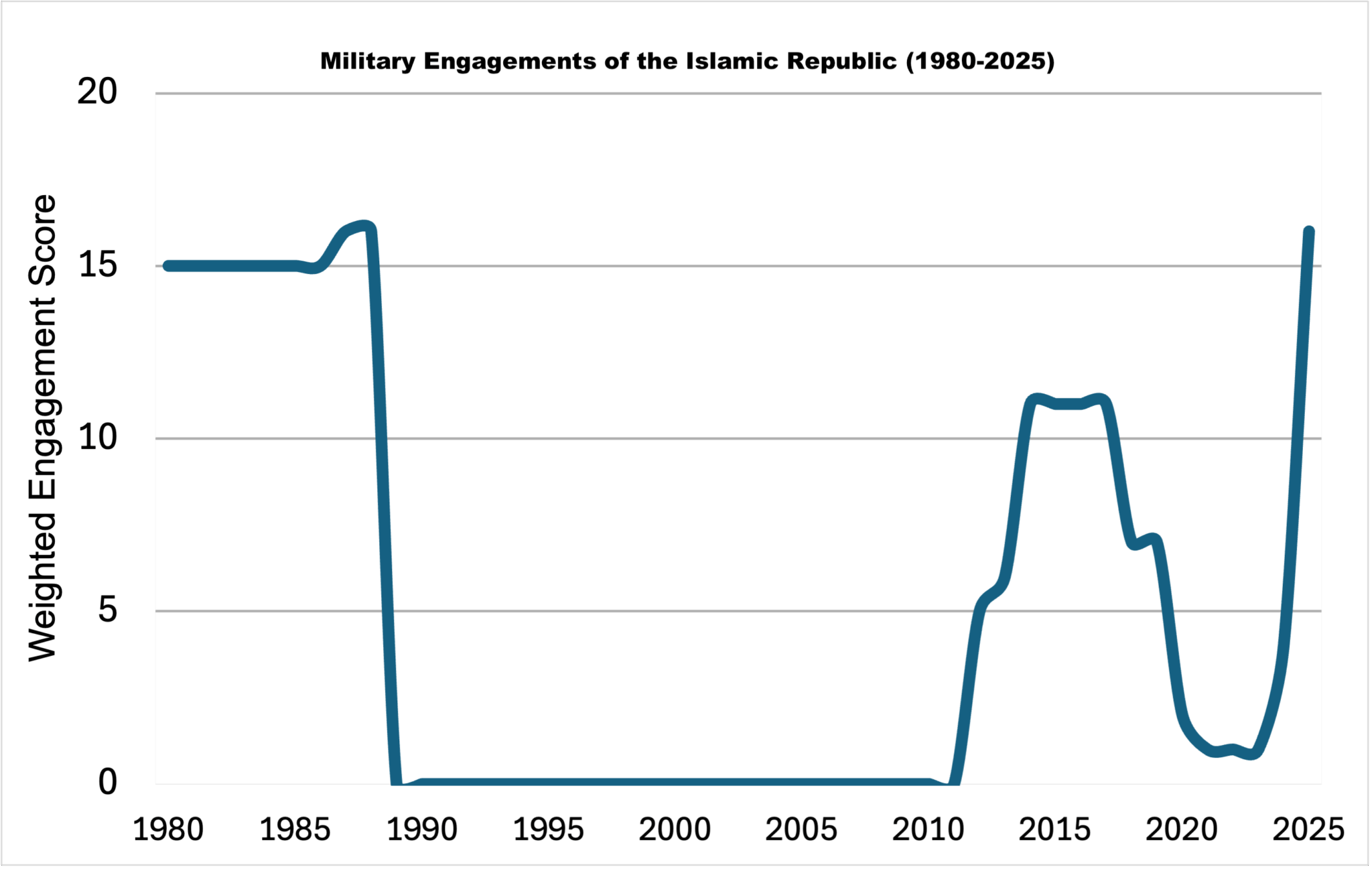
Source: Milad Gaikani*
A clear sign of the regime’s unprecedented instability today is the increase in military conflicts affecting it, their transition from limited operations to the level of war and the reversal of the dynamics of war. The regime is no longer facing weak regional actors like the self-rule authorities in Iraqi Kurdistan, war-torn Syria or the terror group ISIS, which without air power and missiles could not respond to Iranian strikes. It is on the defensive against powers like Israel, the United States and even Pakistan, and has accepted peace out of fear.
Systemic crisis
This concerns only the regime’s direct military interventions or operations carried out from or into Iranian territory. It excludes, for example, the regime’s other, multiple crises — economic bankruptcy, increasing terror operations inside Iran indicating faulty security, diplomatic isolation, environmental crises and resurgent opposition to its rule.
I am even excluding in the same, military domain, the failure of its regional strategies as evidenced in the fall of allies like Syria’s Bashar al-Assad and the severe weakening of proxy forces like Hezbollah or Hamas. The regime’s crisis, in other words, is multidimensional and far starker than set out here. Put together, the various components paint a picture of a systemic crisis or the regime’s definitive decline.
Its situation is exacerbated by the political or ideological considerations that shape its foreign policy in preference to any economic logic (like competing for control of regional transportation corridors or trying to weaken the U.S. dollar by selling oil for non-dollar currencies) or even geostrategic reasoning (like arguing that any Iranian regime would seek a nuclear bomb or finance militias abroad). The regime’s foreign policy should rather be seen as a continuation of its domestic policy — even if its foreign entanglements rarely cause a shift in its domestic policies.
The result is more pressure on Iranians and civil society.
Thus, the regime’s aggressive, exclusionary and lawless methods at home, brazen violation of its own constitution and hostility to the Universal Declaration of Human Rights, its disruption of organic Iranian traditions and indifference to all notions of political good sense, are reflected in its dealings with neighboring states. It stokes insecurity abroad, creates parallel (if not terrorist) structures challenging the state, engages in terror operations, eschews normalization of ties in the wake of past hostilities and disrupts trade.
At the same time, its foreign policy failures, forced compromises and reluctant negotiations never lead it to give into the people’s demands or expand democracy and judicial independence at home. This is illustrated by the hasty executions of detainees, mass arrests and expulsions of thousands of illegal (mostly Afghan) immigrants, just days after its ceasefire with Israel, as attempts to shore up its battered authority.
Whether the regime wins or loses abroad, the result is more pressure on Iranians and civil society. In other words, the regime and Iran are not the same. The regime adjusts its foreign policy to preserve itself; just as it consumes Iran to preserve itself.
America-first trap
Frankly, to adopt an anti-war stance (hostile to Israel in this case) for the sake of a regime devouring the land like some apocalyptic cult or a plague, and equating its destruction with the destruction of Iran, at best, constitute appeasement. This is a loaded word, certainly, for its historical association with the peacenik politicians who yielded to Hitler’s demands in the 1930s, notably the Anglo-French duo Neville Chamberlain and Édouard Daladier. The appeased party today is an Iranian regime with an overworked secret police.
The isolationist MAGA movement wants anything that is neither Bush nor Obama
It seems as if the current U.S. policy of “America First” will again trap the peoples of Iran and the Middle East in a cycle of pain and suffering. As Clément Therme, a French specialist on Iran, points out in a recent podcast episode, when deciding on policy on Iran, the United States is more concerned with the repercussions of their decisions for themselves than with the realities of Iran’s government and society.
President George W. Bush’s administration naively sought regime change and democratization in Iraq and Afghanistan, apparently against the wishes of their societies, while the “Neocon” Republicans who dominated policy making at the time, paid little attention to the socio-political realities of those places, as they were pursuing an ideological project of their own.
MAGA and Mullahs
Back in 2009, Barack Obama’s administration also ignored Iranians, by failing to support the “Green Movement” of protests and saying nothing about systematic human rights crimes. He sought to project his administration as opposed to the Bush presidency and inclined toward diplomacy not war. That again meant policy making based on partisan ideas and domestic power equations, regardless of events in Iran. In his own way, Obama repeated the Bush administration’s mistakes in Syria and Libya.
Now, the isolationist MAGA movement wants anything that is neither Bush nor Obama, oblivious to the fact that in Iran’s exceptional case, the United States should be playing a role not turning its back. MAGA is not of course Donald Trump’s entire administration, which may be credited with having allowed Israel’s strikes to destabilize the Iranian regime.
Arguably, this could not have happened under a previous or a Democratic administration hellbent on appeasement, even if the MAGA crowd are pressuring the administration to find a modus vivendi with the mullahs of Tehran. This risks ignoring the realities of the Iranian situation and may again lead to decisions being based on U.S. domestic political calculations. It seems the isolationists and even realists in the United States are particularly responsive to the propaganda of the Tehran regime and its lobbyists abroad: topple the regime and you’ll face another, calamitous quagmire like Iraq and Afghanistan!
*To measure the security stability of the Islamic Republic of Iran over time, the author developed a weighted system that reflects the degree of direct military engagement by the state, not casualty counts or destructive capacity. The system includes four categories: full-scale wars — such as the Iran-Iraq War (1980–1988) and the 2025 Iran-Israel War —receive a score of 15, representing peak instability and existential military crisis. Extended foreign deployments of Iranian forces, notably in Iraq and Syria, are scored 5, while more limited deployments, like those in 2018–2019, are scored 3. Tit-for-tat precision strikes (including missile attacks, cross-border raids, or naval clashes such as the 1987-1988 U.S.-Iran Gulf confrontation) are assigned a score of 1. This framework deliberately excludes proxy warfare, counterterrorism actions against non-state groups like Jundallah or PJAK, and intelligence or covert operations. The result is a visual representation of how militarily secure or unstable the regime has been, year by year, based solely on its direct military activity. On this basis, the period from 1989 to 2012 can be seen as a time of security stability, with no direct state-level military engagements recorded.