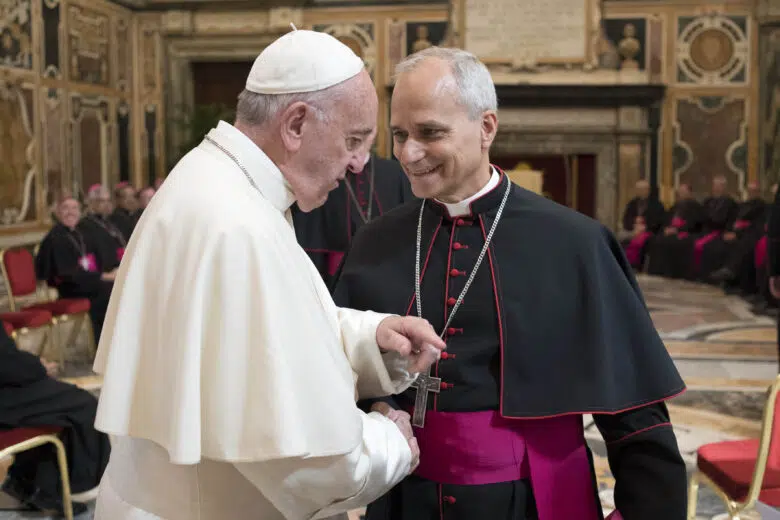
ROME — With his rise to the papacy on May 8, much has been said about U.S.-born Pope Leo XIV’s links to his predecessor, Argentine-born Pope Francis, particularly their shared commitment to society’s most vulnerable.
Still the connection was boosted by the fact that both spent much of their respective pre-papacy years in Latin America. Francis (born Jorge Bergoglio) was a Jesuit priest and eventually Archbishop of his native Buenos Aires. Then known as Robert Prevost, Leo spent two decades in Peru, including serving as Bishop of Chiclayo, before Pope Francis appointed him Cardinal and head of the influential Congregation for Bishops in Rome in 2023.
This interview with Italian priest and writer Antonio Spadaro took place last year while the future pontiff was visiting the U.S., and offers insight on his views and connections with his predecessor.
You worked in Rome during part of Francis’ papacy. You had the opportunity to know him personally. Can you share some insights, experiences and stories, and perhaps tell us a little more about your personal relationship with him?
Well, I can’t tell the best stories here, but if you catch me in the parking lot, maybe I can tell you one or two. The first thing for you to know is the transparency. I first met Pope Francis when I was Prior General (of the the Order of Saint Augustine) and he was Archbishop of Buenos Aires. We met on several occasions for different reasons.
There are many Augustinians in Argentina, so when I went there, we sometimes had various opportunities to meet at the Catholic university or during visits, things like that; so we met there. I’ll tell you, without going into details, that on one of the occasions when the Pope was Archbishop of Buenos Aires he wanted a certain Augustinian to do a certain job, and I, as Prior General, said, “I understand Your Eminence, but he has to do something else,” and so I transferred him elsewhere. I was told he wasn’t happy about this, as can happen, you know.
Unpleasant details
I said to myself, “When he becomes Pope, he probably won’t remember me.” I was naive to think that, and I also thought he would never appoint me bishop.
“Oh my God, what do we do now? The Pope is coming!
Another meeting took place after his election. He was elected on March 13, 2013. It was my last year as Prior General. And on a whim — it had never happened before in the history of the order — I said to the general council, “Let’s write a letter to Pope Francis and see if he will come to celebrate the opening Eucharist of the chapter of the Augustinian order.” We’ve been an order since 1244, and the Pope has always sent delegates; a Pope has never presided. So I wrote him this letter, and he said yes. And then it was like, “Oh my God, what do we do now? The Pope is coming! So we organized the opening celebration at Sant’Agostino in Rome. Some of you have been to Rome; it’s near Piazza Navona.”
And after Mass?
It’s a long story, but I want to say that he was just great, and greeted each member of the chapter one by one. Then he and I talked a bit, and not only did he remember me, but… It’s like a footnote. But he told me something that… aside from that little event I mentioned, there was another incident where I intervened on his behalf in one of the dicasteries in Rome. And he said to me, “I will never forget what you did,” and I replied, “Okay, Holy Father, you can forget it if you want.” But he didn’t forget it, and from there … he appointed me bishop in Peru, and then nine years later he brought me to Rome.
I’ve known Francis for a long time, and I can personally testify that his memory is good. But working with him, I also want to say that he has a deep commitment to justice, charity, and mercy. And his pastoral sense, which sometimes confuses some people, is so acute that he truly tries to live the Gospel in a profound way.

On one occasion — I was bishop of Chiclayo (Peru) — I was in Rome and had an audience with him. We were talking and we were addressing the unpleasant details of a sexual abuse case. Bishops are always dealing with this, unfortunately. We try to be as respectful as possible, first and foremost with the victims, but also with the community. So many people are hurt and affected by this phenomenon, and so it can be a real struggle. We were sharing some thoughts on the matter, and he said, “Wait, I want to show you something.” He went to his room and brought back a photo of an engraving from a Gothic cathedral in France, which depicted Judas after he had taken his own life, with Jesus beside him, holding Judas’s body in his arms. And he said, “There’s nothing dogmatic about this, what could it mean, there’s no need to get into the whole question of heaven and hell; and yes, they exist, but how can you think that God’s mercy can really reach the worst of sinners?”
This message is in the life of Francis, but some people get terribly angry and say, “Well, he should speak out more forcefully on this and he should condemn this and that.” Francis tells everyone, “There are already many people who condemn, we don’t need this. We need people, and especially pastors, who can live and express and offer to others the mercy, forgiveness, and healing of God. That’s what it’s all about,” he says. And if only we could understand that Francis is exactly that.
I think sometimes some of the things he says and does aren’t understood by everyone.
When he was elected Pope on March 13, his first public Mass was on March 17, 2013, in a church that happens to be Augustinian; I was there too. The homily was about the adulterous woman; some are calling for this woman, caught in adultery, to be stoned. And Francis’ homily was centered on mercy. And then, in 2016, there was the Extraordinary Jubilee of Mercy, for the entire Church. This says a lot about who Francis is. Justice in terms of seeking true justice, for all people, especially the oppressed, to help the poor and the suffering, immigrants, and those most in need of God’s mercy, who most need the Church.
There are some Catholic media that are not very kind to Francis.
We all know media websites these days. Some are very good, others are not. And one of the difficulties is that the average person who comes in and starts reading doesn’t know which ones to trust; this is a big problem.
So I’d say we need to learn to read with a very critical eye and mind. Because it’s very easy to distort the truth or mix the truth with absolute falsehood and look for ways to do harm. And this also happened with Pope Francis. I think sometimes some of the things he says and does aren’t understood by everyone.
Truly charismatic
I’d like to tell a story. His first World Youth Day, months after his election, was in Rio de Janeiro. And there he held a magnificent gathering with millions of young people. They say young people aren’t interested in faith. Don’t believe it, and ask yourself instead: how do we attract them? How can we create and promote experiences that truly interest them? Francis succeeds. He’s truly charismatic. So, as he spoke to all these young people, he told them, “When you go home, create problems, be troublemakers for your bishops.”
Well, this was and still is interpreted in many different ways, but it reveals something else about Francis. When I was a priest and heard it, I applauded, but when I became a bishop, I said, “Oh no, what will they do now?”
Francis has a very keen vision of the direction the Church must take. And he recognizes that any large institution can become, just like any person, very closed in its ways. We’ve always done it this way. We don’t want to change. We’ve always done it this way. And one of the risks of this attitude, which is comfortable for us, is that we create a safety zone for ourselves, and that’s actually a good thing. But one of the risks is that we miss the presence of the Holy Spirit, that breeze that can pass by and say, “Yes, you’ve always done it this way, and maybe for six centuries it was wonderful, but maybe it’s time to change.” Maybe the time has come to look at things differently.

And so Francis isn’t afraid to rock the boat a little, to shake things up. And when he does, some people feel uncomfortable. We as Catholics have always believed, and I firmly believe, what Jesus himself said: the Holy Spirit will never abandon the Church. Don’t doubt this.
The Jubilee message
The Holy Spirit participated in some way — I wasn’t there, but I truly believe that Pope Francis was elected by that College of Cardinals in 2013 because the Church needs Francis right now. At another time we needed Pope Benedict, and at another time we needed St. John Paul II, etc.—. But the Holy Spirit will never abandon the Church, and if we manage to live, placing our trust in this, yes, we may be a little shaken, we may need to ask questions, but we continue to walk, placing our trust and our confidence in the Lord, whose Spirit is with us.
A message of hope?
By coincidence or by Divine Providence, 2025 is a Jubilee Year. It is fundamentally a concept that comes from the Old Testament: when every 25 years a specific year is chosen for us, a special year. The Church, in specific ways, offers what I was talking about before, God’s mercy and forgiveness to people. This really comes from an era in the Old Testament when it wasn’t just a spiritual thing, but also a material thing. Debts were forgiven. Often, in the distant past and not so long ago, when slavery existed or when people became indentured servants because they owed money and couldn’t pay it and effectively became someone else’s slave, every 25 years, people were freed and the debts were forgiven and people said, “Let’s start over and do things right.”
Why have we moved away from this? We know that we allow individuals and countries around the world to accumulate trillions of dollars in debt, and we will never forgive them because not everyone believes in the Jubilee. However, there is an important element in the Gospels and in all the Scriptures, the Old Testament and the New Testament, which once again with Pope Francis I believe is very strong, and that is precisely that of offering a message of hope.