-Analysis-
In contemporary political history, authoritarian regimes have always needed crises to survive. Iran is a prime example of this logic: the regime, which faces a crisis of legitimacy, economic inefficiency and a deep rift with its people at home, is not afraid of war and external threats; it sees them as an opportunity to survive.
For the latest news & views from every corner of the world, Worldcrunch Today is the only truly international newsletter. Sign up here.
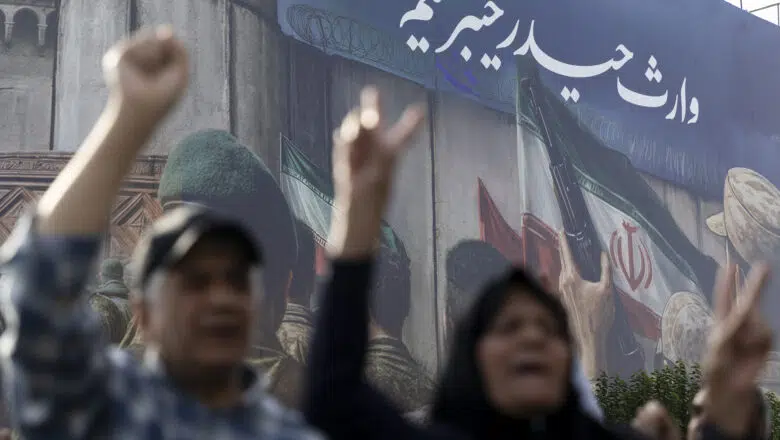
The majority of Iranian society has distanced itself from the regime, and the popular slogan of “Death to the Dictator” has resounded in the streets. Yet for the regime, war and military crisis are an opportunity to rebuild a false legitimacy. Under the banner of “resistance” and “defense of the homeland,” the regime is trying to present itself as the only force that can safeguard Iran’s territorial integrity. The foreign enemy thus becomes the regime’s lifeblood.
Nothing suits an oppressive regime better than a martial atmosphere. In the shadow of war, any civil protest is easily labeled as “treason” or acting as an enemy fifth-column. Security and judicial forces have a far freer hand in suppressing opponents, journalists, students and civil society activists, while ever tighter restrictions on the internet, closures of associations, gatherings and the media space become justifiable.
A collapsing economy, widespread unemployment, systemic corruption and unprecedented elite migration are the true face of Iran’s regime, yet war can divert public attention from these problems to the putative foreign threat. When people are concerned with their livelihoods and with repression, there is no room left to question their rulers’ institutionalized corruption and inefficiency.
The benefits of war
War has another benefit: unifying the system’s top échelons. The factions and groups within the state, which in normal circumstances would compete for more wealth and power, inevitably unite around the regime’s leadership in war time. In this way, war covers the regime’s internal cracks, and the state’s domestic opponents are forced to keep quiet or take its side.
Contrary to what many may believe, for the regime, real negotiation is much more costly than war. Negotiations, especially if they lead to a lasting agreement with the West or internal liberalization, signify the acceptance of fundamental reforms, transparency, accountability and a change in state conduct.
These changes not only limit the absolute powers of Supreme Leader Ayatollah Ali Khamenei but can also lead to the collapse of the entire authoritarian structure. This is why the regime prefers to breathe in an atmosphere of crisis and war rather than an atmosphere of peace and reform.
The war with Iraq
When the Iraqi dictator Saddam Hussein invaded Iran in 1980, the regime was in the early months of consolidating its power. The 1979 hostage crisis involving U.S. diplomats in Tehran, and revolutionary purges, executions and the elimination of rival political forces had gravely eroded its domestic legitimacy. In those circumstances, the war became a political boon for the regime.
Initially, many political groups and the public mobilized to defend the country, but the regime quickly used that fervor to consolidate its own power. War with Iraq became an excuse to suppress any critical voice: from the Islamic-Marxist People’s Mujahedin, to leftist groups and religious liberals or “national-religious” forces. All opposition was suppressed as “betraying” the front line or “collaboration with the enemy.”
In peace, the regime’s inefficiency, corruption and illegitimacy are exposed.
On the other hand, the regime’s insistence on pursuing the war after retaking the district of Khorramshahr from Iraq (1982), showed that the regime was consciously avoiding peace. While there was a possibility of ending the war and negotiating, the regime continued the war for another six years behind its slogan, “The Road to Quds [Jerusalem] Passes Through Kerbala.” This wasn’t to preserve national interests but to consolidate domestic power and impose a security environment on society.
The human and economic cost of that war, which ended in 1988, was immense: hundreds of thousands dead and injured, destruction of infrastructures and economic backwardness. But for the regime, it had a vital achievement: the complete suppression of the opposition and the creation of an atmosphere of legitimacy through its “sacred” defense of what it called the Islamic homeland.
A consistent pattern
That experience shows why the regime still welcomes the shadow of war. Because it is a chance to cover up internal crises, keep society in a state of alert, and stifle any demand for civil rights and freedoms.
From the Iran-Iraq war to the nuclear crisis and regional tensions, the regime’s consistent pattern is clear: avoiding negotiations and real peace, and embracing crisis and war as a means of survival. For this regime, peace is more dangerous than war, because in peace, its inefficiency, corruption and illegitimacy are exposed.
The regime fears peace more than it fears war. Peace means the end of its security provisions, the end of the possibility of unlimited repression, and the exposure of a deep crisis of legitimacy. This is why the regime has always used and will keep using the threat of war to survive. For Iranians, this deadly game simply means more repression and poverty. Only with an end to this cycle of concocted crises can we hope for freedom, prosperity and accountable government in Iran.