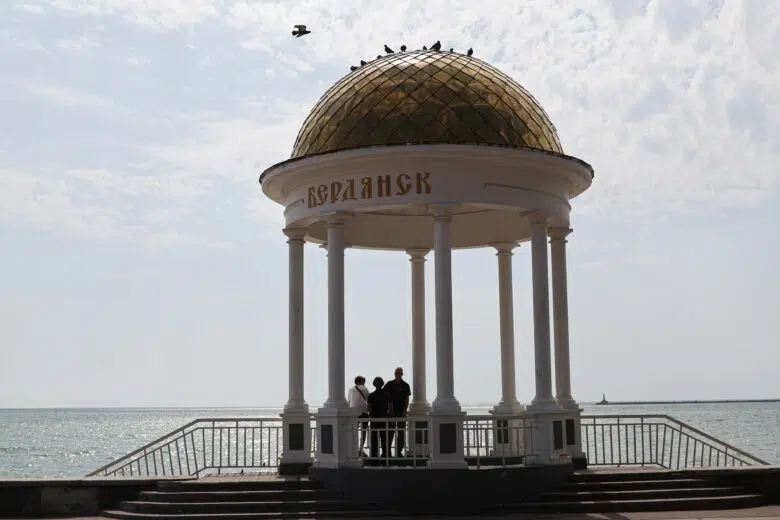
Not much news about daily life in the occupied city of Berdyansk has trickled out. Since Russian soldiers marched into at the end of February 2022, the seaside city has been shut off like a clam. Occasionally, through a narrow slit, one can catch a glimpse inside.
For the latest news & views from every corner of the world, Worldcrunch Today is the only truly international newsletter. Sign up here.
Ihor Bohdanov, a 58-year-old professor of education hears occasionally from people in his hometown of Berdyansk, 175 kilometers away from Zaporizhia, where he fled. “My neighbor called me. He said they broke down the door to my apartment and took whatever they wanted. Then they welded the door shut. Six months later, they did it again.”
Tetyana Tipakova, an activist and head of an aid organization, also now in Zaporizhia and still in contact with many people in Berdyansk, says that women have been tortured with electricity and are regularly insulted. “They all hear the same lines: that Ukraine no longer exists, that they are whores who should not have children.”
Thin walls
When Vladimir Putin and Donald Trump speak of Ukraine’s “cession of territory” to Russia, it sounds as simple as a notary signing off on a house purchase. But what does that word really mean? What kind of lives are lived in these occupied territories that may be handed over? Territories where no independent journalist can move freely.
To protect the identities of those still in Berdyansk, several names in this article have been changed, along with some biographical details. All accounts have been verified by at least two sources or corroborated by a second account.
Sofia Tymoshenko*, 40, who keeps in touch with friends and family in Berdyansk from Tallinn, Estonia, describes the techniques of surveillance. “In the supermarket, sometimes the entrance is suddenly locked and they shout: Phones, everyone! That’s why people delete my Telegram messages straight away. The most important thing is that there’s nothing in Ukrainian.”
Iryna Kovalchuk*, a cancer patient in her forties who fled to Kyiv, recalls that “through the thin walls, I could hear my neighbor on the phone passing information to the occupiers. He would say things like, ‘There’s a bench with a strange package on it, go and check,’ or, ‘Someone new has moved into the apartment, we need to investigate him.’”
And then there is Antonina Boyko*, still inside Berdyansk, who dares to call Die Zeit and describe life in the mid-sized city. Her identity must remain secret; for her, it is a matter of survival. “People are arrested either for acting carelessly or for posting a comment somewhere,” she says. “Some just clicked ‘like’ on something. That’s enough.”

Berdyansk is a spa city on the Sea of Azov, 70 kilometers from Mariupol. Before the war, about 110,000 people lived there. Until 2014, you could take an overnight train directly from Moscow. Hundreds of thousands of visitors came every year to treat their aching joints with mud baths; the sea air was good for the lungs.
Spa guests, vacationers, and locals crowded the beaches, ate at Katran restaurant, famous for its home-brewed beer, or at the Village, which once was featured on a popular TV show. There was a dolphinarium and a water park with slides. On the harbor promenade stood the “Chair of Wishes,” where you could sit and dream.
Katran, the Village, and many other restaurants no longer exist, their owners stripped of their businesses. Half the shops in Berdyansk are closed, as is the dolphinarium.
There are now two Berdyansks. The real Berdyansk, under occupation, and the virtual one, scattered across Ukraine and half of Europe: a Berdyansk in exile.
Since the war began, roughly 60% of Berdyansk’s original population has fled. Some new residents have arrived, but far fewer: mostly Russian soldiers from the North Caucasus, as well as refugees from Mariupol and other embattled regions. This is reported by Oleksandr Pylypenko, 42, co-creator of the online platform Lokator Media. A local journalist, Pylypenko still covers Berdyansk, though no longer from the city. His newsroom is now in Uzhhorod, 1,050 kilometers away, in free Ukraine.
There are now two Berdyansks. The real Berdyansk, under occupation, and the virtual one, scattered across Ukraine and half of Europe, the Berdyansk in exile. It lives on in independent media outlets like Lokator, in a university-in-exile in Zaporizhia where professor Bohdanov and his colleagues keep things going, and in courts that prosecute Berdyansk collaborators, usually in absentia.
There are those who left their homes behind, like cancer patient Iryna Kovalchuk, who refused chemotherapy in Berdyansk rather than accept Russian citizenship. There is activist Tetyana Tipakova, who endured torture and attempted rape in occupied Berdyansk and now helps other women. And there is businesswoman Sofia Tymoshenko, who from faraway Tallinn gets almost daily pleas for help from her frail father-in-law, left alone in Berdyansk.
All of them receive fragments of news from inside the occupied city, mostly via Telegram messages from friends, family, and former colleagues. They have shared these accounts with Die Zeit. Piece by piece, they reveal what Russian occupation means for those who stayed behind.
On the street
Antonina Boyko, still in Berdyansk, says: “Russian flags are everywhere in the city. Russian pop songs play on the radio, on buses, in cafés, in the shopping mall—in every possible place. Often they are propaganda songs.”
Kovalchuk, who left Berdyansk about a year ago, recalls: “When I went to the market with the children, there were men with machine guns. My daughter clung to me. I never looked at them. At first I always felt goosebumps around them, but in time you get used to it.”
Empty houses, shuttered shops, boarded windows and doors: Berdyansk is a city drained of life. On the streets stand many men in uniform. Some wear masks.
“They wore balaclavas and black clothing, without insignia,” Kovalchuk recalls. “Only their eyes showed.”
The new order has lured criminals, profiteers, and opportunists who take what they want: a business, a car, a woman.
In social media photos from Berdyansk, the masked men look like avatars from a combat video game. Tymoshenko says her friends and neighbors often write of “Caucasians” roaming Berdyansk. By that they mean soldiers from Chechnya, Dagestan, and North Ossetia, as well as civilians who arrived in the city and do not need uniforms to exert power. They might tell a hotel owner: “I’ll give you $2,000 for your hotel. If you do not sell, I’ll take it anyway. I’m in charge here now.”
The new order has lured criminals, profiteers, and opportunists who take what they want: a business, a car, a woman.
Anna Lytvyn*, a social worker now far from her native city in a small town near Uzhhorod, hears stories from her parents. “People have resigned themselves to violence,” she says. “Your car is taken away. You are stopped and dragged to the basement of the police station. It’s pure arbitrariness.”
Bohdanov, the professor, says the university’s computer technician was arrested in the street. “It was probably because his son had defended Mariupol. For six months, he was held in a Berdyansk prison that had been turned into a torture chamber.”

Some cafés and restaurants have reopened, now under new ownership. Berdyansk authorities regularly post lists of properties to be seized and transferred into Russian hands. Step by step, Berdyansk is being remade from a Ukrainian city into a Russian one.
“I let myself walk around the city and speak Ukrainian,” says Antonina Boyko. “If you say ‘thank you’ in Ukrainian in a shop, it can be a test of how people react. Some turn aggressive. Others look pleased. With this small test, you quickly see where someone stands. But most of the time people speak Russian to avoid drawing attention.”
Sofia Tymoshenko shares a story that circulates among her acquaintances in Berdyansk: A woman goes to the butcher for a piece of chicken. She doesn’t like the cut he offers. She asks for another. He refuses. When she repeats the request in Ukrainian, he suddenly becomes friendly. “Ah, you’re one of us!” he replies, and hands her the best piece of meat.
Are you still Ukrainian?
The Ferris wheel in Luna Park stands still. From the top, one could see the military installations at the harbor and watch the air defenses.
In June 2023, Russia blew up the Kakhovka Dam, 260 kilometers from Berdyansk. The reservoir overflowed. Even today, water is scarce in southern Ukraine. In some parts of Berdyansk, it flows only a few hours a day.
Curfew compliance is enforced by units of the Russian National Guard, Rosgvardiya, which patrol together with the FSB secret service.
“The Rosgvardiya troops live right in the city,” says Boyko. “They’re in apartments, houses, and on military bases. They are constantly visible.”
Berdyansk, now called a Russian city, is supposed to be filled with Russians. Which means all Ukrainians who remain must become Russian. A Russian passport is an offer you cannot refuse.
To withdraw money from an ATM, you need a Russian bank account. Only those with Russian passports can open one. If you call an ambulance, they will only take you if you have a Russian passport. To register a car, you need a Russian passport.
Natalya Krivoruchko, a journalist at Lokator Media, says: “Absolutely everyone has a Russian passport. You cannot live there without it. There is no other option.”
If you call an ambulance, they will only take you if you have a Russian passport.
Only with a Russian passport can you register your property with the new authorities. If a business or apartment is not registered, it can be seized at any time.
Activist Tetyana Tipakova says a neighbor told her she saw a soldier standing on her daughter’s balcony. “He was wearing her daughter’s bathrobe, smoking, and saying: ‘I’m going to live here.’”
In a café in Tallinn, Sofia Tymoshenko scrolls through photos of her Berdyansk apartment. She spent 15 years paying off the mortgage, renovating it — and then the Russian armored vehicles arrived. She swipes through the photos and pauses on one from New Year’s Day 2022, two months before the invasion: a Christmas tree, a sofa set, LED lights cascading down a curtain like raindrops. Her daughter’s bedroom, with a quilted upholstered bed.
Her father-in-law, still in Berdyansk, now sleeps in the apartment every other night. He alternates between his own and hers, to make it look lived in so no one thinks to seize it. There has already been one break-in.
Tymoshenko shows more pictures: a bent lock, drawers ripped open, papers strewn across the floor. “There are 20 apartments in our building. Soldiers now occupy three. If no one shows up for a while, they move in.”
Attempting to return
Every day, she gets messages from her old neighbors.
“How could you leave your father-in-law alone?”
“He can’t climb the stairs anymore.”
“Now he needs a cane.”
Her father-in-law writes: “I fell outside. I think I broke my foot.”
When she left Berdyansk with her husband, daughter, and dog, Tymoshenko’s father-in-law was hard of hearing. Now he is deaf. Luckily, he learned to use Telegram.
The father-in-law writes: “I can’t make it. Come back.”
Tymoshenko has tried often to convince him to join them in Tallinn. He refuses. She says: “The old cannot build a new life. So they stay.”
One day Tymoshenko decided to return to Berdyansk. The plan was to register her apartment so it would not be seized. To do that, you must appear in person. She knows a few who managed. They took Russian citizenship to enter. She hoped that once there, she could persuade her father-in-law.
There is only one route to Berdyansk: through Moscow. At the airport, Ukrainians heading to occupied territories undergo what is called filtration. Photos, fingerprints, questioning, electronic devices and social media checked. A decision is made on entry and naturalization.
“I was prepared. I had a clean phone, but I think it was somehow linked to my other devices,” Tymoshenko recalls. “After three hours they said, ‘You are not welcome.’ They took another DNA sample. I was banned from entering for 20 years.”
The deadline to legalize her apartment expires on January 1, 2028. By then, it will be confiscated. Unless the rules change. But that too is part of the system of occupation: the rules are constantly shifting. You never know where you stand.
A longer version of this reportage is published in German in the weekly Die Zeit.
* Names were changed by the editors


