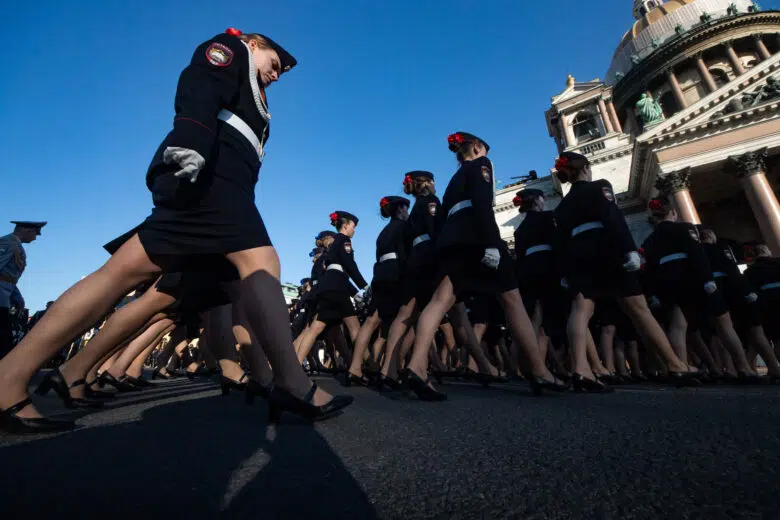
HAVANA — During a recent briefing involving Ukrainian intelligence officials and Cuban-American lawmakers, a little-noticed detail emerged: there is evidence that Cuban women are serving in the Russian army.
The report included images of a passport and a contract signed by a soldier of Cuban origin. According to Ukrainian authorities, the woman identified is named D. G. B., born in Santiago de Cuba, who reportedly joined the Russian army on January 13, 2025.
For the latest news & views from every corner of the world, Worldcrunch Today is the only truly international newsletter. Sign up here.
The young woman was 25 when she signed the contract, and her passport had been issued by Cuban authorities in March 2021. Little is known about her background. It remains unclear whether, like many men, she was recruited in Cuba and brought to the front under false pretenses, or voluntarily joined Russian forces while in Russia.
A simple search on social media uncovered a profile matching the recruit’s name. According to available information, it is likely that D. G. B. was still in Cuba at the end of 2023. In November 2022, she appeared in a photograph wearing the typical uniform for university courses linked to the health sector, consistent with the age on her leaked passport. Another Facebook account under her name was restricted, listing Santiago de Cuba as her place of residence.
So far, the recruitment of men living in Cuba has largely occurred through WhatsApp and social media groups. No evidence has been found of campaigns specifically targeting Cuban women.
Some recruitments were carried out through deception. An audio recording captures a recruiter of Cuban origin assuring recruits that they would not be sent to the front lines, but would serve in support roles.
Cuban citizens benefit from a visa exemption to enter Russia, which facilitates their transfer to the country to join the war. This exemption allows them to remain in Russian territory for up to 90 days. Beyond that period, they become illegal migrants and could be detained and deported back to Cuba. Because Russian laws make it extremely difficult for migrants to regularize their status, some Cubans have reportedly chosen to join the army as a pathway to legal residency. It is not known whether this applies to soldier D. G. B.
Visual evidence of women in combat roles only emerged recently.
Ukrainian intelligence also uncovered that the young woman received a standard salary of approximately $2,000 per month.
Women in the war in Ukraine
Since at least 2023, several media outlets have reported on the presence of Russian women in the army. That year, former Russian Defense Minister Sergei Shoigu stated that roughly 1,100 women were participating in the invasion, primarily in support roles such as nurses or food distributors.
A video that went viral shows several women performing military exercises, reportedly filmed near the front lines.

Screenshot of drone footage showing a female soldier participating in a military exercice — Source: Telegram
A British intelligence report noted that Redut, a state-backed private military company, recruited women in 2023 to serve as snipers and drone operators in its Borz Battalion. Redut — formerly known as Shield — has ties to the GRU, Russia’s military intelligence agency. It belongs to a network of mercenary forces that protect Russian companies’ commercial interests and has been deployed in Ukraine since the start of the large-scale invasion in 2022.
However, visual evidence of women in combat roles only emerged recently. On August 3, 2025, the 3rd Operational Brigade of the Ukrainian National Guard, known as “Spartan,” posted a drone video on Telegram showing a female Russian soldier wounded during an assault.
The average time between signing a contract and a soldier’s death ranges from 140 to 150 days.
“This is the first time a woman has been seen,” the unit wrote beneath images of the wounded soldier. The incident was filmed near the Ukrainian city of Pokrovsk.
According to Ukrainian intelligence, the average time between signing a contract and a soldier’s death ranges from 140 to 150 days. In many cases, however, this period is much shorter, as new recruits are often sent directly to so-called “meat grinder” units, where casualty records are unreliable. Cuban recruits also face a language barrier, making communication with superiors and fellow soldiers difficult.
U.S. response and political implications
The United States ranked the Cuban government at the lowest level in its latest Trafficking in Persons (TIP) report released earlier this month. The report cited several examples of what U.S. authorities consider human trafficking, including the regime’s alleged complicity in facilitating the participation of Cuban nationals in the war in Ukraine.
An internal U.S. government communication, obtained by Reuters, indicates that the Trump administration intends to use the presence of Cubans in the conflict as a political lever, aiming to rally international diplomats ahead of the annual UN vote on sanctions.
Amid the rising attention on Cuban soldiers in the war, there was a recent disclosure of military cooperation agreements between Cuba and the governments of Russia and Belarus. Details of these agreements, including their actual scope and implementation, remain unknown.