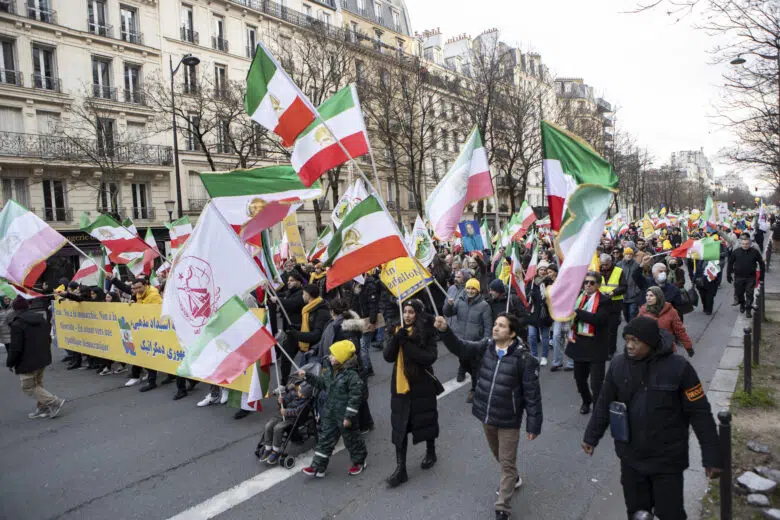
PARIS — In the shadow of the towers of the Beaugrenelle district lies the Rue des Entrepreneurs, full of Persian restaurants and grocery stores. In this quiet street, in the 15th arrondissement of the French capital, where members of the Iranian diaspora like to gather, the atmosphere has been tense in recent weeks. Israeli bombings and U.S. strikes are on everyone’s mind. When the topic is mentioned, many shopkeepers and customers refuse to talk.
For the latest news & views from every corner of the world, Worldcrunch Today is the only truly international newsletter. Sign up here.
Fear of reprisals against their families back in Iran dominates this close-knit community of 62,000 citizens opposed to the mullahs’ regime. Locals claim that on the other side of the Seine, in the 16th arrondissement where the Iranian embassy is located, staff comb through the press and track the names of enemies of the Islamic theocratic republic.
“They kill in Iran, they rape women and they gouge their eyes out,” says a restaurant employee who wishes to remain anonymous. Having lived in Paris for several decades, he knows that this deadly violence can be exported to French soil as he recalls the tragic fate of Shapour Bakhtiar.
On August 6, 1991, the Shah of Iran’s last prime minister, who had taken refuge in the Paris region, was brutally assassinated in the western suburban town of Suresnes. Eleven years earlier, he had already escaped a first assassination attempt. More recently, in 2018, a planned attack targeting opponents of the Tehran regime was foiled in Villepinte, north of the French capital city.
The Iranian terrorist threat in France is being taken more seriously than ever by intelligence services. On June 13, Interior Minister Bruno Retailleau asked prefects to increase security around street addresses that could be targeted. Could the Iranian authorities use hired agents to carry out actions against the community?
“The regime always targets political activists identified as prominent opposition figures,” says a local woman married to an Iranian man, citing the case of Masih Alinejad as an example. An operation in 2020 had targeted the journalist exiled in the United States, after she defied Tehran by launching an anti-veil movement. The plan that aimed at kidnapping and eliminating her had failed.
Communications cut off
Najib, in his grocery store where pistachios, chickpea flour, and fragrant rice fill the shelves, says he feels safe in Paris: “I’m an opponent of the Tehran regime, but I’m first and foremost a shopkeeper.”
“I’m not aware of any particular alert regarding the Iranian community,” says Philippe Goujon, the mayor of the 15th arrondissement, who regularly takes the pulse of this mini ”Tehran-sur-Seine.” In addition to Rue des Entrepreneurs, it also encompasses the Beaugrenelle towers, where many Iranian families reside.
While he’s feeling rather serene, Najib nevertheless admits he had to make a decision: “For three or four years, I’ve broken off relations with former senior officials who are enemies of the current regime and who are living in Europe.” His fear is being photographed with them.
If the U.S. attack doesn’t change anything, it’s the Iranian people who will pay the price.
Bita, who runs the Caspian restaurant with her husband, isn’t taking any special precautions. “There’s no reason. My husband has been identified as a vocal opponent of the Tehran government for years, and he’s never been questioned,” says the restaurant owner, who, however, fears for her family who remain in Iran. “My parents left Tehran to seek refuge in the north of the country, but for several days now, I haven’t heard from them because all communications have been cut off. There’s no more internet. My father just underwent major surgery, and he hasn’t received his treatment.”

A little further down the street, Sam Tavassoli, who runs Mazeh, a renowned Iranian gastronomic establishment, makes no secret of his opposition to Ayatollah Ali Khamenei and his attachment to royalty: “In Paris, I’ve never felt threatened, even though, let’s be honest, I sometimes imagined a possible attack on me.”
Honoring Mahsa Amini
On a shelf in his establishment sits a book devoted to Empress Farah Pahlavi, the wife of the last monarch before the Iranian revolution. “Since Trump attacked Iran, it’s now American interests that are at risk of being targeted. The mullahs have far greater concerns than attacking Iranian merchants in France,” Tavassoli says, with a sad look. “If the U.S. attack doesn’t change anything, it’s the Iranian people who will pay the price. Repression will likely intensify, and the war could drag on.”
Now is the time to demonstrate my opposition to this regime.
On a small street perpendicular to the Rue des Entrepreneurs, the main Iranian bookstore in Paris, Perse en Poche, displays a huge poster in its window bearing the image of Mahsa Amini. The death of this young woman, killed in 2022 by the morality police for wearing a veil deemed illegal, sparked a massive protest movement across the country.
Inside the store, adorned with wood and carpet, books censored in Iran are sold with their full texts. Amir, one of the young employees, continues to defend this freedom of expression after his workday by publishing texts online against the Islamic regime. “There may be risks in doing this, especially for my loved ones who remain in Iran,” Amir acknowledges. “But now is the time to demonstrate my opposition to this regime.”