-Analysis-
PARIS — Hostage diplomacy is one of the evils of our time. There have always been hostage-takings, whether criminal or terrorist, national or international. But cases of “state hostages” have been on the rise in recent years, and the international system is powerless to act.
For the latest news & views from every corner of the world, Worldcrunch Today is the only truly international newsletter. Sign up here.
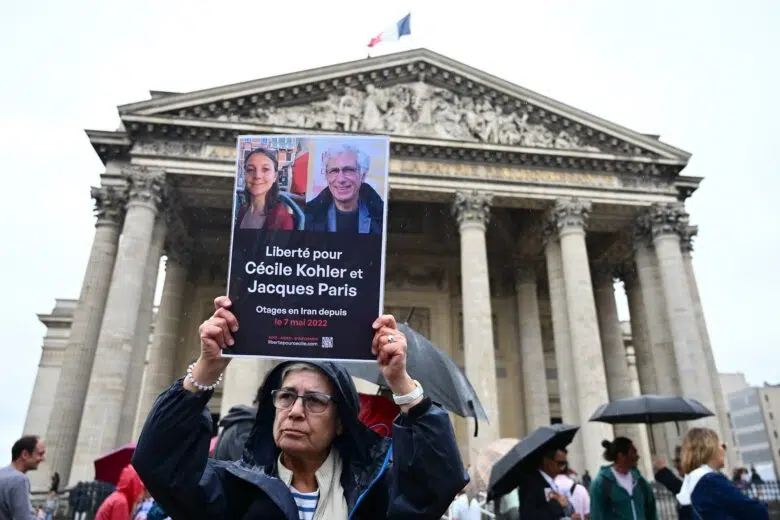
A state hostage is a person held under some pretext by a government that hides behind a pseudo-judicial process. This is what happened to Cécile Kohler and Jacques Paris in Iran: as is often the case, they were arbitrarily imprisoned under the pretense of espionage. This has happened several times in recent years — at the height of this crisis, there were up to seven French nationals being held — but the good news is that there are now no French nationals in Iranian prisons.
We can only celebrate Kohler and Paris being released from prison (they are at the French embassy, awaiting repatriation), which was announced Tuesday evening by French President Emmanuel Macron himself. But we can still be outraged that they spent more than three years in the grim Evin prison in Tehran, at the heart of one of the most repressive systems in the world.
And the logic behind this “hostage diplomacy”? They are bargaining chips. Last January, an Italian journalist held in Iran was exchanged, without further ado, for an Iranian engineer arrested in Milan and wanted by the U.S. justice system for trafficking in military technology.

Last September, the Iranian foreign minister said that the two French nationals would be exchanged for an Iranian woman arrested in France, Mahdieh Esfandari, who has been detained for more than six months for “defending terrorism” online. Whether this deal is real or not remains unclear, but Iran doesn’t release its hostages for nothing.
The price to be paid?
The Iranian regime is not alone in this: in 2018, when the CFO of Chinese tech giant Huawei was arrested in Canada at the request of the U.S., Beijing immediately imprisoned two Canadians without charge. They were held for three years and only released when the Chinese executive was allowed to return to her country.
Western governments are powerless.
Could there be political conditions attached? In Iran’s case, this is unlikely. Franco-Iranian relations have deteriorated further since France, along with the United Kingdom and Germany, pushed in September for reinstatement of UN sanctions for non-compliance with the nuclear agreement. The release of the two French nationals removes one obstacle but does not make political dialogue much easier.
French diplomats are careful not to use the term “state hostages” with Algeria so as not to exacerbate the situation. But the Franco-Algerian writer Boualem Sansal, who has been detained in Algiers for a year, also falls into this category, as does the journalist Christophe Gleizes, sentenced to seven years in prison on absurd charges. Would these two men have been imprisoned if relations between Paris and Algiers had been good?
Western governments are powerless in the face of these “state hostages.” The UN and international courts are at a loss, leaving only negotiation and, more often than not, tacit acceptance of the kidnappers’ conditions. These are indeed states with which we will have to continue to deal in the future. It’s cynical, but effective.