WOLFENBÜTTEL — Bastian Wolff studies how crimes might be solved in the future. It sounds exciting, though the day-to-day reality can be much more mundane. On a rainy day this past summer, he was sitting in an empty room at Ostfalia University of Applied Sciences in Wolfenbüttel in central Germany. Wearing a burgundy polo shirt, the 26-year-old opens his laptop and loads the Home Assistant site. Orange graphs fill the screen. He clicks through the data sets, watches the trends, and checks any odd spikes.
“The sensor has probably already registered that we just came in,” he says in a voice as calm as a meditation app.
For the latest news & views from every corner of the world, Worldcrunch Today is the only truly international newsletter. Sign up here.
Bastian is a student assistant on the SmartHome Forensics project, a joint effort between the university and the Lower Saxony police. At first glance, the idea sounds like an episode of Black Mirror, except this version aims for a positive outcome. For a year the team has been researching how connected devices could help solve crimes.
Sales of smart devices have been rising for years. The Institute for Retail Research in Cologne estimates that revenue for the entire market reached about 4.3 billion euros last year. In 2019 it was 3.2 billion euros. From digital thermostats to voice assistants, all these devices create a sea of data, stored either locally or in the cloud.
Only one in six burglaries is solved
Plenty of companies staring at such data troves are asking a familiar question: how do we turn this into business. The question on Bastian’s laptop in Wolfenbüttel comes from another place. Only one in six burglaries in Germany is solved. Could the little and large data collectors inside a home show how many people were present at a crime scene, and whether the door was forced at 7:13 p.m. or 7:19 p.m. More broadly, will coffee machines and robotic vacuum cleaners one day help catch burglars.
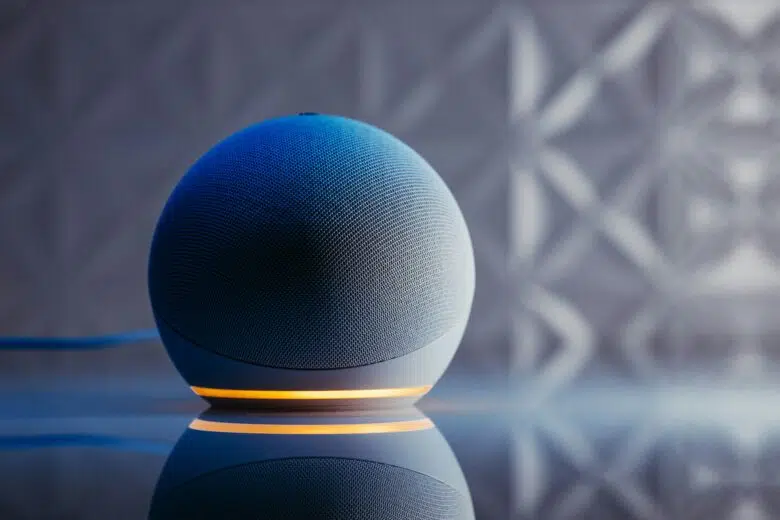
At first the student office looks like any other workspace. Gray carpet, whiteboards covered with circuit diagrams, and floor to ceiling windows looking out on a flat roof. There are also boxes of bright cables, and an Alexa speaker blinking on a desk. The other connected devices hide in plain sight unless you know where to look.
“That little thing up there is the motion detector,” Bastian says, pointing to the white wall. Another small white box looks like a room thermometer and logs CO2 levels and humidity. “At nine this morning all the readings changed a lot,” he says, gesturing at the graphs. The explanation is simple. “That’s when I opened the window, and it has been tilted open ever since.”
There are so many signals flying through the air that we are not aware of at all.
Trained as an electronics technician, Bastian is now earning a Master’s in Intelligent Systems. In the project he also handles the device hardware. He worked earlier as a student assistant in the lab of Felix Büsching, who leads Smart Home Forensics. The team has three professors and four students. Bastian says he uses many connected devices at home, especially Ikea’s smart lights, “simply because they look nice.”
Computer science and intelligent systems have fascinated him throughout his studies. “These are things we usually cannot grasp,” he says. “There are so many signals flying through the air that we are not aware of at all.”
Smart devices everywhere
For now the research team is laying the groundwork. They want to understand how different devices behave. To that end they are building a test lab. The current student office is only a temporary base. Later, students will shadow police and may help investigators reconstruct crime scenes in digital form.
The project runs for two years, funded by the state of Lower Saxony and the EU with just under half a million euros. Büsching and his group expect to continue beyond that.
Bastian explains how their work might help cases. “Sensor data could show that at 9:58 p.m. a living room window opened, and the room temperature fell sharply. That points to a break in at that time,” he says.

Police see real promise in this kind of data. Connected devices are present in about half of German households. In seven years there should be even more, since smart meters are slated to become standard by 2032. Electricity usage will then be transmitted to the grid operator every 15 minutes. Swings will show up quickly and could offer clues. If the halogen light by the door switches on in the middle of the night, a cat might have wandered past. Or it might have been a burglar.
Protection of personal data
Do we actually want authorities to have access to this data? That question is hotly debated in the United States. Ring, the maker of smart doorbells and cameras owned by Amazon since 2018, at times granted police access to users’ data without their consent. Privacy and consumer groups criticized the practice. The company tightened access for authorities. According to media reports, it could expand access again.
In Germany it is not so straightforward. Personal data receives special protection grounded in the right to informational self-determination and the EU’s General Data Protection Regulation (GDPR). Users can demand deletion. Law enforcement can examine information from chats and, depending on the case, from connected devices only with a court order.
Google, Amazon, and other companies can then be compelled to release data. More data does not automatically mean more access for officials. Bastian, his supervisor Felix Büsching, and the team in Wolfenbüttel haven’t yet spent much time on these legal issues. They are convinced that in burglary cases victims will voluntarily share their data to aid the investigation.
Police will be allowed to tap data from thousands of smart coffee machines any time soon
The legal questions may be tougher than they seem. What data may be collected and analyzed for law enforcement in Germany has been repeatedly debated and litigated. Which takes priority, security or data protection? Beginning in 2017, investigators have used spyware to search suspects’ phones and computers. In early August 2025 the Federal Constitutional Court ruled that parts of this were unlawful and curtailed the authorities’ powers. It therefore seems unlikely that police will be allowed to tap data from thousands of smart coffee machines any time soon.

For now the Wolfenbüttel team is concentrating on how investigators can spot connected devices at a crime scene, especially those that are disguised or built into walls. They are developing a tool that can detect them and recommend next steps.
Motion sensors, smart bulbs
Does the motion sensor offer more clues than the smart bulb? Is it safe to unplug the Alexa speaker, or would crucial data be lost? A prototype could be ready next year. One big hurdle is that each device stores and encrypts data differently, and new models appear constantly. “What we find out today could be outdated tomorrow,” Bastian says.
The only answer is to keep researching. Next year they plan to present their results at a tech fair in Hanover. “We will soon test the devices in a real apartment, because our office is not representative of how people behave at home,” Bastian says.
He points to a blue bar chart with numbers and times on the screen. The curve starts to rise at 9 a.m. From 3 p.m., it drops quickly, with a single spike at ten at night. What do these anomalies show? It is the coffee consumption of the Faculty of Electrical and Information Engineering, transmitted by the smart coffee machine in the staff kitchen.