-Analysis-
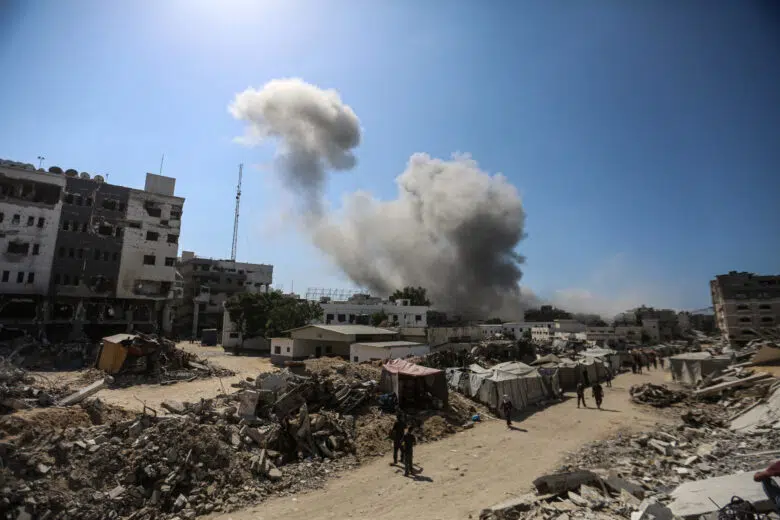
When Israeli Defense Minister Israel Katz posted a video Monday on social media showing a bombed tower in Gaza City, he added the words: “Al-Ghafri terror tower crashes into the sea. We are suppressing the hotbeds of terrorism.” The day before, he had posted another video of the destruction of the Islamic University in Gaza City, he wrote: Eliminate sources of incitement and terrorism.
For the latest news & views from every corner of the world, Worldcrunch Today is the only truly international newsletter. Sign up here.
As the Israeli army begins its full-scale occupation of Gaza City, stepping up operations in the urban heart of the Palestinian enclave and destroying residential towers and university buildings that served as shelter for the displaced, it is increasingly evident that the language used by the Israeli government is also part of its arsenal.
It is a use of language that does not simply accompany the military advance but precedes it, builds its narrative, grants it legitimacy, and shields it from dissent. A language that becomes a weapon of war, able to turn an announced invasion into an act of defense, and the systematic destruction of an entire city into a surgical “security” operation. A language in which every crime is concealed behind the rhetoric of the war on terror.
Lexicon of destruction
Two days earlier Katz, posting yet another video of a residential building destroyed by Israeli bombs, wrote: “House of cards. The skyline of Gaza is changing.” Gaza’s urban profile, Katz tells us, is changing. A message meant both for domestic opinion and international allies, and one that goes beyond war rhetoric: Gaza is no longer a city but a target to be demolished, no longer an inhabited space but raw material to be bulldozed. What Katz calls “transformation” is in fact the annihilation of Gaza City, and the changing skyline is its identity being wiped out.
House of cards. The skyline of Gaza is changing… is a phrase that sums up the brutality of military strategy, a lexicon that is not the byproduct of violence, not its consequence, but itself an act of war. Not accidental, but deliberate, pervasive, and sophisticated. It comes before the attack, legitimizes it, and turns it into spectacle.
This strategic use of language, which is never neutral, represents a sophisticated form of symbolic violence
He who controls words controls reality as it is perceived, a fact Netanyahu knows well, just as his predecessors did. Over the years, but with particular brazenness in the past 23 months, Israeli policy — led by Netanyahu and propped up by some of the most extreme factions of his government — has systematically manipulated language with a clear aim: to twist words so as to justify occupation, repression, and displacement.
Acceptable terms
This strategic use of language, which is never neutral, represents a sophisticated form of symbolic violence. It redefines reality in terms acceptable to internal and external audiences, concealing the moral and legal weight of the actions taken and — in the case of Gaza — masking the true goals of the offensive: not its liberation from Hamas but Israeli military occupation and the forced displacement of its inhabitants.
The legitimacy of Israel’s conduct has long hinged on the gap between words and reality, a gap that has left the international community paralyzed, too timid for too long to call out the deception.
In the dominant Israeli narrative, the occupied Palestinian territories have for decades been described as “disputed,” a formulation that undermines the legal status of occupation. The separation barriers are recast as “security walls” for Israeli citizens. Detention without trial becomes “administrative arrest,” turning abuse into bureaucratic jargon. Settler violence is described as “incidents,” masking the asymmetry of power and creating the illusion of parity where none exists. The word “kill” is replaced with “neutralize,” stripping away humanity and rendering the use of force palatable, even routine.
For decades, this distortion of language has made the intolerable tolerable, transforming segregation, annexation, abuse, and disproportionate force into necessities. Today, Netanyahu tailors his rhetoric to two audiences: an increasingly radicalized domestic one, and an international audience that grows more skeptical by the day.
The objective: to normalize the exception, to make the unspeakable speakable.
At home, he invokes “historical rights” and “biblical conquest.” Abroad, he falls back on the slogans of “fighting terrorism” and “self-defense.” But both registers pursue the same objective: to normalize the exception, to make the unspeakable speakable, and to present as inevitable what is in reality a deliberate political choice — the permanent control of Gaza, the erasure of a Palestinian state, and the annihilation of self-determination.
What is normal
Words dictate what counts as normal, what is deviant, and what is acceptable. In times of crisis, power tightens its grip on discourse, not merely by bombing but first by constructing the idea that what is being bombed is absolute evil. Only in this way can the semantic field be narrowed, and with it morality itself. Those who die cease to be children and become collateral damage; those who flee are no longer refugees but potential human shields.

Michel Foucault, the philosopher of knowledge and power, taught that there is no innocent truth, that every discourse is born of power relations, and that what we call reality is often the product of language.
This holds true even—perhaps especially—in times of war. When Netanyahu or IDF spokesmen describe a “humanitarian zone” as an area bombed and then set aside for thousands of displaced civilians, they are twisting language. It is not humanitarian, it is forced deportation, often to unsafe places.
When we hear talk of “voluntary migration” from Gaza, the fact that civilians are being driven from their homes under threat of death is deliberately ignored. When every hospital is labeled a “terrorist operations center,” the medical profession itself is dehumanized in order to justify bombardment.
Gaza City was recently described as a “terrorist haven.” In reality, it is a city of more than half a million people, many of them women and children.
To reduce the entire territory to a “Hamas nest” is to craft a narrative in which every strike is justified. This is Foucault’s theory of power in practice: producing a truth that sanctions abuse, silences dissent, and turns a military campaign into a morally righteous mission. This is how the language of power operates: by constructing moral categories, drawing lines between who can be killed and who must be protected. This is the core of discursive power. And to leave it unchallenged is to be complicit in it.

