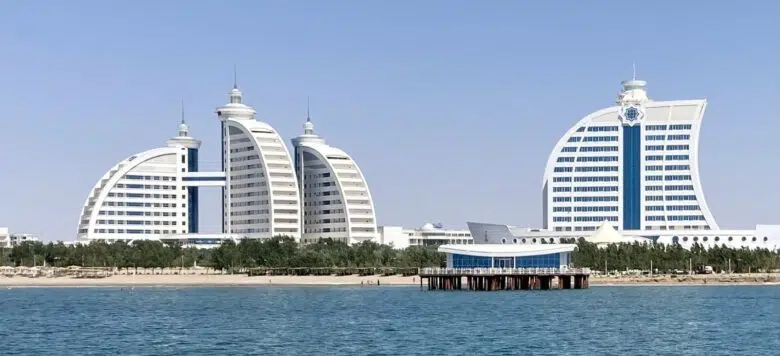
AWAZA – Along the Caspian coast, rows of luxury hotels rise from the sand, surrounded by manicured green oases. Wide, empty avenues cut through the resort, patrolled only by a few police cars parked at intersections. This is Awaza, a tourist town built from scratch fifteen years ago, just a few kilometers from the port of Turkmenbashi — once Soviet Krasnovodsk.
For the latest news & views from every corner of the world, Worldcrunch Today is the only truly international newsletter. Sign up here.
The project, modeled after Dubai, was launched by then-President Gurbanguly Berdymukhamedov in 2007. He had just taken over from the country’s founding strongman, Saparmurat Niyazov — known as Turkmenbashi, “father of all Turkmen” — who ruled this desert nation with an iron fist from Soviet times until his death. Three-quarters of Turkmenistan is covered by the unforgiving Karakum Desert, and power has remained as concentrated as ever.
The country’s immense gas reserves — the fourth largest on the plane, wth 13.6 trillion cubic meters — are its lifeline, making it the world’s seventh-biggest exporter. But as the war in Ukraine scrambles regional alliances, Turkmenistan finds itself squeezed between powerful neighbors: Russia and China on one side, Iran and Afghanistan on the other. The tectonic shifts of global energy politics are forcing this isolated state to look for new ways to sell its gas.

Back in Awaza, the glittering resort meant to showcase Turkmenistan’s modern ambitions feels eerily empty. Towering hotels overlook deserted streets, a seaside city wearing clothes too big for it. Activity flickers to life only in summer, when the regime’s elites descend or when international events are staged. One such occasion came last month, when an investment forum opened a rare window into this “black box” nation — one that foreign journalists almost never get to see.
For the second edition of the Awaza Investment Forum, around 400 participants were flown in on a special Boeing 777 from the capital, Ashgabat, some 600 kilometers away. The guest list was eclectic: representatives from Chinese, Turkish, Russian, Kazakh, and Azerbaijani companies mingled with a few Americans — and even a couple of French businessmen. Ministers, deputy ministers, and heads of the country’s powerful state-run oil and gas companies were out in force, joined by regional directors from international organizations such as the World Bank, the OECD, the EBRD, and various UN agencies.
Most of the visitors, however, saw little of Turkmenistan beyond the thickly carpeted conference halls and their hotel lobbies. The more curious managed a brief escape to the Caspian shore, where the sea shimmered under the low autumn sun — beautiful but fragile, plagued by pollution and silting. One speaker even voiced fears that it could go the way of the Aral Sea, now reduced to a desert.
“The UN is the only international organization Turkmenistan really trusts,” one observer noted — a legacy of December 12, 1995, when the UN General Assembly granted the country official “neutral” status and a self-styled role as regional peace broker. The designation has since become a shield, a way to keep its vast resources out of its neighbors’ reach. Nearly three decades later, that isolationism still holds: there are no direct flights from Ashgabat to any of the other “-stan” republics, and even flights to Moscow must stop in Kazan — still within the broader Turkic world.
A country that has always been at a crossroads
Suspicious of alliances, Turkmenistan also keeps its distance from regional organizations that emerged after the collapse of the USSR: the Collective Security Treaty Organization (CSTO) and the Shanghai Cooperation Organization (SCO). On December 12, Ashgabat will celebrate the 30th anniversary of its declaration of neutrality with great pomp and circumstance. Turkmen diplomats have been tasked with ensuring a strong international turnout — and Vladimir Putin is expected among the guests.
At the forum, one expert after another took the stage — not to talk about touchy topics like repression or the absence of any real opposition, but to sing the praises of Turkmenistan’s economic potential. This has always been a country at a crossroads. The ancient city of Merv, whose crumbling ruins still stand in the desert, was once a major stop on the Silk Road. The story hasn’t really changed — only the stakes. Today, it’s all about gas.

Up until the mid-2000s, Russia’s Gazprom was Turkmenistan’s main customer. But as Moscow developed its own gas fields, the flow of Turkmen gas north slowed down. So, Gurbanguly Berdymukhamedov looked east: to China. In 2008, a landmark deal was signed with China’s national oil giant CNPC to develop the huge Bagtyyarlyk and Galkynysh gas fields in the country’s southeast. A year later, the Central Asia–China pipeline opened, sending Turkmen gas straight to Beijing. It marked a major shift, and one that didn’t exactly please Russia.
Currently, Turkmenistan’s oil and gas sector is heavily dependent on China, which absorbs roughly 85% of production and allows Ashgabat to maintain a trade surplus of $12 billion — an unusual figure for the region. Since 2022, however, the situation has become more challenging. Exports fell by 30% during the Covid crisis, and the country’s exit from Russian dependency has placed it in direct competition with Gazprom in Beijing’s energy market. With Moscow increasing its trade with China in response to Western sanctions, Turkmenistan faces mounting pressure to diversify and secure new outlets for its gas.
To the west, the idea of a Caspian pipeline linking Turkmenistan to Azerbaijan and the Southern Gas Corridor has long been discussed as a way to deliver gas to Turkey and Europe. The project, decades in the making, has gained renewed attention since the war in Ukraine and the disruption of Russian gas supplies. Yet funding remains scarce, and Russia has consistently opposed it. European actors remain cautious but interested; TotalEnergies, for example, sent a representative to the recent Awaza Forum.
To the south, Turkmen gas flows to Iran, interrupted for years over financial disputes, have recently resumed, allowing supplies to reach Azerbaijan and Turkey via Iranian territory. Sanctions, however, block potential exports to Iraq.
China remains the most reliable partner. In September, CNPC secured the fourth development phase of the massive Galkynysh field, adding 30 new wells and increasing output by 10 billion cubic meters per year. The expansion could support a new pipeline route through Uzbekistan and Tajikistan. Meanwhile, the long-delayed TAPI pipeline — stretching 1,700 kilometers to Afghanistan, Pakistan, and India — resumed construction in late 2024, with 214 kilometers already completed despite security concerns.
A post-Soviet economy
These projects represent tens of billions of dollars, yet the country’s development remains highly centralized. Gurbanguly Berdymukhamedov, now the self-styled Arkadag or “protector,” retains a cult of personality and a taste for grandiose projects. His latest venture is a “smart city” 30 kilometers from Ashgabat, which bears his name and over which he presides as chief architect.
Ashgabat itself is a city of contrasts: marble avenues, monumental palaces, and government buildings coexist with emptiness and underused infrastructure. Many of these constructions were built by France’s Bouygues, which at one point earned more than 80% of its foreign revenue in Turkmenistan. The National Bank, crowned with a giant golden coin, epitomizes the extravagant scale of state investment.
You need a meeting with the president — that’s the only way to get things done.
At the Awaza Forum, discussions centered on digitalization, public-private partnerships, and logistics — though internet access in Turkmenistan remains tightly controlled and restricted to a few elite “bubbles.” Outside the gas sector, private enterprise barely exists, and state funds dominate investment. Even in energy, foreign firms largely act as operators rather than decision-makers. Currency controls (including the manat’s non-convertibility and dual exchange rates) further complicate the repatriation of profits. Attempts at reform in the early 2010s stalled, leaving vertical power structures firmly in place.
“We’ve become pragmatic,” said a Chinese businesswoman traveling with a delegation of Beijing entrepreneurs. “You need a meeting with the president — that’s the only way to get things done.” Her group is pursuing projects in chemistry and rail transport.
Diversification remains urgent but slow. Agriculture, Turkmenistan’s second-largest export sector, faces severe water challenges. The Soviet-era Karakum Canal (the world’s longest at 1,375 kilometers) loses up to 30% of its flow to the desert sands. A Vinci subsidiary, France’s Carpi Tech is competing to restore the canal, using modern geomembrane technology rather than concrete.