TUNIS — “Here’s the police station. They’ve arrested me twice in one month for drug use, so I’ve come to get my identity card back,” says the young man. Behind him, the police station in the Hay Riadh district of Sousse, Tunisia. His friend, holding the camera, films him entering the station.
“He’s really crazy, he’s crazy,” they say. A few seconds later, a fireball and screams, then the video stops. Transferred to the Ben Arous severe burns hospital during the day, the victim died a few days later. The first suicide by self-immolation of the month took place on Feb. 6, 2025.
For the latest news & views from every corner of the world, Worldcrunch Today is the only truly international newsletter. Sign up here.
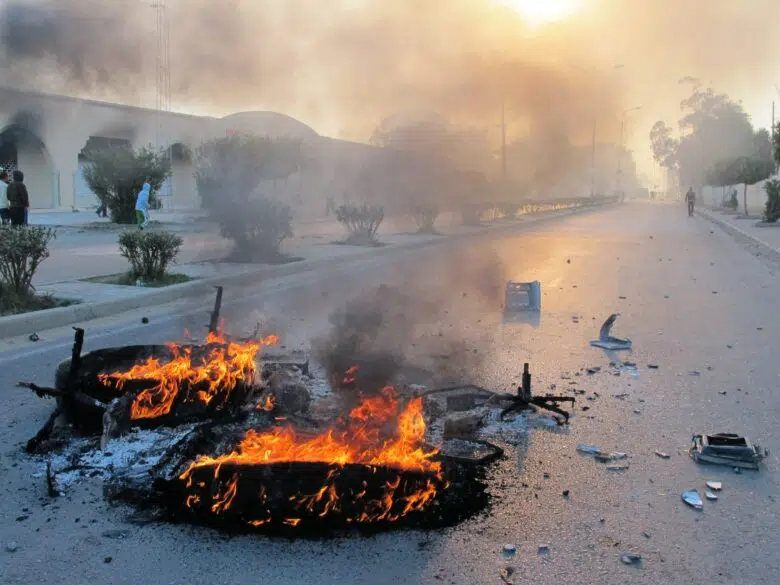
Two weeks later, no trace of the incident in the Hay Riadh police station remained. On site, police officers refused to comment “without authorization from the Ministry of the Interior.” It must be said that the case is sensitive: images of the incident were immediately posted on social networks, quickly circulating on the Internet and causing a stir. On the night of Feb. 6, the Hay Riadh police station was targeted by Molotov cocktails and fireworks.
In the weeks that followed, several media also highlighted other suicides by immolation. “We have compiled the events and published the figures in the form of a special graphic,” explains the online media Rassd, which, the day after the Sousse suicide, listed at least 10 similar cases since December 2024.
Tunisia’s President Kais Saied even declared that “a series of events occurred before Ramadan, such as suicides by immolation, poisonings, sudden supply shortages,” before the National Security Council on March 21, 2025.
In the same speech, Saied, who had just dismissed Prime Minister Kamel Maddouri, denounced “stone-throwing” and “mortar fire,” which he claimed were coordinated “in several regions, as was the case in 2011 and 2012.” It is important to note that in Sousse, the images of the clashes with the police were reminiscent of the early days of the immolation phenomenon, which began with the revolution. But the phenomenon is neither new, nor increasing.
Inherited from the revolution
“I saw the youths arrive with molotovs, so I closed the store and went home,” says a grocery store owner who witnessed the clashes in Hay Riadh. Few people in the neighborhood are willing to talk about what they saw that night. In images shared online, dozens of silhouettes can be seen running through the streets adjacent to the police station, hurling projectiles at the police vans trying to arrest them. “The ones who make trouble with the police are the drug addicts, the dealers,” says the grocer, who explains that he “doesn’t understand” what could have driven the victim to set himself on fire.

“After the revolution and Mohamed Bouazizi, self-immolation became a recurrent mode of protest,” says Hatem Nafti, author of several books on Tunisian political life. The suicide of Bouazizi, a young street vendor, in Sidi Bouzid launched not only the protest movement that toppled Tunisia’s Ben Ali regime, but also a series of similar acts, which continued beyond 2011. According to statistics from the Tunisian Forum for Economic and Social Rights (FTDES), the phenomenon peaked several years later, between 2015 and 2018.
“Between 2016 and 2017, there was a kind of disenchantment with the social movement,” Nafti says, “power had settled in, Youssef Chahed, [prime minister from August 2016 to February 2020], was imposing himself and demonstrations were no longer yielding results.” According to FTDES data, suicides by self-immolation decreased sharply during the COVID-19 pandemic, then stagnated at a low level from 2021 onward – the year of Saied’s coup d’état.
A key factor in the increase in the suicide rate is the Werther effect, a contagion phenomenon.
Nafti recalls that Saied “succeeded in rallying around him the marginalized, those who had a grudge against the system,” while gradually stifling dissident voices. “The repression of social movements, the elimination of intermediary bodies, arrests, prosecutions, and the return of a police state: All these factors broke the momentum of protest, the most extreme expression of which could be self-immolation,” Nafti says.
Between January and March 2025, 12 cases of suicide or suicide attempts by self-immolation were recorded, according to the latest quarterly report from the FTDES. This figure is equivalent to that recorded for the same period in 2022 and slightly lower than that for the first quarter of 2023, which recorded 15 cases. It is therefore difficult to interpret these incidents as signs of renewed political protest, especially because this form of radical action had already begun to decline.
While the words spoken by Hay Riadh’s victim on camera leave no doubt about his conflict with the police, it is difficult to know exactly what his motives were. When contacted on social media, some people who shared videos of the clashes confirmed that they knew the victim, either personally or indirectly, but did not wish to comment on the incident.
Media responsibility
The person who took the video of the self-immolation in Hay Riadh was arrested and taken into custody, before being released pending trial a few days later. He too refuses to explain why he filmed the incident and did not help his friend, despite evidence of a premeditated act. “The images, the way people talk about them, can encourage others or make the event seem more important than it is,” says an officer from the Zaouiet-Sousse police district, who is in charge of the case.
“A key factor in the increase in the suicide rate is the Werther effect, a contagion phenomenon identified by sociologist David Phillips in 1974, who observed a rise in suicides after the media coverage of certain cases,” says Farah Trabelsi, a clinical psychologist and member of the Tunisian Association for the Promotion and Prevention of Mental Health among Young People (ATPPSMJ).
“The phenomenon takes its name from Goethe’s novel, The Sorrows of Young Werther, published in 1774, which triggered a wave of copycat suicides among young readers at the time.”
According to Trabelsi, this imitation effect stems from complex and diverse causes, some of which are linked to the “repeated and sometimes sensationalist media coverage” of suicides by self-immolation.

Nafti acknowledges that “in the race for clicks and views, the Tunisian media have proven that they are willing to go to great lengths” and points out that the Independent High Authority for Audiovisual Communication (HAICA) had committed to responsible coverage of the phenomenon before being rendered powerless by Saied. Media regulation therefore remains fragmented. In June 2024, however, the Ministry of Health published a 15-page “guide to media coverage of suicide,” which made several recommendations to journalists working on these issues.
“Avoid providing graphic or sensational details about methods of suicide, as this could negatively influence vulnerable individuals” is the first of the recommendations made in the Ministry of Health’s guide.
These measures are in line with WHO recommendations, which call for “responsible coverage of suicide.” However, this requirement for discretion does not sufficiently explain why the government communicates so little about the phenomenon, limiting itself to statements from court spokespersons in the most high-profile cases.
For example, there are no public statistics on the evolution or distribution of suicides by self-immolation in the country, with the FTDES being the only organization to publish such data. In some documents, “the team that drafts the reports has decided to avoid communicating about the method of suicide,” explains Romdhane Ben Amor, spokesperson for the FTDES. He specifies that these decisions are made “without any pressure” from the authorities.
From “protest” to “self-destruction”
The FTDES’s approach also reminds us that before being considered a possible form of political protest, the phenomenon of self-immolation was part of the broader trend of suicide in Tunisia. In fact, in the monthly reports published by the organization, the causes frequently listed include “school problems,” “family conflicts,” and “psychological disorders,” in addition to socioeconomic reasons such as “unemployment” and “precariousness.”
Last year, the FTDES also noted that suicide — in general — seemed to be increasingly aimed at taking one’s own life, with a survival rate of 21.05% for attempts in the first three months of 2024. “It seems that these acts are increasingly leading to death and that the goal of these actions is no longer protest, but the erasure and definitive self-destruction of the people who commit these acts of self-inflicted violence,” explains the FTDES report.
FTDES data also shows that suicide by self-immolation generally follows the statistics for other forms of suicide. Men are slightly overrepresented, as they are already the population most affected by suicide. Worldwide, “statistics reveal a marked prevalence among men, particularly young adults,” Trabelsi says, noting that “men more often use violent means, such as hanging or self-immolation, which explains the higher death rate.”
The goal of these actions is no longer protest but erasure and definitive self-destruction.
The psychologist explains that these figures can be explained, among other things, by “norms of masculinity that discourage the expression of suffering.”
Faced with this phenomenon, the current authorities are benefiting above all from the investments made after the revolution in the field of suicide prevention. “Tunisia is the first country in the Arab world to have developed a national strategy for suicide prevention, covering the period of 2016-2019,” Trabelsi says. In 2015, a technical committee to combat suicide led by Dr. Fatma Charfi was also set up — and was notably behind the HAICA’s recommendations.
In February 2025, the Ministry of Health also launched a free psychological counseling service. When called several times between late April and early May 2025, there was no answer at this number.
Faced with this epidemic, Tunisia can nevertheless boast a network of associations specializing in mental health, which “play a fundamental role in suicide prevention and psychological support in Tunisia,” and thus contribute to the fight against suicide by self-immolation, Trabelsi says.
From this perspective, the ATPPSMJ recommends a comprehensive approach, through awareness-raising activities in schools, affordable psychological consultations, and communication in the Tunisian dialect on social media. For Trabelsi, “it is not just a question of preventing extreme acts like self-immolation, but of reducing the overall risk of suicide by taking action at all levels.”
