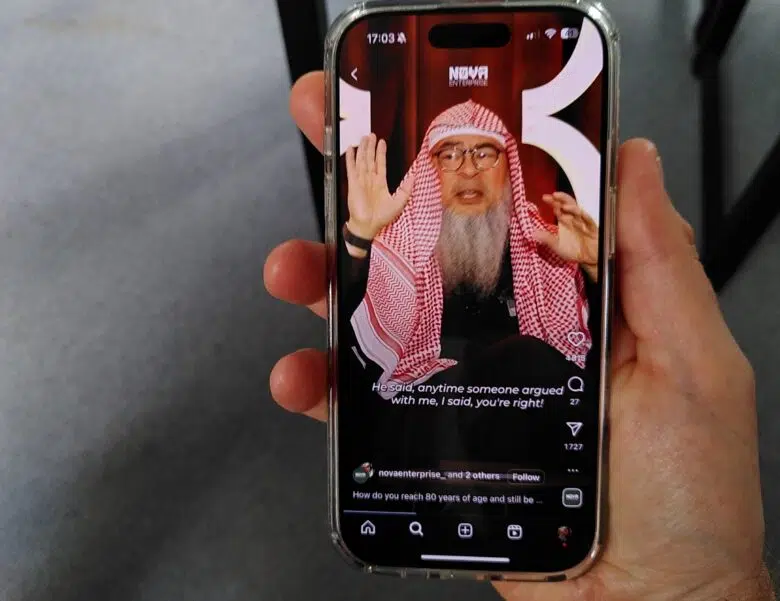
CAIRO — The ring light flickers on, and Mostafa Hosny leans gently into the camera. With soft piano music in the background, his voice is calm, almost a whisper. Forgiveness, he says, is a thing of beauty. “Don’t let your pain define your heart,” reads the Arabic caption below.
For the latest news & views from every corner of the world, Worldcrunch Today is the only truly international newsletter. Sign up here.
A decade ago, Hosny’s sermons echoed from mosque loudspeakers and aired on satellite TV. Today, they’re framed in 60-second reels, built for scrolling — and sharing.
Once a familiar face on religious talk shows, the Egyptian da‘iya has recast himself for the age of Instagram. The new Hosny speaks directly into smartphones, bathed in warm lighting, dressed in athleisure, offering spiritual reminders that feel more like therapy than theology.
Hosny’s media transition helps count him among the growing ranks of “Instagram Sheikhs,” online preachers who blend Islamic guidance with lifestyle aesthetics to connect with a new generation of believers online across the Middle East and North Africa.
Authority shift
Religious leadership in Islam has traditionally relied on scholars deeply trained in jurisprudence, Qur’anic exegesis, and classical Arabic, often affiliated with institutions like Al-Azhar in Egypt or the Zaytuna Mosque in Tunisia. These were figures rooted in years of rigorous education and institutional credibility.
But Gen Z and millennials across the MENA region — often alienated by political instability, religious bureaucracy, and widening generational divides — are looking elsewhere. The Instagram Sheikh doesn’t necessarily carry formal credentials: his authority is rooted in relatability, charisma and content consistency. Their mosque is the smartphone, and their congregation is global.
Young Muslims are no longer waiting for Friday sermons to find spiritual guidance.
According to a 2022 Pew Research Center study, 85% of young Muslims aged 18–35 in MENA countries regularly consume religious content online. In Saudi Arabia alone, over 70% of the population is active on social media, and Instagram usage grew by more than 16% between 2020 and 2023.
Business of belief
This new wave of digital religious expression is not just a cultural shift, it’s an economic one. Instagram Sheikhs often work as lifestyle coaches, modest fashion ambassadors or motivational speakers. The modest fashion industry, closely intertwined with religious identity, was valued at $295 billion in 2021, according to the Global Islamic Economy Report. This number is expected to reach $375 billion by the end of 2025.
Platforms like Instagram and TikTok have enabled Muslim influencers to monetize their platforms through brand collaborations, product lines and paid subscriptions. Figures like Leana Deeb — a Palestinian-American fitness influencer who often references Islamic values — boast millions of followers. Her content is a cocktail of Quran verses, high-protein recipes, gym routines, and spiritual affirmations.
Another example is Dina Tokio, a British-Egyptian YouTuber and Instagram personality, who pioneered modest fashion content online and inspired a generation of Muslim women to embrace hijab while engaging with mainstream fashion and media.
This blend of faith and monetization has been praised for normalizing Muslim identity, especially among younger audiences, but also criticized for reducing religious practice into an aesthetic or product.

Faith vs. filters: the debate
The emergence of Instagram Sheikhs is not without controversy.
Conservative Muslim scholars argue that theological authority cannot be “liked” into existence. In 2021, the religious authorities of Egypt’s Dar al-Ifta warned against following unqualified religious influencers on social media, citing the risk of misinterpretation and misinformation. The Mufti of Lebanon echoed similar concerns, noting the danger of “spiritual populism.”
Some have withdrawn from social media citing the toxicity of religious policing and online judgment.
There’s also the issue of mental health and public scrutiny. Many influencers — especially women — report burnout, cyberbullying, and the pressure to constantly perform piety for an unforgiving audience. Several high-profile figures have withdrawn from social media citing the toxicity of religious policing and online judgment.
And yet, there are good reasons for faith to seek this new outlet, notably that traditional institutions have often failed to engage younger generations. In a 2023 survey by the Arab Barometer, 64% of youth in North Africa said they distrust government-aligned religious institutions. Instagram Sheikhs, for better or worse, fill that gap — offering an accessible, emotional, and visually compelling version of Islam that feels more in sync with 21st-century life.
Politics of platformed piety
There’s also a geopolitical layer to this phenomenon. Governments across the region are increasingly aware of the soft power that comes with religious content creators. Some states — like the UAE and Saudi Arabia — have promoted “moderate” influencers as part of broader narratives of modernization and religious reform.
Saudi Arabia’s Vision 2030 campaign includes digital ambassadors who combine national pride, religious values, and online visibility. Similarly, influencers in Egypt and Jordan are sometimes quietly supported or monitored by government agencies keen on curating a controlled brand of “youthful religiosity.”
But this commodification of piety is a double-edged sword. While it can democratize spiritual discourse, it can also dilute its meaning, reduce religion to brand engagement, and elevate charisma over scholarship.
Between relevance and reverence
Ultimately, the rise of Instagram Sheikhs is not just about new technology — it’s about a profound generational and cultural transformation in how faith is understood, practiced, and shared. It’s about the migration of authority from the scholarly elite to the social media elite, from the certainty of dogma to the fluidity of personal storytelling.
Young Muslims in Cairo, Casablanca, Riyadh, and Tunis are no longer waiting for Friday sermons to find spiritual guidance. They are scrolling through their feeds between classes or meetings, searching for meaning, affirmation, and a faith that reflects their lived realities — complicated, globalized, aspirational, and deeply online.
