-Analysis-
ROME — Differences remain. The Catholic Church holds on to the supremacy of the Pope, while the Anglican Church has the British monarch as its supreme governor, under the Archbishop of Canterbury. The Anglican Communion also allows priests to marry, including women, and permits the marriage of divorced and same sex couples, which the Catholic Church does not. It recognizes only two sacraments, Baptism and the Eucharist, and does not accept Marian dogmas such as the Immaculate Conception and the Assumption.
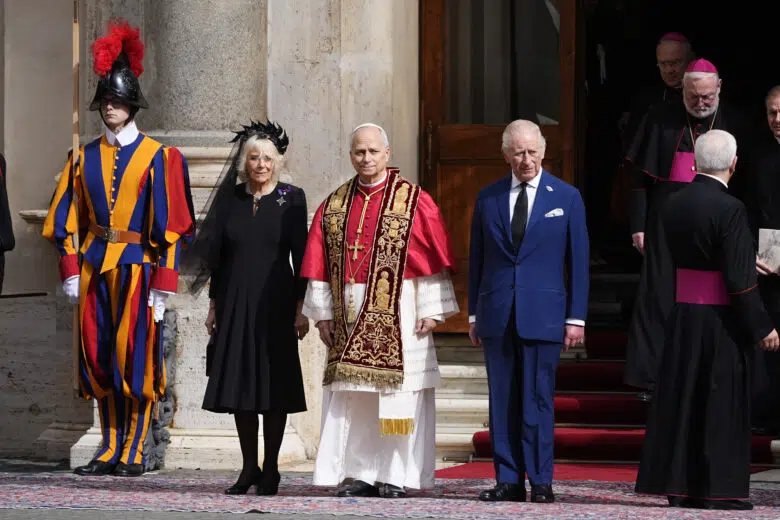
Even so, Thursday’s shared prayer in the Vatican brings Rome and London closer than at any time in five centuries. Ecumenism and ecology, with an eye to COP30 in Belém next month, and a commitment to peace offer the frame of the audience granted by Leo XIV to King Charles and Queen Camilla.
For the latest news & views from every corner of the world, Worldcrunch Today is the only truly international newsletter. Sign up here.
The British royals’ visit to the Vatican is brief yet rich in ecumenical meaning and focused on environmental stewardship, a theme dear to Charles III. For the first time since the Anglican Reformation 500 years ago, a British sovereign will pray publicly with a Pope in the Sistine Chapel, and for the first time the head of the Anglican Church will be named a Royal Confrater in the Basilica of Saint Paul Outside the Walls. Everything is therefore concentrated into this one moment.
After Charles III and Camilla were received in a private morning audience by the Pope, just after noon came the most solemn and historic moment, an ecumenical prayer for the care of creation in the Sistine Chapel, presided over by the Pontiff and organized by the Dicastery for Promoting Christian Unity. The liturgy was in English and Latin.
The psalms and readings centered on God the Creator and on hope, including a passage from Saint Paul’s Letter to the Romans. Texts were also drawn from Saint Ambrose and from Saint John Henry Newman, a former Anglican who became Catholic and will be proclaimed a Doctor of the Church on November 1.
The royals were not accompanied by the new Archbishop Sarah Mullally, since the See of Canterbury is currently vacant. Mullally was appointed on October 3, with installation scheduled for March 2026.
Ecumenical Prayer
The ecumenical prayer featured not only the Sistine Chapel Choir but also the choir of Saint George’s Chapel at Windsor Castle and the children’s choir of the Royal Chapel at Saint James’s Palace.
The royal visit, marking the Jubilee, had originally been set for April and tied to the 10th anniversary of Francis’s Laudato si’. After the death of Pope Francis, everything was postponed.
Companies were selected by the Sustainable Markets Initiative, founded by King Charles to bring together private sector leaders and speed the transition to a sustainable future.
Before the ecumenical celebration, the royals visited the tomb of Saint Paul. Historically, the Basilica of Saint Paul Outside the Walls and its Benedictine Abbey have had a strong bond with the English Crown.

In the footsteps of Augustine
In the centuries after the mission of the monks with Augustine of Canterbury, Saxon kings began to provide for the upkeep of the tombs of the apostles Peter and Paul, and by the late Middle Ages the kings of England were recognized as protectors of the Basilica and Abbey of Saint Paul Outside the Walls. That historic bond was not broken by the 16th century separation between the churches of England and Rome nor by the long centuries of estrangement that followed.
In recent centuries, relations between the Church of England and the Catholic Church, and between the United Kingdom and the Holy See, have deepened, and King Charles himself has played a role in this rapprochement.
In gratitude for these historic ties and for the progress already made along the road toward reconciliation and healing of the wounds between the Church of Rome and the Church of England, the Archpriest of the Papal Basilica and the Abbot, with the approval of Pope Leo XIV, have proposed that King Charles be granted the title of Royal Confrater. The title of Royal Confrater is intended as a gesture of hospitality and ecumenical welcome that testifies to these historic links and to the journey undertaken. The royal day concludes with a reception for Charles at Beda College and a meeting for Camilla with nuns engaged in the fight against trafficking.

