
BRUSSELS — After camping outside Elon Musk’s headquarters for months for a YouTube video, running a half marathon barefoot in the snow, going without food for 30 days, and spending 100 hours in solitary confinement, influencer Fidias Panayiotou came up with his most consequential prank yet: He ran for the European Parliament in his native Cyprus.
A year later, in May 2025, Panayiotou is lounging in an armchair in the corridors of the European Parliament. His legs are stretched out as if this were his living room. Every now and then, men and women in business attire walk by.
Many greet him. Panayiotou is quite well known here by now. He giggles like a little boy. It’s crazy where this wild idea of running for office has taken him. “I can’t believe how much power I’ve accumulated by just being a silly kid.”
“I love you. That’s all from me”
Many voters don’t care much about the elections to the European Parliament. In half of the EU member states, less than half of those eligible to vote cast their ballots. This was also the case recently in Cyprus, the third-smallest country in the European Union. But in the last election, on June 9, 2024, voter turnout jumped from 45 to 59%. It was thanks to him: Fidias Panayiotou, a then 24-year-old YouTuber who ran without a party, experience or support.
Even on the ballot paper, where party names usually appear, it simply read: Fidias. On Cypriot television, Panayiotou sat in a T-shirt next to the other candidates in suits and said he knew nothing about politics. In the election, he received 19.4%, placing third. When journalists asked him what he wanted to say, his response was: “Hello ladies and gentlemen, I love you. That’s all from me.”
Panayiotou has 5 million followers, five times the population of Cyprus.
Today, the YouTuber, whom even the European Parliament simply calls Fidias, posts political videos on social media almost daily. Sometimes he explains what members of European Parliament (MEPs) earn, sometimes he confronts journalists who report critically about him, sometimes he interviews guests from the far left to the far right. He travels to Russia on the day commemorating the victory over Nazi Germany and calls for unrestricted freedom of expression on social media. His political platform can be summed up in one word: anti-establishment. Panayiotou has reached 5 million followers, five times the population of the Republic of Cyprus.
Panayiotou isn’t the first newcomer to enter politics. The U.S. is governed by a reality star turned entrepreneur, and in Ukraine, a former comedian is steering his country through the war. But an influencer elected without prior political knowledge and without an agenda: that’s unprecedented in the EU.
A political office changes many people, but does it also change a YouTuber? Has he been living out of the prank for a year? Or is he mutating into a real politician?
“It’s a theater”
In the rooms where EU committees meet, time is constantly ticking. Experts’ speaking time is 10 minutes. Questions and statements from MEPs are two minutes. Experts’ replies are five to eight minutes. To ensure fairness in parliamentarism, each hour is divided into proportional chunks. This Monday in mid-May, from 3 p.m. to 6:30 p.m., the Special Committee on the European Shield for Democracy will meet.
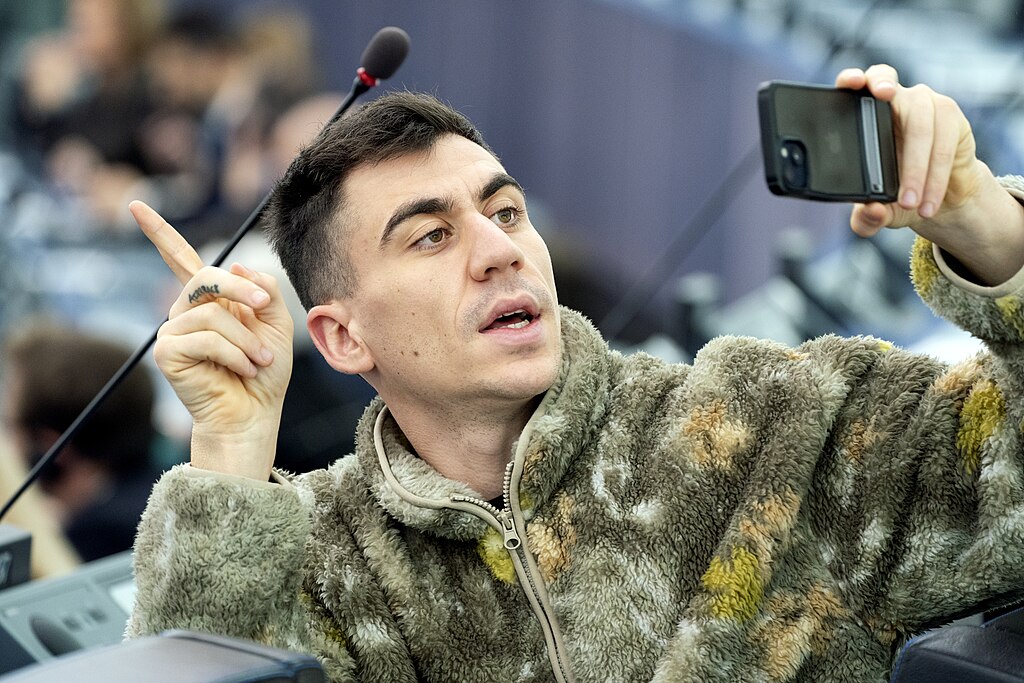
Panayiotou, now 25, enters the chamber wearing a white hoodie. He’s just arrived from the airport; his backpack is still in his office. He spent the weekend visiting his fiancée in Greece, where she was a contestant on the new season of Big Brother. Now he flops down in his chair and watches as the members of parliament around him discuss the importance of independent media and the dangers of AI. He turns his chair toward the speakers, rests his chin on his hand. He sneezes and types something into his laptop. At one point, he holds up his name badge and shortly afterward says into the microphone: “I think it would be a good step to label AI-generated information.” None of this will have a direct impact on EU laws. Special committees only produce reports and recommendations.
“It’s a theater,” Panayiotou says on his way back to his office. “No one will change their mind because of this debate, especially the way we’re conducting it.”
Panayiotou still goes to these meetings. He wants to learn what makes the MEPs tick. He wants to be seen — because only those who are seen will receive support for his political projects. And then he also creates content for social media; he made three videos during this meeting. When two MEPs verbally abused each other over a Goebbels comparison, he pulled out his cell phone and filmed.
The European Parliament comprises 719 MEPs, 2,000 parliamentary assistants, and 7,500 staff. It has 15 buildings in Luxembourg, Strasbourg and Brussels, the most important of which, in Brussels, has five towers with up to 17 floors. Sometimes it feels like a white, chrome and glass Hogwarts, with elevators that don’t stop on the sixth floor and escalators that skip a floor. Panayiotou says that when he first entered this confusing cosmos, he thought: What the fuck.
The American dream?
Panayiotou comes from a village of 1,000 inhabitants in Cyprus. Meniko is located in the interior of the island, near the ceasefire line and the occupied Turkish territories. His father is the local Greek Orthodox priest; he has five siblings, and the family owns a donkey. As a teenager, he admired YouTubers like MrBeast, for their fame, for having started their own big businesses. He wants that, too.
In his first YouTube video, 18-year-old Panayiotou looks into the fake camera and says he just slept for 14 hours. But on TikTok, his channel quickly grows to 150,000 followers. He just can’t find any sponsors. So he breaks up with his first girlfriend and moves to Los Angeles.
There, Panayiotou appears in his idols’ YouTube videos. He also publishes his own videos, with titles like “Homeless in the Most Dangerous Place in America” and “I Survived Seven Days Alone in the Wilderness.” He once won a $300,000 Lamborghini in a challenge set by his idol, MrBeast, by touching the car for 71 hours straight. Panayiotou, as you can see from his videos, is very good at one thing: pushing boundaries.
No one knew what Panayiotou’s political views were — not even he did.
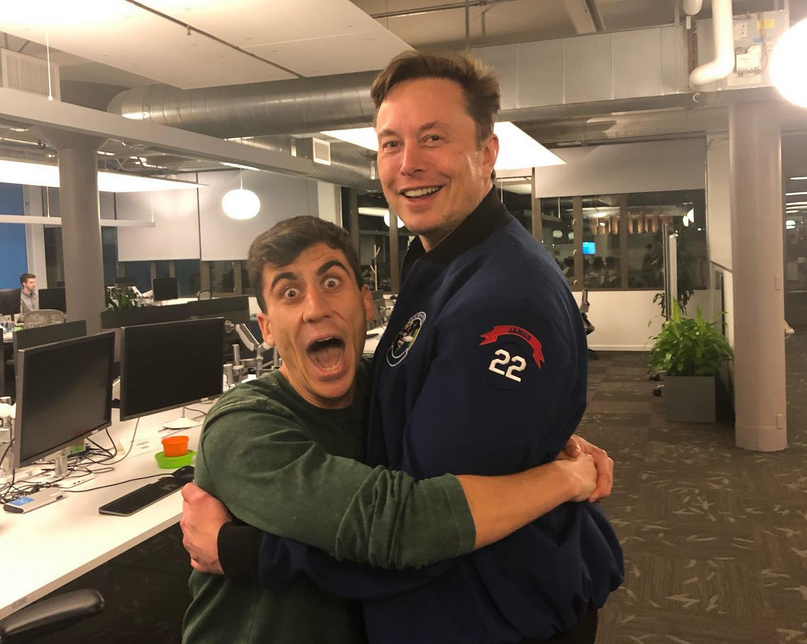
Mostly it’s his own, like when he runs barefoot in the snow. Sometimes it’s foreign borders, like when he rides the subway without a ticket in Japan because his challenge doesn’t allow him to spend any money. But nothing gets him as much attention as the Elon Musk thing. For months, he camped outside the SpaceX founder’s headquarters to swindle him for a hug. On day 105 of his challenge, he got the hug. And more importantly: 15 million views.
The American dream. That’s what his story sounds like. And like many American dreams, politics eventually comes into play. Until 2024, Panayiotou had never voted in an election. He thought Cypriot politics was dull and all about power. Then an acquaintance suggested he run for European Parliament. And Panayiotou thought what he had probably thought before pretending to be homeless or living alone in the wilderness for seven days: Wouldn’t that make a great video?
The Parliament is the only institution in the European Union that is directly elected by citizens. Yet it holds far less power than a national parliament like Germany’s Bundestag. The EU Parliament sits between the European Commission and the Council of the European Union. It cannot propose legislation itself. That task falls to the Commission, which then hands over the proposals to the parliamentary committees for discussion and amendment before they are voted on in the plenary. Amended laws then go to the Council of the EU, made up of ministers from member states. If the Council rejects a law, it has to go back to the drawing board.
For MEPs like Panayiotou, what really counts are the amendments. They’re the tangible proof of their work, their fingerprint on EU legislation. But what, exactly, is Panayiotou’s fingerprint?

Left, Right, Left, Right
His role models are hard-right UK politician Nigel Farage, U.S. President Donald Trump and Elon Musk.
During his first speech in Parliament, Panayiotou briefly stood up. “This is my first time speaking in the European Parliament,” he said, lanky and smiling as he leaned into the microphone. “I’m 24 years old and a YouTuber with 5 million followers across all platforms. Maybe I’m missing something here, but…” Then he criticized the fact that the EU had only received 7,000 petitions in five years. That number could be in the hundreds of thousands. He ended the speech with: “Thank you, and I love you all.”
In the EU Parliament, that line became his signature. Other members, intrigued by the young man who was so open about his lack of experience, responded with goodwill and curiosity. When the EU Ombudsman answered Panayiotou’s suggestion about the petitions, she noted that he was the same age as her youngest son. But the mood wouldn’t stay this forgiving forever.
When Panayiotou was elected, no one knew what his political views were — not even he did. The only clear thing was what he didn’t want: the status quo. Since then, he’s expressed views that stretch across the political spectrum. He talks a lot about innovation (liberal), and he made a video for Pride Month (left). He launched an app that lets citizens vote on how he should cast his vote in Parliament. Direct democracy is one of his favorite themes (sometimes considered left-wing, sometimes right).
But the views he’s best known for are those on the political fringes. Panayiotou repeatedly criticizes the EU as being out of touch and dishonest. He sees anti-disinformation policies as efforts to silence free speech. Some have called him a puppet of Musk, especially after he posted a meme about finding budget cuts in Parliament, DOGE-style, and Musk replied to one of his posts with “Fidias for EU President!!” (Panayiotou had applied to chair an EU committee, but was rejected.) Since traveling to Moscow recently to meet Duma deputies, some have gone further, accusing him of being a Russian stooge.
Ask Panayiotou about his role models, and he’ll name Farage, for being a powerful communicator —“He’s very effective. He convinced Britain to leave the EU.” Trump, who dominates both politics and social media. Musk, who stands uncompromisingly for freedom of speech. Three men from the right.
And yet maybe it’s not really about right, left or liberal. What these three have in common is something else: They are entertainers.
A Bro-caster with a mandate
In the U.S., a group of podcasters reaches millions — mostly men, mostly Trump fans. They don’t have a clear ideology or much expertise. The most famous is Joe Rogan, who, as Slate Magazine once noted, supports universal healthcare but also said Adolf Hitler got “too bad a reputation” during World War II. These podcasters are often called bro-casters.
Bro-casters are experts at connecting with people who are fed up with the polished language of elites. Their fans don’t care so much about the content. They want someone who feels real.
Panayiotou once described himself as a populist in a video. It fits, considering his anti-establishment attitude and blunt answers to complex issues. But maybe there’s a better description for him: He’s a bro-caster with a mandate.
Other MEPs have their political groups. Panayiotou has his team. Like him, they all go by first names.
There’s Jesús, from Spain, who used to be his cameraman and still is. He also handles public relations and writes the scripts for Panayiotou’s videos, like a speechwriter for the social media age. (Panayiotou himself only finds out what they’re about when he reads them.)
Gina, from Romania, used to work for a conservative MEP. She combs through hundreds of pages of policy documents and coordinates the political work. No one on the team knows more about the EU than she does. Then there’s Loukanikos, first his teacher, then a character in his YouTube videos, now part of the EU team. Loukanikos is a nickname, roughly meaning “sausage.”
After all, he has no natural political allies.
Panayiotou often turns to them for opinions and advice. Like what Gina thinks about the Romanian elections, or where the intern stands politically. After all, he has no natural political allies.
Early in his term, Panayiotou asked his TikTok followers whether he should join the Green group in Parliament or go solo. He enjoys involving his followers in these decisions; another time, he posted on X: “Do you want me to vote for Ursula von der Leyen to remain president of the European Commission?” (85% voted no.)
But this decision had big consequences. His followers chose independence. That meant he had to build majorities for his amendments — his most valuable political currency — from scratch. He could only speak in Parliament at the end of debates. It also made it unlikely he’d be elected to chair a committee or take on a key legislative role. In the Brussels plenary chamber, he sits in the second-to-last row, next to the communists, right-wing extremists, and others who want nothing to do with party politics. He sits so far back, you can’t even see him from the press gallery.
“Enjoy the argument!”
By evening, the Parliament is hushed and empty. The meetings and committees are done, the cafeteria is closed. There’s nothing left for a typical MEP to do. But Panayiotou is not your typical MEP.
He prefers to film his videos late at night, shooting as many as he can in one go. The empty committee rooms make an ideal stage: the blue EU banners, the semicircle of seats. A fluorescent lamp above clicks softly, but otherwise it’s silent. Jesús lines up the camera. Panayiotou, the YouTuber, counts “one, two, three,” and shifts into character.
Panayiotou throws up his arms, eyes wide. “I was here in the European Parliament today and saw a big argument between two members of the Parliament!” he shouts in English. Loudly. “Why do you want to make it so aggressive?” Jesús asks.
Panayiotou lowers his arms again. “It was crazy, they were arguing, they were almost at each other’s throats.” He resets his stance and repeats: “I was in the European Parliament today and saw a big argument between two MEPs!” he yells. “Enjoy the argument!”
“But it was a very serious argument,” Jesús says. “It was about Nazis.”
Panayiotou glances at the script, mutters the lines. Then he tenses his body again and delivers a calmer version.
He plays around with tone. Serious, animated, grave. He climbs the podium, leans on a desk, strolls between the seats. His whole body is in motion, from eyebrows to fingertips, each moment a new pose. Once the camera rolls, he moves like an actor preparing for the monologue of a lifetime.
Panayiotou’s currency is clicks. While other politicians plan their weeks around legislative agendas, he plans his around social media content: committee statements, video shoots like this one, podcast recordings. His videos get millions of views every week.
Talk to journalists? Only if he benefits from it
When he learns that the reporter is unavailable for his social media videos, Panayiotou initially reacts irritably, then apologizes, eventually saying: “I have no interest in talking to journalists if I don’t benefit from it on social media. Because then you control the narrative. I don’t know what you’ll write.”
Everything Fidias Panayiotou does is intended to serve his brand.
He likes to say he’s an insider for ordinary people in the European Parliament, the eyes and ears for those who will never enter. He often complains about the EU’s aloofness. And yet he spends hours in committees. He tries to get amendments through Parliament, which rarely works, but sometimes does.
The only question is: why?
When asked why he ran for election, Panayiotou replies: “For fun.” Then he adds that the candidacy was a good opportunity for a YouTube video. It helps his brand, because as a regular YouTuber, you’re one of many, but as a YouTuber who enters politics, you’re unique.
During the campaign, he walked 80 kilometers across Cyprus, encouraging people to register to vote. According to Cypriot media, 2,000 people did so that same day. He himself eventually voted for the first time, and for himself. The audience he attracted was young; they were protest voters and the politically disengaged.
Influencers and politicians, he thinks, are a “killer combination.”
He opposes European arms deliveries to Ukraine and believes NATO provoked the war.
On Wednesday at 5:30 p.m., Fidias Panayiotou steps out of the staff office into the corridors of the European Parliament. He has just given an interview to a blogger. As he talks about it, his voice suddenly sounds agitated. “He accused me of being a Russian stooge and got millions of views out of it!”
Panayiotou has been posting videos about the Russian war in Ukraine for some time. He opposes European arms deliveries to Ukraine and believes NATO provoked the war. Sometimes he quotes Russian Foreign Minister Sergei Lavrov in his videos; in others, he argues that Ukraine urgently needs elections to define the “long-forgotten will of the Ukrainians.” Recently, he was one of only three members of the European Parliament to vote against a resolution calling on Russia to return abducted children to Ukraine. He later changed his vote to abstain.
And then there was the trip to Russia, on the day of the victory over National Socialism, with four other MEPs, two of them from Germany, from the Sahra Wagenknecht Alliance. They were greeted there by a Duma deputy. Since then, he has repeatedly been accused online of being a Russian agent.
Just yesterday, a member of parliament accused him in committee of making promotional videos for Putin. And yet now, in the corridors of the EU Parliament, Panayiotou’s voice becomes calmer. It’s interesting to see what happened yesterday, he says, almost thoughtfully. His team has edited a video of the incident, including the MP’s accusations and Panayiotou’s response. “We uploaded the video, and many people attacked him online.”
Dictating, simplifying, distorting
He’s glad he’s not alone. He has many supporters. Which means a negative situation can turn into a great opportunity — as with the blogger who just accused him of being a Russian stooge, the one who got millions of views with it. “He has no evidence, and we’re going to use that. We’re going to make a lot of shorts out of the interview, saying he has no evidence, and we’re going to get billions of views with our response.”
This is how populism works: dictating, simplifying, and distorting narratives.
Later, Cypriot media will report on the interview, saying Fidias is embarrassing them in Brussels. The German newspaper Tagesspiegel will also pick up the story and claim Panayiotou has been exposed. Panayiotou’s fans will support him under his own video, and his fans will do the same under the blogger’s videos.
And who wins then? Who gets the most views?
Fidias Panayiotou responds, there in the EU Parliament, before all the texts and videos go online. “Who cares who wins? We’re all going to die someday.”
Shortly afterwards, Panayiotou sits down on the windowsill of the staff office. He calls his intern over. In front of him at the desk sits Gina, who has opened a long Word document. Tomorrow, Parliament will vote on five bills with dozens of amendments. In the document, Gina has summarized each one and marked it with plus and minus signs to indicate whether she would approve it.
A damn long time
Other parliamentary groups rely on the expertise of their colleagues during the voting process. They compile lists of voting recommendations, because no one can sit on all 24 parliamentary committees. Panayiotou also sits on only four of them; he has to form an opinion on the other 20 in other ways — by asking Gina.
She’s now going through the list. She’s saying things like, “This amendment is very populist,” and “The group wants to be more Catholic than the Pope,” and “I put a plus here because it’s good for the economy.” It’s about the Green Deal, emissions trading, and the import of grain seeds from Ukraine. It’s about nuclear research, bears, and the Catalan language.
Panayiotou has had ChatGPT summarize Gina’s Word document and is reading along. He says things like, “So it’s a simple election, right?” and “I’m in favor,” and “How many more do we have?” When it comes to the Catalan language vote, he tells his Spanish colleague, Jésus, “You vote.” This goes on for two and a half hours. Sometimes it takes them a whole day.
A day later, Panayiotou enters the plenary chamber. Carrying his black backpack, he will fly back to Cyprus immediately after the vote. He disappears to his seat in the second-to-last row in Parliament.
At the front, President Roberta Metsola presides over the vote. It moves quickly: Amendments 25, 26, 30. The MPs vote by show of hands. Metsola says “rejected,” “rejected,” “rejected,” and much less frequently, “adopted.” Everything Panayiotou’s office had previously worked out is thrown out the window, a single vote out of 719.
Panayiotou says he would probably find it boring to remain in parliament for another term. Maybe because he’s completed the EU level once. Maybe because a bro-caster doesn’t need a mandate to go on air. In any case, five years is a damn long time for a YouTube video.