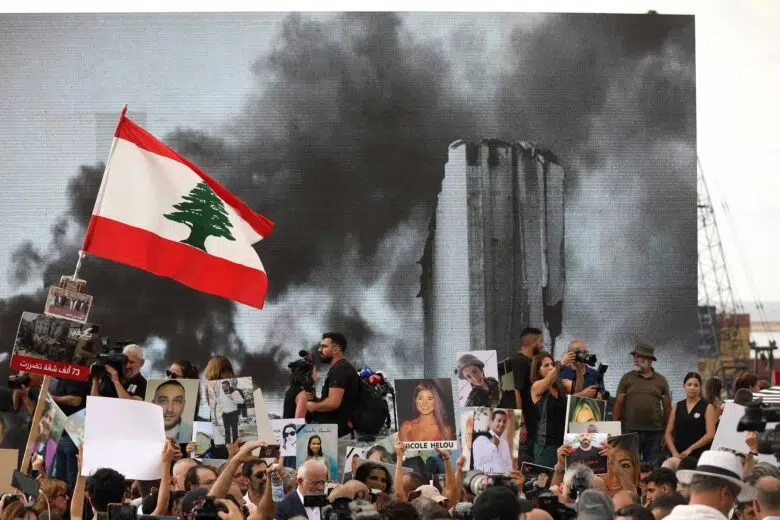
BEIRUT — Five years have passed since a massive explosion at Beirut’s port tore through the Lebanese capital, killing 220 people. But after years of stalling and obstruction of the investigation, the cause of the Aug. 4, 2020 tragedy remains unknown to this day.
For the latest news & views from every corner of the world, Worldcrunch Today is the only truly international newsletter. Sign up here.
The silos still stand as silent witnesses to the horror of the disaster, along with a city ravaged by the blast: the building of the Lebanese Electricity Company has not been repaired to this day, and many shops remain with broken doors and windows. Yet the deepest and most painful break remains in the hearts of the victims’ families ; they alone know the meaning of the open wound. As the Lebanese saying goes: “The ember only burns where it lies.”
A “new era” began with the Jan. 9 election of General Joseph Aoun as president, and gave a glimmer of hope to the port victims’ families. Since the new government, led by Prime Minister Nawaf Salam, took office in February, and Justice Minister Adel Nassar assumed his post, the judicial investigation into the port explosion was revived — after years of suspension due to political interference and legal obstacles.
Trials resumed after the political authorities pledged not to interfere, and the investigative judge, Tarek Bitar, began summoning several officials and defendants. Meanwhile, some former officials — notably MPs Ghazi Zeaiter and Ali Hassan Khalil from the Amal Movement — continued to abstain from attending the hearing sessions before the investigative judge.
Judge Ghassan Oueidat also refrained from attending two investigation sessions scheduled for him in July 2025, refusing to grant any legitimacy to the investigative judge. In his statement, he documented what is considered a complete rejection of the judiciary’s authority, prompting human rights groups to demand he be stripped of his honorary judicial position.

What investigations have shown
In November 2013, the Moldovan-flagged cargo ship MV Rhosus docked at Beirut’s port, carrying 2,750 tons of ammonium nitrate. According to official documents, the shipment was headed from Batumi, Georgia, to Beira, Mozambique, on behalf of the Mozambican explosives company Fábrica de Explosivos de Moçambique (FEM). Yet the shipment’s true destination, original purpose, and funding source all remain unclear.
The intermediary was Savaro Ltd, a shell company registered in the United Kingdom with ties to other opaque business activities. Savaro Ltd’s ownership remained hidden until it was later revealed that the director was Volodymyr Hliadchenko, a Ukrainian born in 1976, appointed in 2021. The company is currently in liquidation.
The ammonium shipment was offloaded in 2014 into Warehouse 12 at the Port of Beirut. For more than six years, numerous warnings about the danger of these materials were ignored by officials and judges. Investigations later revealed suspicions that quantities of nitrate were gradually siphoned off before the explosion. It was found that the amount that exploded was significantly less than the original stored quantity — possibly no more than one-fifth, according to FBI estimates.
After the port explosion on Aug. 4, 2020, attention turned to Igor Grechushkin, a Russian citizen in his 40s residing in Cyprus, as the ship’s owner. However, an investigation by the Organized Crime and Corruption Reporting Project (OCCRP) and its partners uncovered further details, revealing that Grechushkin was not the ship’s actual owner.
If we do not find out what happened, the foundations of the state are at risk.
Documents show that Grechushkin had a history of working in administrative roles at companies managed by others, and had been convicted in Russia in the mid-2000s on theft charges, though the reasons remain unclear. Legally, he was not the ship’s owner — he operated it via Teto Shipping, registered in the Marshall Islands, which had leased the ship from Briarwood Corporation, registered in Panama.
An OCCRP investigation found that Briarwood was owned by Cypriot businessman Charalambos Manoli. Three of Manoli’s other companies helped the Rhosus obtain a Moldovan flag, issue seaworthiness certificates, and provided intermediary services to keep the ship operational despite its serious mechanical issues.
Documents obtained by OCCRP show that the importing factory, FEM, is part of a network of companies, some linked to Mozambique’s ruling elite, and previously investigated for illegal arms trade and supplying explosives to terrorist groups. FEM is 95% owned by the family of the late Portuguese businessman Antonio Moura Vieira, through the company Moura Silva & Filhos. The company has previously appeared in international investigations into arms smuggling and the supply of explosives for terrorist operations, such as the Madrid attacks.
In an email, FEM spokesman Antonio Cunha Vaz said the company ordered the ammonium nitrate through the British firm Savaro Ltd, and did not seek to recover the shipment when it failed to arrive in Mozambique. Instead, they simply submitted a new purchase order.
“This case must lead to the truth. Our goal is to know what happened and who is responsible,” Justice Minister Nassar said. “We cannot claim that the courts will deliver justice to the victims unless the truth emerges — and I fully agree with that. Only the truth delivers justice to the victims. The victims are the primary stakeholders — but all Lebanese people are concerned as well. If we do not find out what happened, and there is no legal accountability or prosecution, the foundations of the state are at risk… A state that cannot inform its citizens of the truth or hold those responsible to account, or at the very least clearly identify the perpetrators, has abandoned its role.”
A priority for the Justice minister
In an interview with Daraj, Nassar said he believes that “the time factor is not the key issue in this case. What matters is that the decision is comprehensive and addresses all aspects of the file — not just that we set a date for the announcement regardless of whether investigations are complete. What determines timing is the file’s completeness, not any other consideration.”
Nassar said that one of this three main goals as Justice minister is to “remove obstacles to the investigation into the port explosion file.” He also said that “it is clear that the atmosphere has changed. The current public prosecutor reversed the decision of the previous prosecutor not to cooperate with the investigative judge, and this reversal had a major impact on reviving the investigation.”
What matters is not how quickly the case is closed, but whether the truth is reached.
Nassar confirmed that he informed the investigative judge that all available resources and tools within the ministry’s authority would be placed at his disposal to facilitate his mission. The Minister of Justice also initiated contact with the French side to enhance cooperation and coordination between relevant authorities, especially since parallel investigations are being conducted in France due to French victims in the explosion. A French delegation had visited Lebanon recently and met with all concerned parties, including the investigative judge and the public prosecutor.
“I believe that if this file is not concluded and fully completed, we cannot say the state has regained its foundations. A state that does not hold those responsible for the catastrophe accountable or explain the truth to its citizens cannot claim to possess the essential elements of a functioning state. For this reason, it is very important to me that this case is seen through to the end, and that the judiciary is able to fully perform its role. Ultimately, what matters is not how quickly it’s done, but whether the truth is reached. The trial phase can only begin after that,” Nassar said.

Three key obstacles
In an exclusive interview with Daraj, a legal source familiar with the case said that the indictment decision may be close — but there are three main issues not directly related to Bitar’s work that are hindering progress in the Beirut port explosion investigation:
First, judicial requests have been sent to European and Arab countries (which have not yet been publicly named), but have not been answered. The information that may come from abroad could strengthen the local investigation and provide additional evidence. These requests pass through a lengthy administrative process.
Second, about 50 lawsuits have been filed against Bitar before the General Assembly of the Court of Cassation regarding the port case. Around 20 of them have been decided, while about 30 remain pending. One of the most prominent is the case filed by former public prosecutor Ghassan Oueidat, accusing Bitar of “usurpation of authority.”
Were these lawsuits deliberately left unresolved to weaken the investigation?
If unresolved, this could lead to suspending the Judicial Council’s work and halting the implementation of Bitar’s indictment. Our source emphasizes the need for the judiciary to fulfill its role in resolving these lawsuits so they do not become a major obstacle to accountability. As long as the lawsuits remain unsettled, the case risks being frozen — even if the indictment is issued publicly.
“Were these lawsuits deliberately left unresolved to weaken the investigation? It is a sword hanging over the neck of the port investigation,” our source wonders.
Third, is the role of the Public Prosecutor’s Office, which must review the entire case once Bitar completes the investigation and present its legal opinion before the case can be referred to the Judicial Council.
According to Daraj, the Lebanese investigation includes a full disclosure of information related to the case, including the shipment and the circumstances of its arrival, supported by evidence. Bitar has not yet decided whether to wait for responses to the international judicial requests and the resolution of lawsuits against him before concluding the investigation and submitting it under current conditions. Yet our source believes that closing the case at this stage may not be in its best interest. In the five years since the explosion, there has only been about one year of serious investigation due to the freeze on Bitar’s work and three years of political obstruction.
The source notes that Bitar has not yet taken direct measures against the accused, preferring to await the completion of all investigations and procedures in order to take legal action against all parties at once — based on the principle of equal judicial treatment.
Journalist Mian Mousaad contributed to this report.