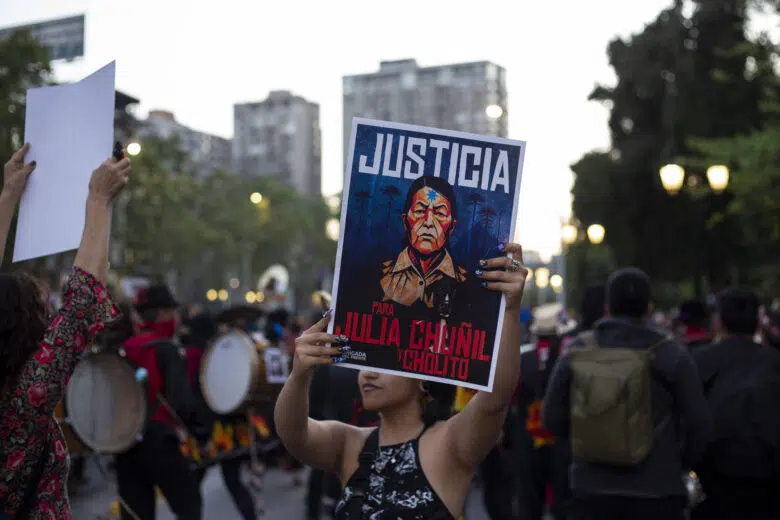
Julia Chuñil has been missing for almost a year. She knew she was in danger and had been warning family and friends for years. At 72, she lived alone in a remote wooden cabin beside the Valdivian rainforest in Chile’s Los Ríos region, about 800 kilometers south of Santiago. On Nov. 8, 2024, she left home with her dog, Cholito, to search for some lost animals. The animals returned — but Julia and Cholito never did.
For the latest news & views from every corner of the world, Worldcrunch Today is the only truly international newsletter. Sign up here.
“For Julia, her land was her life,” says her son, Pablo San Martín. “She was devoted to protecting it and the local environment. If a single tree was cut down, she knew about it. She knew this land like the back of her hand, and she never wanted to leave.”
Julia’s case is one of many documented by Global Witness, which reports that in 2024 there were 146 murders and long-term disappearances of environmental and land activists —down from 196 in 2023. “We know many attacks go unreported, so the real figure is likely higher,” the NGO stresses in its report Raíces de Resistencia (Roots of Resistance).
Since 2012, when the organization began tracking attacks, roughly three activists have been killed or disappeared each week, totaling 2,253 cases. “This shocking statistic highlights the ongoing violence faced by defenders,” the report states.
A Latin American phenomenon
In 2024, 82% of recorded cases occurred in Latin America. Indigenous people and farmers were the most targeted, with 45 activists killed or disappeared in each group. Mining was the deadliest sector with at least 29 cases, followed by logging (8) and agribusiness (4). Deadly attacks were also linked to road and infrastructure projects, illegal hunting and hydroelectric power. Just under a third of all cases involved organized crime.

Colombia stands out as one of the world’s deadliest countries for activists, with 48 killings — accounting for a third of all lethal attacks documented by the NGO. The report warns:
“Since the 2016 Peace Agreement, organized crime and armed groups have exploited the weak state presence in former FARC territories to fund themselves through illegal activities — from drug trafficking to mining — impacting biodiversity-rich regions like Cauca, Nariño and Putumayo. Many indigenous, farming and Afro-descendant communities fear reporting environmental damage caused by extractive industries, particularly activists working near armed groups or in conflict zones.
Land disputes
Land conflicts continue to drive violence in Colombia: 20 of those killed in 2024 were farmers, most from indigenous communities, including 13 members of the Nasa community in Cauca. At least six were indigenous guards or local authorities responsible for protecting territory and land rights.
The masterminds behind these attacks often go unpunished.
Colombia is followed by Guatemala (20), Mexico (19) and Brazil (12). Africa accounted for nine killings (6% of the total), while Asia recorded 16 (11%). Global Witness notes:
“Our years of working with activists and documenting reprisals show that impunity remains widespread. Families of murdered or disappeared defenders, as well as those targeted in non-lethal attacks, rarely see justice. At best, the hired assassins are arrested and tried, while the masterminds behind these attacks often go unpunished due to the state’s inability to investigate and identify them.”
Julia’s daughter, Jeanette, has also faced extreme harassment. Police and Public Prosecutor’s Office personnel allegedly raided her home seven times. “In one instance, an officer questioned her in front of the local prosecutor. Later, in a testimony published by the Inter-American Commission on Human Rights (IACHR), Jeanette described how the questioning quickly turned into an intimidating inquisition, with officials accusing her husband of murdering Julia and her of being his accomplice,” the report states.