-Analysis-
It was one of Vladimir Putin’s least publicized appearances during his four-day trip to China. Yet the Russian dictator’s exchange with Slovak Prime Minister Robert Fico in Beijing revealed more about his frame of mind than all the carefully staged images put together.
For the latest news & views from every corner of the world, Worldcrunch Today is the only truly international newsletter. Sign up here.
Putin, who lately has been projecting renewed confidence, seemed visibly rattled. He spent a long time complaining to his EU ally Fico about Ukrainian attacks on Russian energy infrastructure. Indirectly, Putin added, the attacks would also hurt Slovakia, which imports oil from Russia through a pipeline. He also urged Slovakia to stop exporting gas and electricity to Ukraine altogether.
On the world stage, as recent days have shown, Putin may not feel much pressure right now. But what worries him are the precise strikes Ukraine’s military has been able to deliver in recent weeks, especially against Russia’s oil industry.
Balance of threats
Since early August, Ukrainian drones have damaged at least eight major refineries in western Russia. They were forced to shut down or cut production, at least temporarily. Twice, drones hit a key pumping station on the Druzhba pipeline, which carries oil to Slovakia and Hungary. Both times, the oil flow stopped for several days. An export terminal in Ust-Luga near St. Petersburg was also hit, sharply reducing crude oil loading for export at the end of August. Meanwhile, Ukrainian President Volodymyr Zelensky has promised further strikes “deep into Russia.”
While Europe still debates security guarantees and a potential peacekeeping force, Ukraine in recent weeks has been proving how resilient it already is. These new attacks followed several months of relative calm, with both sides avoiding each other’s energy infrastructure. That unwritten truce ended in June when Russian missiles struck Ukraine’s largest refinery in Kremenchuk. The result was an escalation that turned into regular waves of attacks by August.
Ukraine is pursuing several objectives with the latest strikes, explains military analyst Mykola Bielieskov, a research fellow at the National Institute for Strategic Studies in Kyiv. First, they cut into Russia’s revenues from its oil and gas business.
Militarily, the attacks create a dilemma for Russia’s top brass. To defend civilian infrastructure, they would have to pull air defenses away from military sites. “Moreover, Ukraine is creating what is known as a balance of threat, a credible source of pressure to hypothetically reach some form of non-aggression agreement and thereby secure at least its own critical infrastructure,” Bielieskov said.

The German way
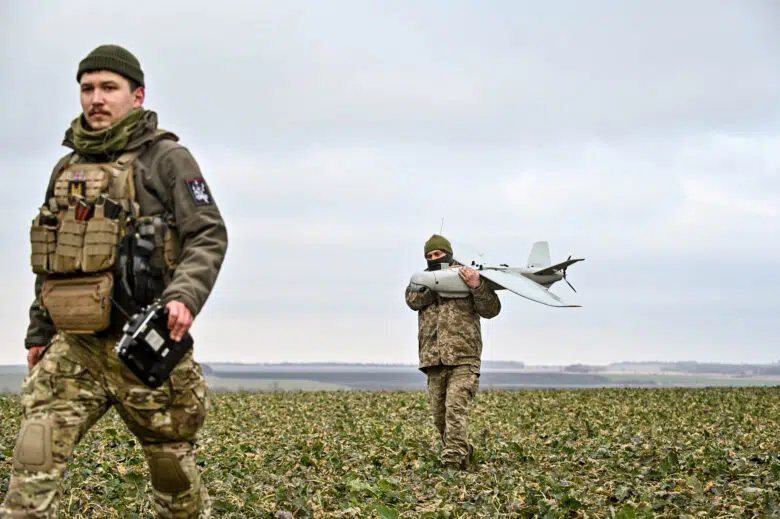
These strikes have been possible because Ukraine, like Russia, has invested in mass-producing its own drones. The Ukrainian military relies mainly on two models in most of its operations.
First is the Antonov-196 single-use aircraft, which has been in series production since 2024. This missile, about 4.5 meters long, can carry a 50-kilogram warhead over 1,000 kilometers. The An-196 is powered by a compact engine from the German mid-sized firm Hirth. According to Der Spiegel, a “three-digit million” sum in German aid is said to have gone into production of the An-196. Despite repeated Russian strikes on its suspected production site, the Kyiv-based Antonov factory, manufacturing continues.
The second model is the FP-1, a long-range drone with a reach of up to 1,600 kilometers and a warhead capable of carrying as much as 60 kilograms of explosives. Its lightweight body, partly built from plywood, is powered by an engine originally designed for large model aircraft. That keeps costs down and makes mass production easier.
In the past, the Ukrainian armed forces could at best launch a few dozen drones in a single operation, says expert Bielieskov. “Today, it’s hundreds.” Russian Defense Ministry figures back this up. On the night of September 3 alone, more than 100 Ukrainian long-range drones were reportedly intercepted over Russian territory. “Russian territory is simply too vast to defend comprehensively against such large numbers of drones,” Bielieskov explains.
The Flamingo missile
As painful as these Ukrainian strikes are, drones alone have not yet caused lasting damage to oil refineries. While facilities accounting for 13 to 17 percent of Russia’s refining capacity have been hit, some are already expected to resume operations soon. In the meantime, the Russian government has suspended gasoline exports for two months. On average, Russia produces about 20 percent more gasoline than it consumes. Its diesel surplus exceeds 50 percent. For now, there is no talk of a supply crisis.
But to really hit Russia’s economy harder, Ukraine would need not drones, but larger missiles. One candidate is the newly developed Flamingo FP-5, unveiled to international journalists just last week. According to Ukrainian manufacturer Fire Point, the missile can fly up to 3,000 kilometers and uses old Soviet bombs with 1,000 kilograms of explosives as its warhead. It is powered by a jet engine from Ukrainian firm Motor Sich, last used in training aircraft and in series production since the late 1960s.
This design is simpler than that of Western or even Russian rockets and cruise missiles, making it feasible to begin mass production in a short period of time. There has not yet been a confirmed combat use of the new Flamingo. Its accuracy and striking power still need to be proven.
At the same time, experts from the Conflict Intelligence Team in Washington, DC, point out that the bulky Flamingo missile, unlike smaller drones, is easier to spot on radar. Another drawback is that the missile apparently flies at under 900 kilometers per hour, barely faster than a regular aircraft. Its interception rate is therefore expected to be high.

Dark in Dnipro
Meanwhile, concerns are rising in Ukraine that Russia may further escalate its strikes on heating and power plants. Ukrainian military officials already report more reconnaissance flights by Russian drones over energy sites. In recent weeks, Russian missiles have repeatedly hit gas plants in the Poltava region as well as an oil terminal on the Danube. In the industrial city of Dnipro, several districts lost power for days after a Russian strike on August 30. In Sumy, power and water supplies also went out after an attack on a substation in the regional capital.
In previous waves of attacks, Ukraine’s energy system has proven more robust than many Ukrainian and Western experts expected. This is largely because, according to the Ministry of Energy, more than 60 percent of the country’s electricity comes from its three remaining nuclear power plants. These have so far been spared Russian attacks, presumably to avoid provoking retaliation against Russian facilities. Ukraine also relies on imports from Hungary, Poland and Slovakia.
Even so, Ukraine’s energy infrastructure remains exposed, says Yuriy Korolchuk, an expert at the Kyiv Institute for Energy Strategy. About 60 percent of the power plants and substations damaged in earlier waves of Russian strikes are said to be fully repaired. “Still, it is impossible to completely rebuild all of these facilities in such a short period of time,” Korolchuk notes. The impact of renewed attacks could therefore be severe.

