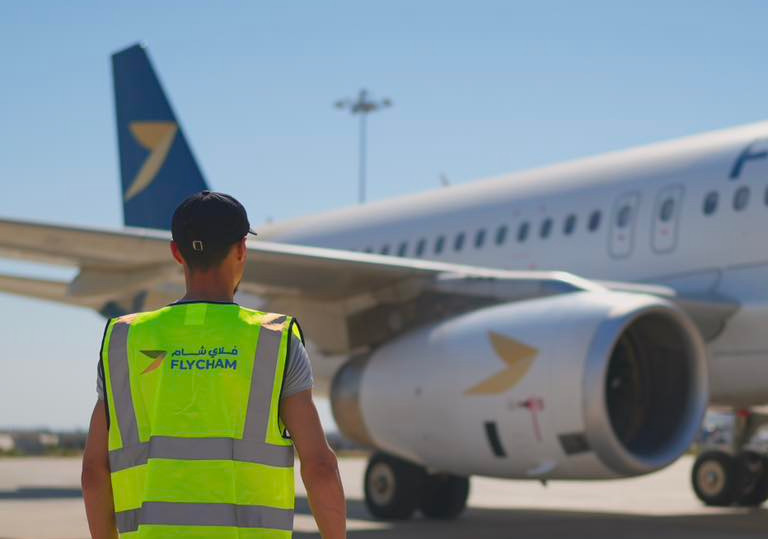
BEIRUT — On June 5, it was officially announced in the Syrian capital Damascus that “Fly Cham” was launched as a company owned by two firms, one Emirati and the other Syrian, both owned by an Emirati businessman.
For the latest news & views from every corner of the world, Worldcrunch Today is the only truly international newsletter. Sign up here.
Behind this announcement the actual management and operations remained in the hands of the same staff of the Syrian airline “Sham Wings” owned by Syrian businessman Mohammad Issam Shamout, who is listed on the U.S. and European sanctions lists.
What happened was essentially a repositioning in the market by taking over Sham Wings Airlines with the approval of the Syrian government then changing its name to “Fly Cham” along with the names of the owners naturally due to the change in ownership then reintroducing it to the markets under a new name as revealed by this investigative report.
Despite most sanctions on Syria being lifted in early July, the United States excluded Sham Wings Airlines from the decision keeping it on the sanctions list under the amended Executive Order 13224 due to its ties with Issam Shamout, whose assets are frozen under the amended Executive Order 13224.
While the founders and owners of Sham Wings were brothers Mohammad Issam bin Mohammad Anwar Shamout and Mohammad Nour bin Mohammad Anwar Shamout, the new owner of “Fly Cham” became the Emirati company “Rawdat Al Reef Project Services LLC” and the Syrian company “Rawdat Al Reef Project Management Services LLC” as a partner.
What happened is that during the process of share transfer, Sham Wings Airlines was not dissolved, but its name and owners were replaced while keeping the same commercial registration number 14683. In other words, the Sham Wings Airlines established in 2006 was replaced by the new company in the same commercial registry.
From Sham to Cham
Before reaching the stage of addressing the Syrian Civil Aviation Authority to change the company’s name, in preparation for announcing the new carrier “Fly Cham,” there had been previous measures of ownership transfer and share assignments between the parties. An implicit agreement contract was signed and the shares were transferred then later confirmed by a judicial decision at a commercial court without disclosing the value of the transaction, which remained vague and undisclosed.
Interestingly, in March, another “share sales and assignment” document listed the Syrian Company for Commercial Consultations LLC as a new buyer for the Shamout brothers’ shares. The ultimate beneficiary was Rawdat Al Reef Project Management Services LLC whose share became 137,500 alongside “Rawdat Al Reef Syria” which came to own 122,000 shares, totaling 250,000 shares.
While the Syrian company for commercial consultations was listed as an official buyer its name later disappeared from the final court ruling issued on March 26 which approved the sale of shares to Rawdat Al Reef without any explanation for the company’s disappearance from the sale process.
A legal expert who preferred to remain anonymous for security reasons, said “This arrangement involving inserting then quickly removing a local company confirms the hypothesis that the Syrian company was perhaps used as a temporary legal front to pass the sale during a period of asset freeze or to clear the shares from the sanctioned seller’s name before ultimately registering them in favor of a single party whose identity they wanted to hide.”
Most Sham Wings Airlines employees moved to similar positions in Fly Cham.
There is little information about the business activities or companies owned by Emirati businessman Nawaf Mohammad Mahdi Al Hamed Al Hashemi in Syria, other than his ownership of Rawdat Al Reef Syria.
Four days after submitting the transfer letter, Syrian Minister of Economy Mohammad Nidal Al Shaar sent an urgent letter on May 12 to the Civil Aviation Authority requesting to expedite the transfer procedures. Approval was granted on May 15, conditioned on settling financial obligations under applicable laws.
In response to the investigation team’s inquiries about the transfer of Sham Wings Airlines ownership to Rawdat Al Reef Mustafa Kaj, the media officer at the Syrian Civil Aviation Authority clarified that the Authority’s role is limited to updating the operating license based on what is received from the Ministry of Economy and it has nothing to do with the sale or transfer procedures.

He said “Our role in the Civil Aviation Authority is limited to modifying the operating license when the commercial registration is officially amended which we did after receiving an official document proving the company’s ownership transfer to an Emirati Syrian company.”
After the fall of the Syrian regime, a new business pattern has emerged in Syria observed by researcher Ayman Al Dasouqi from the Omran Center in Ankara, Turkey. He noted that sanctioned businessmen linked to the former regime and its financial networks “are trying to adapt to the changes in Syria by shutting down old companies or canceling old commercial registrations and opening new companies with new names and partners who may have ties to the new authorities to operate freely without being chased by the burden of old sanctions.”
The Fly Cham team
Open source research conducted by the investigative team showed that most Sham Wings Airlines employees moved to similar positions in the new company, Fly Cham, including cabin crew and pilots one of whom appeared in a photo with Syrian Foreign Minister Asaad Al Sheibani on a previous Sham Wings flight to Baghdad. Even the new company’s planes are the same aircraft previously operated by Sham Wings carrying the same identification codes (YK BAA, YK BAE, YK BAG and YK BAC). The ownership of the aircraft YK BAG, however, was transferred to Syrian Airlines and made its first flight to Istanbul on June 10 with only the company’s new logo repainted.
Research also revealed that the person who became deputy general manager of Fly Cham had previously served as CEO of Sham Wings Airlines before its closure.
A correspondent spoke to one of Sham Wings’ previously accredited ticket offices in Damascus inquiring about booking a flight to Kuwait on “the new company’s” planes. The response was: “Nothing has changed booking is as before, and flights are the same. Do not worry what changed is only the name, but our work is the same.” What happened with the new Fly Cham is that the planes it now operates retained the same codes previously used by Sham Wings Airlines.
Sham Wings Airlines did not respond to the investigative team’s questions via the company’s official email regarding fleet ownership transfer and share transfer to Fly Cham.
These tricks carry a great risk for those who use them.
Fly Cham in its response stated that it is “a completely new company and among our first Emirati group investments in Syria. We started with the air transport sector and purchased the company in several stages. It is now fully owned by us, and we aim to increase our fleet size expand our network and add new planes to our fleet.”
The company concluded by asserting that it is not concerned with any sanctions or asset freezes that do not legally involve it and that it has nothing to do with any previous files related to the former company, adding “We are not obligated to respond to false information that lacks credible sources.”
In a later response sent by the company to the investigators, after its manager agreed to meet them in his office in the Damascus free zone, the company provided more details about the ownership transfer process stating that “the acquisition began in 2020 with a 55% stake then the company acquired all shares registering it officially under Syrian law with the supervision of a legal office in Abu Dhabi and a team of financial and administrative experts. The share transfer was legally executed before the Syrian judiciary and any previous sanctions or freezes do not concern Fly Cham nor are they legally related to it.”
It concluded by saying it “is working to expand its fleet and develop its routes especially toward Europe America and Africa promising to gradually announce its upcoming projects” adding that it “is not concerned with rumors or inaccurate information without credible sources.”

International sanctions on Sham Wings
The European Union Council on Jan. 22, 2024 listed Sham Wings Airlines on the sanctions list for its involvement in transporting mercenaries arms trafficking drug trade and money laundering supporting the Syrian regime’s activities. The company had also been on the U.S. sanctions list since December 2016 for its logistical and material support to the regime and its official airlines.
In 2020 Libya’s Government of National Accord accused Sham Wings of transporting military experts linked to Wagner Hezbollah and the IRGC to Benghazi Airport in support of Haftar’s forces.
Despite Western sanctions, especially U.S. ones, under the Treasury Department and OFAC Executive Order 13582, to meet rising passenger demand, Sham Wings Airlines managed to add a new Airbus aircraft to its fleet by using a covert method to avoid sanctions.
Sham Wings Airlines also did not respond to the investigative team’s questions about aircraft purchases and transfers via email sent to its official address. Airbus also did not respond to the investigative team’s questions about the aircraft purchases or whether it wished to comment on the aircraft transfers to Syria via Minsk, Belarus.
Running forward
Sanctioned businessmen under the previous regime or accused of violations against Syrians and collaborating with the Assad regime to help it evade international sanctions are seeking to change their companies hide their past and present themselves under new companies attempting to stay active to protect their assets and funds in Syria and preserve what they can.
Fadel Abdul Ghani, the human rights lawyer and director of the Syrian Network for Human Rights, says “The strategy of changing the name does not succeed in providing legal protection, especially if it is revealed that the new name is merely a front for a company sanctioned internationally.”
He adds that “These tricks carry a great risk for those who use them because sanctions laws now also pursue the supporting entities in the background. If a new company is established it is quickly exposed, and even if a non-sanctioned company acquires a sanctioned one, it will also be pursued because this action itself places the non-sanctioned company under liability.”
Researcher Ayman Al Dasouqi says “Sham Wings Airlines is trying to erase its old negative image and the violations favoritism and ties with the regime that accompanied it. It is seeking, in one way or another, to dilute the sanctions by creating new and multiple entities, canceling the old companies, and entering into multiple companies and fronts, making it difficult to verify the implementation of sanctions on the sanctioned companies and individuals.”