-Analysis-
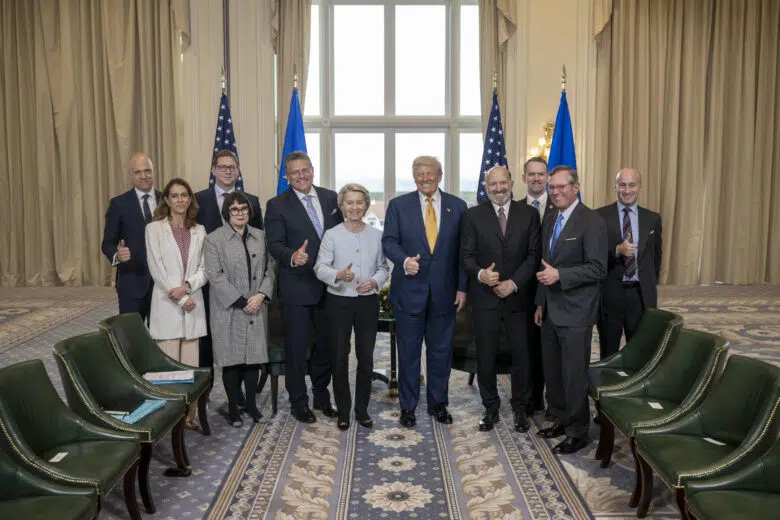
PARIS — Just a month ago, European Commission President Ursula Von der Leyen reached a major trade agreement with U.S. President Donald Trump. Some Europeans breathed a sigh of relief at having avoided confrontation with America, even as others denounced it as a humiliation for the European Union.
For the latest news & views from every corner of the world, Worldcrunch Today is the only truly international newsletter. Sign up here.
At least, we hoped, the trade issue was closed. But not for Trump: He has secured an additional 15% tariffs on European products, and he wants even more. As usual, he took to social media to make his move. His new target: digital regulation.
In his post, he demands that all countries that have implemented digital taxes, legislation and regulations repeal what he describes as “discriminatory” measures. This is an order, and those who do not comply will face additional “substantial” tariffs.
Trump concludes his threatening message with these words: “Show respect to America and our amazing Tech Companies or, consider the consequences!”
Washington’s offensive
Trump does not name any countries, but Europe is the principal market for American tech giants, and it is clearly the target. In recent years, it has adopted a whole series of laws, a legacy of Thierry Breton’s time as the EU’s Internal Market commissioner. Known by their acronyms, DSA, DMA and AI Act, these rules horrify Silicon Valley.
Last February, during his flash visit to the White House, French President Emmanuel Macron told us that during the lunch between the two delegations, U.S. Vice President JD Vance talked about only one subject: digital regulation and the fact that Europe should get rid of it. Vance is close to the “tech oligarchs,” as they are nicknamed.

Mark Zuckerberg, the boss of Meta, which owns Facebook, Instagram, etc., explicitly addressed the Trump administration in a message at the beginning of the year, asking for its help against European regulations. Six months later, here we are: Trump’s tweet announces the start of the offensive.
Europe’s dilemma
Europeans are therefore faced with a new dilemma in their complex relationship with Trump. Can the EU resist? In principle, it has no reason to give in: American companies need the European market, the first in the world, and Europe has traditions different to those enshrined in the First Amendment of the U.S. Constitution.
But the digital issue is not isolated. The United States still, in principle, ensures Europe’s security through NATO, and a delicate situation is unfolding around the war in Ukraine, Trump-Putin relations, and transatlantic relations more generally.
Giving in simply means accepting subjugation.
Resisting Trump means running the risk of entering into a trade war that will inevitably have political and security repercussions; giving in simply means accepting subjugation, in other words, losing all capacity for choice.
The alliance between Trump and Silicon Valley foreshadowed this moment of truth: The new contours of American hegemony are now clear. Europe has its back against the wall.