
-Analysis-
PARIS — “All history is contemporary history.” Benedetto Croce’s phrase seems to perfectly apply to the commemoration of the 80th anniversary of D-Day on the Normandy beaches on Thursday, just as we’ve done every 10 years: 1984, 1994, 2004, 2014, 2024.
Forty years ago, during the Cold War, during the time of Ronald Reagan and François Mitterrand, June 6th was a reminder of the righteousness of the cause of freedom and the importance of transatlantic relations. “Pacifism is to the West and euro missiles to the East,” the French president had aptly noted.
In 1994, the Berlin Wall had fallen, and freedom had triumphed in Europe, even if it was not the “end of history,” and war had returned to the Balkans. November 9, 1989 seemed almost like an extension, if not a confirmation, of the message of June 6, 1944.
Connecting the past and present
As early as 1985, German President Richard Von Weizsäcker recognized that for his country, defeat had meant liberation from Nazism. In 2004, for the first time, a German chancellor, Gerhard Schröder, was present at the June 6th commemorations. The past has not only transcended: After the Iraq war — in which neither Paris nor Berlin had participated — the past was there to aid the present.
In 2014, after Russia’s invasion of Crimea — an event that should have been seen as a much more serious warning than it was at the time — a new problem was emerging. Would Europe always be able to count on America? Or would the lessons of June 6, 1944, begin to fade?
In 2024, however, as war in Europe drags on, deepens in the Middle East and threatens to extend to Asia, the return of tragedy is omnipresent. With one direct and immediate consequence: the reawakening of NATO.
“Never again”?
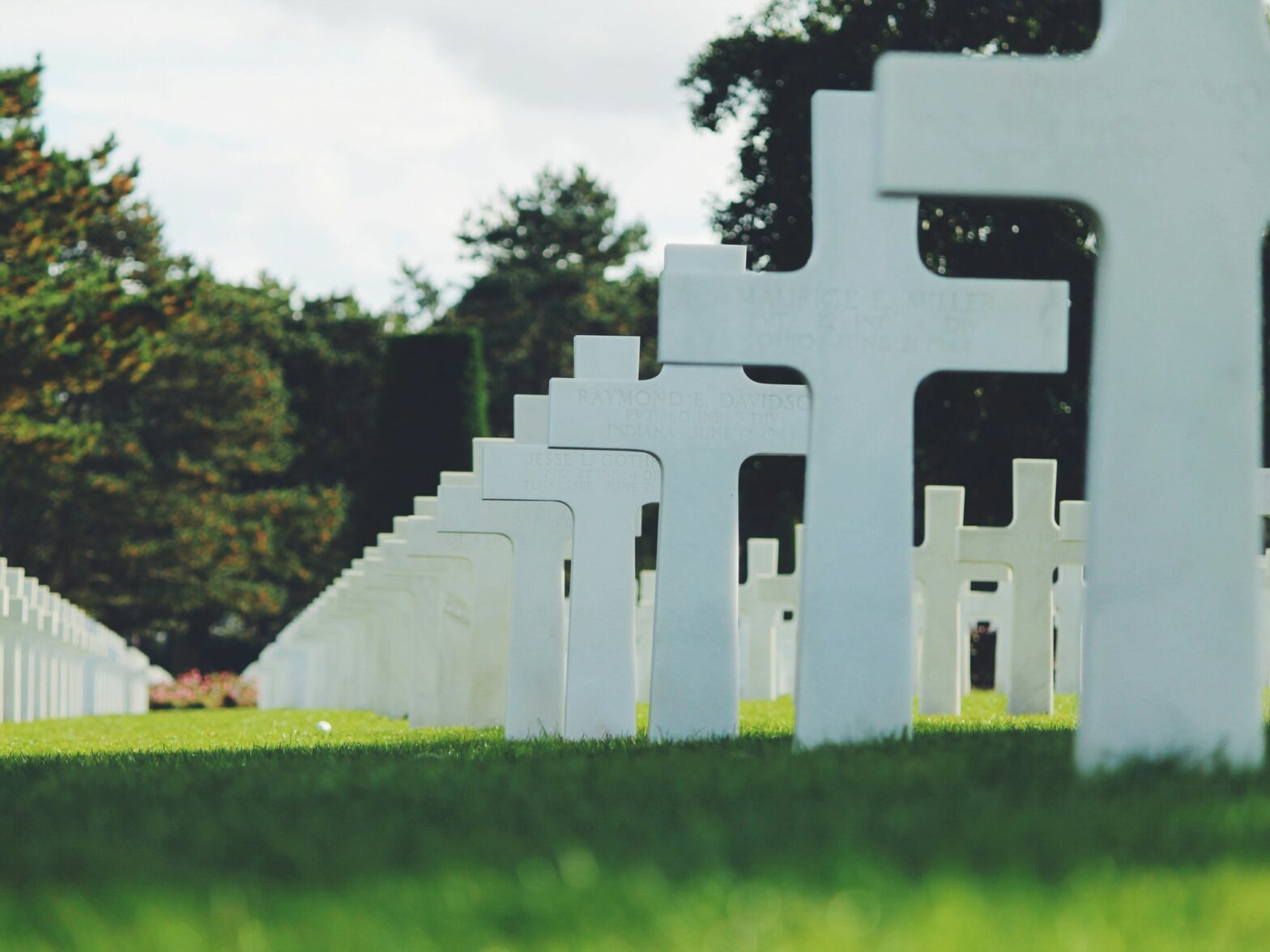
Do the graves at the Colleville-sur-Mer cemetery not evoke those of the Ukrainian cemeteries? Once again in Europe, people are dying in the defense of freedom. Would the war that ended in 1945 — thanks to the Allies’ victory on the Western front and the USSR on the Eastern front — be resuming, but this time between the former victors?
Now we have Putin’s Russia playing the role of Hitler’s Germany.
As if the sacrifice of a generation of heroes and victims had not been enough to quell the ill winds of nationalism and populism? As if the positive “never again” from the last D-Day commemorations was giving way to a form of resignation to the return of the worst?
Now we have Putin’s Russia playing the role of Hitler’s Germany. The contrast is now between the solemn and confident architecture of the Colleville cemetery, overlooking Omaha Beach, and the foreboding and chaotic reality of the present has simply become too great to ignore.
At the end of World War II, the USSR and China were on the side of the victorious Allied powers, even though the first signs of the Cold War were already being felt, even though Sun Yat-Sen’s China was about to give way to Mao Zedong’s.
Today, if Moscow and Beijing invoke memories of their common fight against Nazi Germany and Imperial Japan, it is not in a spirit of unity against the return of war, but of aggression towards a Western world perceived as decadent and obsolete in its essence as well as its performance.
Ominous winds
In 2024, the guest of honor for the 80th anniversary of the “Longest Day” is Ukraine. In June 1944, by landing on the Normandy coast, the Allied troops advanced the cause of freedom in a historically decisive way.
Since February 24, 2022, by defending their territory, Ukrainian troops are not only fighting for their country’s independence but for the cause of freedom against an enemy who, under Putin’s leadership, embodies the negative values that were defeated 80 years ago.
But it is at the moment when the message of the commemoration is clearest that the darkest clouds and the most ominous winds are on the horizon. In 1944, America was an essential part of the triumph of freedom and democracy. In short, it was the solution. In 2024, it constitutes a decisive element of the problem, as a momentous election looms in November.

Last time?
The still-living veterans who will be on the beaches this year number are just a few dozen. In 2014, they still numbered in the hundreds. They were treated like icons. They were treated with respect and tenderness, as if their simple presence elevated us.
For the 90th anniversary, there will likely be no D-Day veterans left alive.
In 2034, for the 90th anniversary of the landing, there will likely be no D-Day veterans left alive. And what will America have become in 10 years if it succumbs once again to the sirens of populism and to the allure of a man condemned by justice who knows no limits to his egotism?
Is 2024 above all “the last time,” the final commemoration with witnesses, for purely biological reasons. Or does this feeling of “last time” primarily reflect a geopolitical and political concern with an America distancing itself from Europe to focus most of its attention on Asia?
And worse still, is this an America that is forgetting its attachment to democracy, losing the sense of one of the most glorious chapters of its history?