HAMBURG — My shift at the kebab shop begins with a lighter in my hand. I press the switch on the gas grill, the flame catches, and the skewer begins to turn. Fat drips quietly into the round stainless steel bowl.
We have been running our family business, Frechener Grill, in a two-story half-timbered house at the entrance to pedestrian zone of Frechen — a suburb of the western German city of Cologne with around 53,000 people — since 1990.
For the latest news & views from every corner of the world, Worldcrunch Today is the only truly international newsletter. Sign up here.
My 64-year-old mother is a cook, kebab vendor, and pastor. She knows her customers’ faces, tastes and stories.
And me? I hold a master’s degree in political science. Yet here I am, between the salad bar and the kebab stand, in the place where I first learned to walk.
Monday through Saturday, I pull my black apron from the coat hook. My mother changes her shoes in the same spot several times a day, sneakers, sandals, hiking boots. But the pain in her feet never leaves.
“Two more years of cutting kebabs, then I’ll put the knife down,” she says.
I admire my mother deeply. She has been working at the skewer for more than three decades, a woman in an industry men like to dominate.
Since the start of the year, I have been helping out for two hours a day to ease her burden after one employee threw in the towel. I am actually a freelance writer and a public speaker for an education initiative.
For me, the kebab shop is more than just a workplace. It is an archive. A collective memory that carries our family story: Kurdish, female and defiant.
May 1, 1990. Labor Day. A day usually devoted to strikes and the fight for better working conditions. Ironically, it was also the opening day of our family business. We were the first snack bar in Frechen to serve döner kebabs.
The idea came from my father Aydin, now 67.
In the late 1970s, in his early 20s, he came alone to Germany. He completed his Abitur, the high school diploma, at night school and began studying agricultural economics in Bonn. He paid for his books by trimming hedges and weeding gardens in the residential area of Bad Godesberg.
The traces of a family history
In 1985, while still studying, my parents married. A year later my older brother Cem was born in Darmstadt. For the first four years they lived apart: my mother and brother with relatives in Darmstadt, my father in Bonn.
At that time his elder brother Aziz was already living in Frechen. Uncle Aziz persuaded my father to try the restaurant business there. The idea was practical: earn enough money in a few years to finally live together as a family. Out of love, my mother followed him into it.
The kebab shop was my playground — and the only place I could truly be near my mother.
In the shop’s small back room, where sacks of flour, rice and stacks of white napkins are stored, music by Kurdish singer Ahmet Kaya plays softly. My father reaches into the meat grinder, shaping thick round patties from the pinkish meat paste, stacking them from small to large. Then he trims thin white slices of fat. Meat, fat, meat — the skewer grows layer by layer, all by hand.

My mother never wanted me to become a kebab vendor. The work was too hard and too thankless. She once dreamed of being a kindergarten teacher.
As a child, I celebrated birthdays in the shop with singing and dancing. I made prank calls from the old payphone and secretly slipped coins into the long-gone slot machine.
The kebab shop was my playground — and the only place I could truly be near my mother. She spent seven days a week there, from 7 a.m. to 11 p.m.
Her gaze runs across salads, feta and sauces. The smell of roast chicken fills the air. Then she takes up a pen and writes the weekly shopping list: napa cabbage, aluminium foil, mayonnaise. I lean against her shoulder.
The shopping list holds traces of our family story — small spelling slips that reflect the struggle my mother faced to gain her footing in Germany.
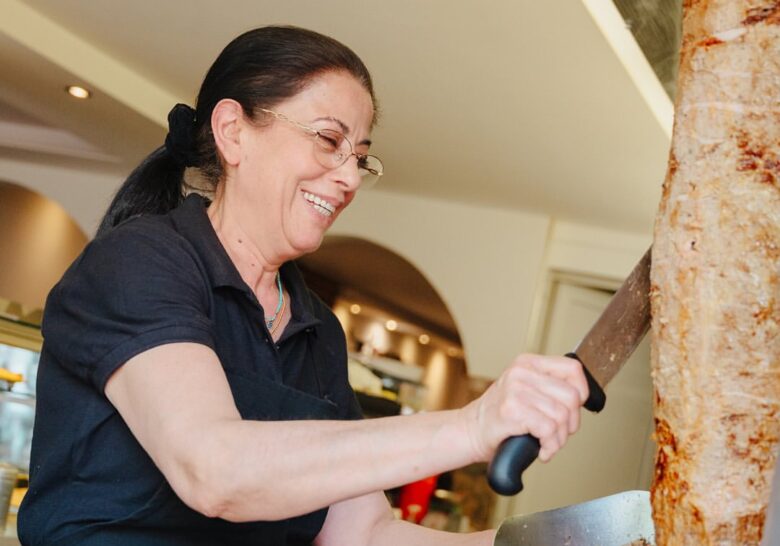
Fifty degrees Celsius, or 122 °F. That is the heat in front of the skewer. My mother grips the handle of the 55-centimeter knife. With practiced movements she carves the veal.
She felt abandoned, I felt trapped.
The routine is set. It has been for 35 years.
The fire in the grill flickers. My mother’s face stays expressionless. Yet the work leaves its marks: orange grease stains her black polo shirt. Her hands, cheeks and chest glow bright red from the heat.
“A döner kebab in bread, salad, sauce, Coke Zero — 10.50 euros, please,” I say. The blond-haired customer smiles and says, “Wow. Two strong women. Really great.”
The girl of the house
I look at my mother and grin. We high-five each other. Mother and daughter. Side by side. But it was not always this way.
When I was a teenager, our apartment was right above the shop, and I slept in a walk-through room without heating. I did not even have my own key. My every move was watched. Three generations lived in tight quarters.
“Sen evin kızısın” — you are the girl of the house, my mother used to tell me. To her, that meant staying home, focusing on school, and helping with the housework.
I did the opposite. I skipped school until I needed a doctor’s note, refused to load the dishwasher, protested against right-wing extremists, came home with fines and broken ribs, and danced at Cologne parties with someone else’s ID.
My mother did not see it all, but my yearning for self-determination alone seemed like a threat. Maybe because she herself never had the chance to live freely.
We talked about feelings, but always at cross purposes. She felt abandoned, I felt trapped.
My tight clothes, my politics, my views on love and sex. Every day our home turned into an election arena: loud, heated debates, me against the rest.
At 17, the break came. I moved out, worn down by the arguments and my double life. At last I had four walls of my own, at last I could be myself. But the freedom was laced with loneliness.
And then there were the days when other teenagers mocked me because of the kebab shop. I took down my framed childhood photo from the snack bar wall.

In the 2000s, headlines spoke of the so-called “Döner murders.” This was the series of killings committed by the National Socialist Underground (NSU) terror cell between 2000 and 2006, in which nine men of Greek, Kurdish and Turkish origin were murdered.
Despite clear signs of right-wing extremist perpetrators, authorities and the media turned their focus on the victims and their families until the NSU exposed itself in 2011. Instead of investigating racism, they accused them of drug trafficking and extortion. The kebab became a symbol — of supposed foreignness, of threat and violence.
Still a “Döner Woman”
When my mother first opened the shop in 1990, she sold not only kebabs but also supermarket goods: sumac, henna, Ceylon tea. In the mornings, colorful crates of fruit and vegetables were stacked in front of our door.
It was the same for Süleyman Taşköprü in Hamburg and Habil Kılıç in Munich, until both were murdered by the NSU in 2001. By coincidence, we even share the same last name as Habil Kılıç.
Mehmet Turgut in Rostock, İsmail Yaşar in Nuremberg: they, too, ran snack bars and sold kebabs. Until 2004. Until 2005. Until they too were gunned down.
If “kebab murders” was rightly condemned as racist, why am I still called a “kebab woman” today? Am I a walking skewer?
Mehmet Kubaşık, Enver Şimşek, Abdurrahim Özüdoğru, Halit Yozgat and Theodoros Boulgarides were also murdered by the NSU for racist reasons.
After the NSU exposed itself in 2011, the term “Döner murders” was named the “worst word of the year,” because it trivialized the group’s racist killings. People were murdered, not kebab skewers.
Three bells jingle as a customer steps into the shop. The middle-aged man, in blue jeans and a wrinkled white T-shirt, orders a kebab plate with fries and salad. When he asks my mother if she eats kebab every day, her eyes light up. She giggles and says she could eat it daily, but of course she doesn’t.
“My husband still makes our skewers himself, every day,” she says with a look that makes clear how proud she is.
I am proud of my parents. And I love our kebab shop. But working behind the counter is also frustrating: hair pulled back tight, no necklaces, no gel nails, no backtalk, and always a smile. What irritates me most, though, is when someone calls me “kebab man” or “kebab woman.”
If “kebab murders” was rightly condemned as racist, why am I still called a “kebab woman” today? Am I a walking skewer?
For many Kurdish families, the move to Germany was also a silent flight from the Turkish state.
Whenever my mother speaks about her early days as a vendor, she cannot hold back tears. “We barely had any customers; many didn’t even know what kebab was. Our mountain of debt grew every month. In winter, I had to wear three pairs of socks over slippers because I couldn’t afford proper shoes.”
In 2004, I sat in an elementary school classroom, legs swinging. Next to me sat my mother, upright, alert, determined. She believed in high school, in me. My teacher, who used the N-word, saw it very differently.
It starts quietly
For many Kurdish families, the move to Germany meant more than the hope of work, freedom from poverty, and the right to education. It was also a silent flight from the Turkish state.
In German-Turkish stories about so-called guest workers, the reality of Kurdish migrants is often overlooked. Kurdish culture, language and identity have been hidden, criminalized and erased in Turkey for decades.

Even though my mother never mastered German perfectly, she read me a bedtime story every night. She insisted that, despite our Alevi faith, I should attend Catholic religious classes to broaden my knowledge. And she would rather drench herself in perfume after a long shift than miss a parent-teacher meeting.
Students with names like Ariya, Diyar or mine were judged not just by performance but also by their names.
Once in math class, a teacher grabbed my hair from behind, scratching my scalp. “Is your hair real?” she asked. I felt uneasy, though at the time I did not know why.
That same teacher gave me a five for my oral work. In Germany, grades go from 1 to 6, with 1 the best and 6 the worst. I was never absent, never disruptive, and I tried hard.
It became painfully clear that students with names like Ariya, Diyar or mine were judged not just by performance but also by their names. My mother refused to believe it then.
Why raise my hand in math class when I knew I would be marked down anyway? So in high school, instead of sitting quietly at my desk, I blocked train tracks to stop neo-Nazi marches and stood in the way of German and Turkish fascists.
I barely made it to the 2013 graduation ceremony. That same year, a study found that one in four students with a migrant background felt discriminated against in German schools.
The 3.1 on my diploma was a disappointment at first sight for my parents. But relief won out: the university doors were still open.
While studying politics in Duisburg, my mother and I got to know each other again. Letting me go was hard for her, even though my new home was not far away. Separation anxiety from her own childhood returned.
While my choice of university made many smile pityingly, I loved my time in the Ruhr. Between the library and the pub, I began to truly understand my family’s story: my mother’s and grandmother’s lives, our kebab shop, my class awareness, my Kurdish identity, somewhere between assimilation, tradition and integration. No longer just a daughter stuck in the middle, full of anger and frustration, but a scholar with a clear outside view. With that came compassion and understanding for my mother’s reality. The Kurdish feminist slogan gained new meaning for me: Jin, Jiyan, Azadî! Woman, Life, Freedom!
The skewers will keep turning even without us.
My mother, too, dared to try new things. I stood in the fitting room of a clothing store, she outside nodding as I came out in a miniskirt. Between rainbow flags and loud music, we marched together for queer rights on Christopher Street Day in Cologne.
She no longer clung to outdated expectations of my life. She listened, took my concerns seriously, and tried to understand my perspective.
During my studies she encouraged me, recognized the unequal odds I faced as the first in my family to go to university, and helped me graduate with an A.
Although my mother and I still do not agree on everything, unlike the women before me, I grew up with full access to education. The skewers will keep turning even without us. I will not stay at the Frechen Grill forever. But I will never forget what I learned here: sometimes feminist resistance starts quietly, behind the salad bar, with a kebab knife in hand.