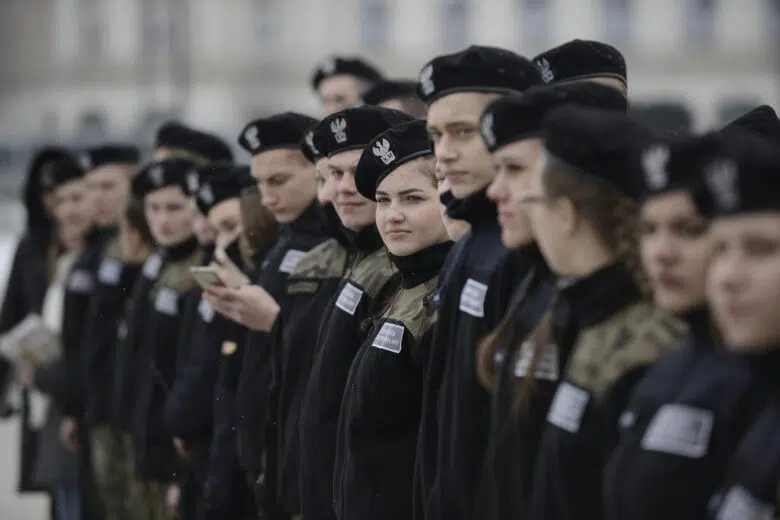
WARSAW — More and more young people want to study at the Military University of Land Forces (AWL) in Wrocław, which is why the university is systematically increasing its admissions limits. While there were once around 200-250 places, a total of 958 people will begin their studies in the next academic year.
For the latest news & views from every corner of the world, Worldcrunch Today is the only truly international newsletter. Sign up here.
Approximately 2,000 people apply for admission, meaning there are two applicants for every spot. The military academy provides students with free meals and accommodation and a monthly salary of approximately 6,200 zloty ($1,710) net.
The AWL exams begin this weekend and will last a week. To take them, you must have
passed your high school leaving exam. The first component of the exam is fitness testing. For men, this includes a 1-kilometer run, pull-ups and a shuttle run (10 times 10 meters between designated lines). Women must run 800 meters, pass a pull-up test and complete an envelope, or zig-zag, run.
Although the number of candidates has been rising, university faculty members note that
their profile has been changing.
“The candidates who are applying clearly represent the generation from the COVID-19
pandemic. Young people have been stuck at home for a long time, which is why they are
physically weaker, and many have difficulty doing even pull-ups. But there are also
candidates who have been preparing for the exams, and that’s also noticeable,” says AWL spokesperson Major Roksana Borowska.
Lieutenant Colonel Kociuba, who also works for the university, adds that young people
struggle most with endurance, as many of them do little in the way of physical preparation.
“Cell phones and tablets are stealing the time young people used to spend playing football or riding bikes,” he points out.
Studying in the military
After the fitness tests, candidates must undergo an interview, during which a commission
assesses their motivation to join the army. A medical commission then determines their
physical and mental fitness for military service.
But not all those who are accepted to a military academy ultimately become students. The next stage of the verification process is a 28-day basic unitary training course, which begins at the end of August. Candidate soldiers learn to use weapons, undergo drills and prepare for their oaths. Some drop out because they can’t adapt to military life.
“One of the guys quit on the first day, right after he walked in and saw that he would be living in a room with 10 other people. He thought he would be alone. He took his suitcase and turned around,” recalls one AWL student. During unitary training, many young people, as many as 200-300, drop out of military careers. They are replaced by others from the reserve list.
Some students are surprised that they have to make their own beds and keep things
tidy.
“In the army, most things have to be done on command: eating, getting up, and moving
around. Some people are surprised that they have to make their own beds and keep things
tidy,” says Major Borowska. That doesn’t mean that the students don’t find time to socialize.
Several couples who met at AWL married during their studies. But they still live separately because there are no rooms designated for families. So many young people want to become professional soldiers that the academy’s large complex on Czajkowskiego Street is running out of space. Some buildings are being modernized, and new dormitories are being built.
Yet the academy authorities don’t want this situation to last too long. They believe it’s better for soldier candidates to live in a military unit rather than in the center of a large city.
Who is signing up to fight?
Patryk is 21 years old and hails from Ełk in the northeastern Masurian Lake District. Tall and slim, he is focused and serious during our conversation. He is in his second year of studying Command. He decided long ago to become a professional soldier. This choice was largely influenced by family tradition — his father is a military man — and financial stability. I ask if anything particularly surprised him.
“No, not really,” he replies calmly. “It was probably easier for me than others, because I knew
the army from stories my dad told me. Besides, I attended uniformed service, and then I
served in the Territorial Defense Forces.”
He began his studies at the AWL when the war in Ukraine was already underway. I ask if he ever had any concerns that the future might lead to him being sent to war and having to fight on the front.
“Everyone joining the army should be aware that they might be used in combat. It’s inherent
in this profession. A soldier has to fight,” he says with conviction. Do other military academy students feel the same way? Aren’t they also afraid of being sent to war? I ask.
“I don’t know what others think,” he says, closing the subject.

Aleksandra, a 22-year-old from the southwestern city of Legnica, is a third-year Logistics student at AWL. Her father, like Patryk’s, is also a professional soldier. She recalls being a Girl Scout, and says that her father “instilled a fascination with the military in her.” But she initially had no intention of following in his footsteps.
“In high school, I studied biology and chemistry and considered medicine. But over time, I
came to the conclusion that I wouldn’t be able to find my place in that profession. I studied
management at the Wrocław University of Science and Technology for a year, but it wasn’t
what I was looking for. It didn’t appeal to me. Then my dad suggested I try the military,
saying he saw me as a good fit,” she says.
She admits that what surprised her most at the academy was the discipline. She compares
that at home, her parents demanded and maintained discipline, but “not as much as in the
army.”
“You have to accept orders and follow them. By the third year of studies, only those who
adapted to the military remained,” she says. You have to get used to a daily rhythm of fixed hours and activities: wake up at 5:30 a.m., then a three-kilometer run — regardless of the weather — classes, exercises, roll calls, meals and curfew at 9:30 p.m.
Uncomfortable high heels
Military regulations detail the appearance of a female soldier. Hair must be tied back so that it doesn’t touch the uniform. Nails may extend no more than 0.5 millimeters beyond the
fingertips, and no nail polish is allowed. Makeup is also prohibited, unless it’s very subtle.
“Red lipstick is not allowed,” Aleksandra says. “Sometimes I want to feel feminine, and the university puts a stop to that. So when the weekend starts or I go on vacation, I paint my nails, put on makeup and then take a picture. We all look the same in uniform, and that’s how you stand out.” She adds, however, that she doesn’t like wearing heels because “they’re uncomfortable.”
Lieutenant Colonel Piotr Szczepański, vice-rector for student affairs, recalls that when the
first women arrived at the university in 1999, it was “something new.” Today, over 10% of the
members of Poland’s military are women.
We must be willing to sacrifice for our country.
“They serve in various roles, in all groups. They are excellent analysts and very
conscientious,” says Lieutenant Colonel Piotr Szczepański.
Military logistics — which Aleksandra is studying — mainly involves delivering munitions,
organizing supplies for the army, and building warehouses. Like every cadet, however,
Aleksandra also takes shooting classes. She knows that in the future she might find herself in the background of a war. Students from her university are sent to the Polish-Ukrainian
border as part of the course.
“Every soldier should know how to shoot, because if necessary, we can fight on the front
lines. We must be willing to sacrifice for our country,” she says, adding: “I’m a good shot,
both at moving and stationary targets. I have a good eye and a calm demeanor.”
Lieutenant Colonel Piotr Szczepański concludes, “Now there are no more women and men; there are soldiers.”