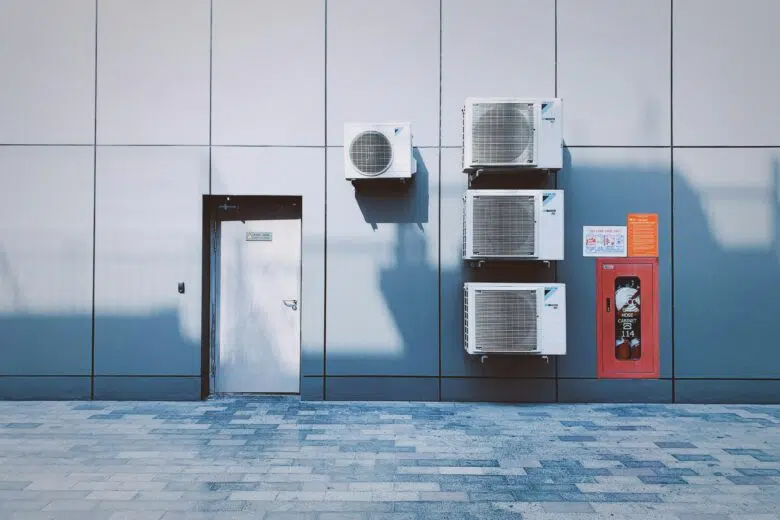
PARIS — Environmentalists who would like to ban air conditioning, particularly in schools, are as clear-sighted as those who campaigned for the closure of the Fessenheim Nuclear Power Plant in northeastern France. They think they’re environmentalists when they’re really just reactionaries.
For the latest news & views from every corner of the world, Worldcrunch Today is the only truly international newsletter. Sign up here.
Their reasoning is based on the idea that the use of air conditioning, which admittedly consumes electricity and generates heat transfer, has a net positive impact on global warming. The problem is that this idea is false when we consider the impact of heat waves on the overall functioning of our societies. Even from a climate perspective, it’s better not to collapse in the heat.
Only 25% of French citizens are equipped with air conditioning, far fewer than in Japan or the United States. In France, the rate of air conditioning in shops and offices is high, but that of educational institutions (primary and secondary schools, high schools, universities, etc.) is less than 10%. Yet, the link between temperature and productivity is well-known.
A negative relationship
Economic historians have long emphasized the negative relationship between temperature and economic development. Wealth was located in temperate or cold countries, while poverty was concentrated under tropical skies.
Even within a temperate continent like Europe, productivity has long been lower in southern regions. This relationship is less clear today, as hot and humid countries like those in Southeast Asia — or regions like Andalusia — rely heavily on air conditioning. According to the OECD, 10 days above 35 °C (95 °F) cause French GDP to drop by €8 billion ($9.4 billion).
We lose almost half a workday per week when the office temperature exceeds 30 °C (86 °F).
What is true at the national level also applies at the individual level. The impact of temperature on individual productivity follows a bell-shaped curve that peaks at around 23 °C (73,4 °F). We lose almost half a workday per week when the office temperature exceeds 30 °C (86 °F).
This productivity issue is a major concern in schools, since extreme heat like the one we have been recently experiencing diminishes students’ learning capacity. But rather than installing air conditioners, we prefer to shut down public services. As I write these lines, more than 1,000 schools are closed, and environmentalists are happy.

No problem, you can cool down your homes
Air conditioners use electricity, it’s true. But in France, our electricity is carbon-free thanks to nuclear power — and not thanks to The Ecologists party. In the summer, it’s abundant because consumption is generally lower than in winter. Electricity demand is at least 33% lower in June than in January. So, no problem, you can cool down your homes.
A more valid argument concerns the heat islands emitted by air conditioners. It’s true that using these devices can increase the outdoor temperature. But considering only this issue fails to address the problem in its entirety.
A recently published study by the National Bureau of Economic Research (NBER) in the U.S., which focuses on the climate effects of a possible population decline, has just reminded us that the best lever for combating global warming is… economic growth, which allows for investment in decarbonization.
Refusing to use air conditioners is therefore not saving the climate; in fact, it’s exactly the opposite.
Refusing to use air conditioners is therefore not saving the climate; in fact, it’s exactly the opposite. Letting our fellow citizens sweat limits learning, reduces working hours and clogs hospitals. About 5,000 French people died from the heatwave in the summer of 2023 (15,000 in 2003). The climate gains nothing from this — quite the opposite.
On the other hand, allowing pupils, students and workers to work in a temperate environment gives them the best chance of being useful in a society that effectively combats global warming. Dear Minister of National Education Élisabeth Borne, install air conditioning in schools!