HAMBURG — Artificial intelligence has long played a key role for many white-collar workers. And even as AI will shrink the number of office jobs in many sectors, it is expected that AI will revolutionize manual labor too, sooner or later.
For the latest news & views from every corner of the world, Worldcrunch Today is the only truly international newsletter. Sign up here.
Of course, it hasn’t yet. Chatbots and AI agents can handle plenty of tasks, but laying tiles isn’t one of them. Julian Wiedenhaus isn’t changing that anytime soon. Still, his AI is already helping calculate exactly how many tiles are needed for a certain size bathroom, giving a worker more time to actually lay them.
Together with Alexander Noll and Richard Keil, Wiedenhaus founded Plancraft in Hamburg in 2020. Today, the three employ more than 100 people, and just a few weeks ago they secured 35 million euros from investors.
Voice command
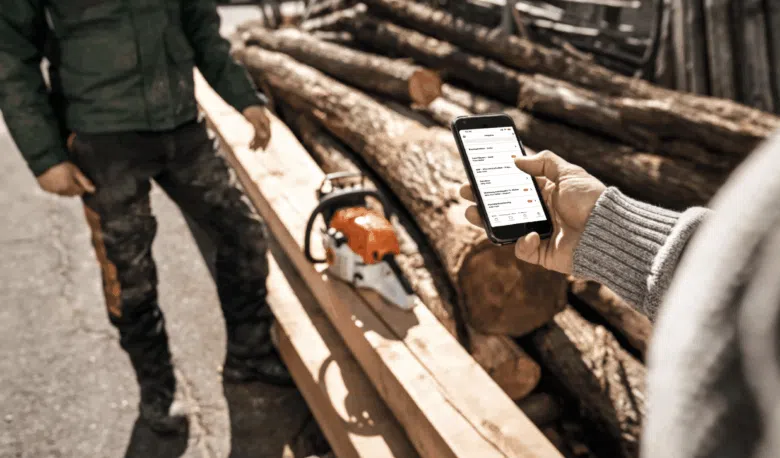
Plancraft offers subscription-based software designed specifically for small craft businesses. It allows users to create quotes, log working hours, and send messages to employees. Thanks to AI, some of these tasks can now even be done by voice command.
If you’re reading this, you likely have no idea what a “measurement” actually is.
For instance, there’s a function that records the so-called measurement at a customer’s site using voice input. If you’re reading this, chances are you have a white collar job or at least work in an office and, like I did before speaking with Wiedenhaus, have no idea what a “measurement” actually is. To stick with the tiling example: when a tradesperson comes to your bathroom and notes how many square meters of tiles are needed, and whether recesses, corners, and edges must be considered, that’s the measurement. It forms the basis for the quote and the planning of the work that will eventually be carried out in your bathroom.
This information can be dictated directly into the Plancraft app. Thanks to an integrated speech model, it can recognize what’s being said and distinguish between numbers, descriptions, and instructions meant for colleagues.

Target users
When listening to the heads of major tech firms, one might get the impression that AI simply needs to become ever smarter and more powerful, and then it will somehow, almost magically, solve every problem. But speaking with Wiedenhaus makes it clear that his challenge isn’t about making AI stronger; it’s about building a product his target users actually want to use.
The skilled trades are a relatively traditional field, where many workers still rely on little to no software and are hesitant to start. “Our task,” he says, “is to make the translation so good that we can reflect every trade and its specific characteristics.”
Human touch
For that to succeed, it’s essential that as many tools as possible come from one source and that they truly save time or make possible tasks that would otherwise be dropped, since skilled trades are among the industries hardest hit by a shortage of qualified workers.
To improve his AI, Wiedenhaus needs to understand what a carpenter requires and what an electrician needs.
Wiedenhaus points to the automated AI answering service. It logs customer requests, drafts quotes, and relieves the managing director, whose phone no longer rings off the hook.
To improve his AI, Wiedenhaus needs to understand what a carpenter requires and what an electrician needs. To get that insight, you have to go into the field. “We spend a lot of time with our customers, standing next to them as they use our software,” says Wiedenhaus.
For that, you still need a human touch, just as you do when laying tiles.

