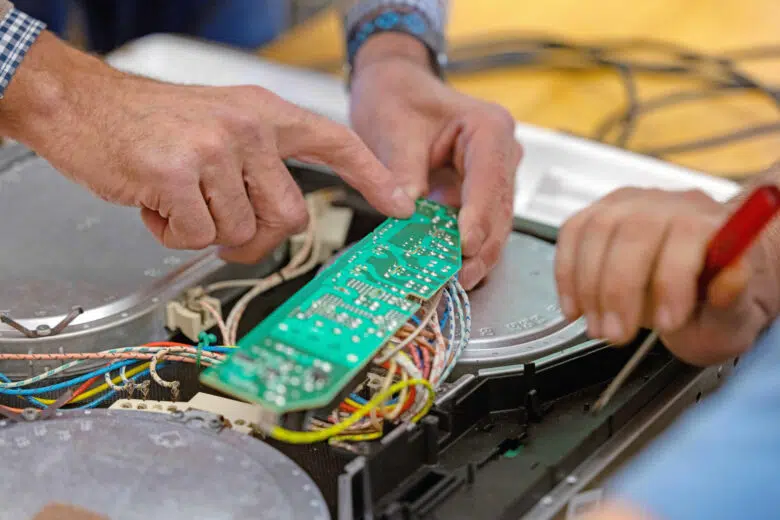
MADRID — A cell phone ends up in the trash because its battery has stopped charging. A robot vacuum cleaner that no longer moves due to a broken wheel follows the same path. And the car’s GPS, which is getting too slow. And the microwave, which has two buttons that no longer work. And the printer, which has suddenly started showing errors and no one knows why.
It’s very likely that you’ve recognized yourself in one (or all) of these situations: The objects we live with break down very often. Yet many can be repaired to extend their life and avoid ending up in the trash. It’s just that accessing such repairs is not always easy.
For the latest news & views from every corner of the world, Worldcrunch Today is the only truly international newsletter. Sign up here.
In 2022, 62 million tons of electronic waste were generated worldwide, the highest amount recorded to date by the International Observatory on Electronic Waste. That is just over 7 kilograms per person per year, a figure that rises to 17.6 kilograms per person if we look only at European waste.
This waste results in the loss of billions of euros in valuable metals, has a significant social and environmental impact (most of the waste is incinerated), and perpetuates a linear production and consumption system, in which we extract finite resources from the Earth only to throw them away shortly afterwards.
The system’s weak spot
All of this is no coincidence. This system is the basis of countless companies’ business models, which use planned obsolescence or perceived obsolescence as a powerful tool. The linear economy — in which we extract, produce, waste — started with the Industrial Revolution and has been ruling everything ever since. But this system has a weak spot: reparation, a common practice until not so long ago, which has also been recognized as a right in the European Union.
“Repairing not only extends the life of products, but also reduces environmental impact, decreases waste, and gives power and freedom back to people. The right and ability to repair are necessary to regain control over what we buy and resist planned obsolescence,” says Restarters Valencia, one of the many groups that have emerged in recent years to promote repair. The Restart project is a global community founded in the United Kingdom and present in more than 20 countries.
Repair is important as a matter of social justice.
“We hold meetings where volunteers with technical knowledge offer their time to help other people who want to repair a broken device. We also try to explain and teach them what is wrong with the device, why it has broken, and how we can repair it. Often the repairs are surprisingly simple and inexpensive — although in other cases we are left disappointed, of course. And in almost all cases we end up cursing poorly designed and user-unfriendly products,” explain Restarters Barcelona, another of the network’s local groups.

Exercising the right to repair
There are many ways to make an item obsolete. Products may have a limited lifespan by design, they may become obsolete due to new technical standards, they may no longer be supported or have replacement parts available, or they may simply appear old or outdated due to marketing and advertising. And although electronics is the sector where these obsolescence practices are most evident, they are actually widely used in any sector that depends on constant innovation and short product cycles, such as fashion or automotive.
“Repair is important, first, as a matter of social justice and because it offers business and employment opportunities in the locations where products are consumed and used, with guarantees similar to those offered to consumers and users,” explains Alberto Vizcaíno, environmental scientist and expert in obsolescence. “Repair is also important because of the environmental, economic and social costs generated by the products we consume. Each one contains raw materials that have been extracted somewhere in the world, hours of labor, emissions caused by transportation… Once the product is in our hands, the ideal is to keep it as long as possible to reduce environmental and social impacts.”
We work to promote a culture of sufficiency, of making the most of what we have.
According to the expert, if a product breaks down, the first thing to consider is whether it is under warranty. In the European Union, consumers are covered for manufacturing defects in any product during the first three years of use. Beyond the warranty (and even when covered by it) repairing is not easy.
“There is legislation regulating the right to repair, but it is not properly enforced. Consumers are not aware of the options available to them and do not have the time or resources to exercise them. Obtaining a repair involves an effort that discourages users and leads them to buy new products to meet their needs,” Vizcaíno says.
Restarters Barcelona and Valencia agree on the diagnosis: The right to repair has been enshrined in law, but there are no tools to make it effective. “Many of the European directives have not yet been implemented, and it remains to be seen how they will translate into practice. As of today, information is still unavailable, device manuals are locked, parts cannot be obtained, software is restricted, repair methods are artificially complicated… All of this significantly limits the actual right to repair,” the Valencian collective says.
Solutions to repair and overcome obsolescence
When it comes to repairs, where can we find help? In many towns and cities, there are still repair shops for clothing, appliances and electrical products, but these businesses are becoming increasingly rare. The main obstacles to repair are: generational change; difficulties in accessing spare parts, components and applications suitable for repair; lack of qualifications and openly available technical information; the absence of incentives to encourage the population to repair; and changing the mindset that it is better to buy something new.
In Spain, there are several initiatives aimed at bringing repair services closer to consumers. In addition to groups (such as Restarters Barcelona and Valencia), there are Repair Cafés (free-access places, such as a bar or restaurant, where people get together to repair items), social economy projects (such as Recumadrid and Traperos de Emaús), and professional initiatives that seek to connect repairers with people who need their services (such as Guía Reparaciones). A simple internet search or a navigation app can help you find options in your area.
“We work to promote a culture of sufficiency, of making the most of what we have, of taking ownership, of removing the heavy mental burden of defining ourselves through material possessions and, above all, of creating networks and valuing mutual support over the false ideal of individualism,” Restarters Barcelona says.
“To encourage repairs, we need changes at several levels: stricter laws that force manufacturers to facilitate repairs; education that teaches us from an early age to care for, repair and value objects; giving cultural value to repairs as something useful, creative and necessary; or tax incentives and subsidies for those who repair and promote this type of activity,” Restarters Valencia concludes.