BUENOS AIRES — Our Clarín newsroom is two-and-a-half hours from Ibicuy, northeast of the Argentine capital, on a group of islands shaped by the Paraná river delta. We’re in a landscape of low-altitude forests and thorn trees like the espinillo, and the most resonant sound this sunny morning is the chirping of the Southern Screamer, a local bird. As we approach, the exposed houses built on stilts indicate the terrain has changed.
For the latest news & views from every corner of the world, Worldcrunch Today is the only truly international newsletter. Sign up here.
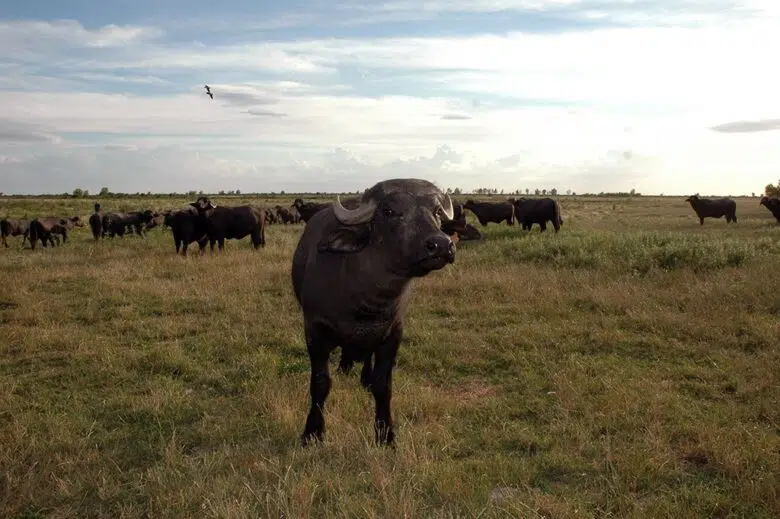
The greenery seems immaculate until you spot, off in the distance, black animals that look like Tornado, Zorro’s horse, a little more robust than a steer and with horns that are more impressive than intimidating. They’re not from around here, we’re told, but seem quite at home.
They are, in fact, water buffalos (Bubalus bubalis), common in Asia and especially India and China, their countries of origin, and domesticated more than 4,000 years ago. Their silhouettes jutting out of the rugged terrain make them look like cardboard paintings.
One senses they’re friendly: they even turn to look at the camera. Do they feel like stars? They may be in the world of livestock, where their meat is highly prized in the wake of scientific studies quantifying its benefits.
Water buffalo production in meat-loving Argentina is expanding, as data from the farming sector confirm. In the provinces of Formosa, Chaco, Misiones, northern Corrientes and Entre Ríos, it has doubled since 2000, going from 100,000 to more than 200,000 animals. Today, the buffalo is at the center of a gradual transformation of the gourmet palate in our country, where the cow typically symbolizes livestock farming and beef at the table.
But does it still? “The only thing that used to be taken into account was the tenderness of meat cuts, or whether it was soft or tough,” says Ezequiel Penzo, Executive Chef at the Hilton hotel in Pilar, outside Buenos Aires.
Every time you eat, you’re deciding what world you want to live in.
But he adds, the exotic buffalo’s increasing popularity is based on several factors. The flavor and product itself are also valued, not to mention people’s greater awareness, or knowing where and how what we have on our plate got there. In that context, water buffalo meat has advantages including being lower in fat and healthier, which is obviously appealing.
Penzo is one of the top young chefs taking stock of this particular meat.
Its biggest boost however came from Mauro Colagreco, the Argentine chef with three Michelin stars and a UNESCO Goodwill Ambassador for Biodiversity. He chose water buffalo meat to make a special-edition burger. It is one of the products offered by his brand Carne, rounded off with pecan bread, brie, bacon with wetland honey, organic arugula and green apple chutney. A gourmet burger, if ever there was one.

His sister and company co-founder Carolina Colagreco, tells Clarín: “Carne Hamburguesas is certified B-Corp for its triple positive impact (economic, social and environmental). We promote the pillars of sustainable gastronomy and believe that eating is a political act, which is why we say: ‘Every time you eat, you’re deciding what world you want to live in.’”
The firm has a research space, Carne Lab, where it launches special editions with the aim of highlighting projects that have a positive social and environmental impact. Buffalo meat is a part of this experimental scheme. The animals are raised in the Entre Ríos delta by Armando Cadoppi, who met the Colagrecos in May 2016. “When I found him,” says Carolina, “I fell in love with the project: having an animal that adapts to an environment without altering it, while bringing benefits to the island community. That’s why we decided to do this special edition.”
Where’s the water?
Cadoppi, the man who impressed the Colagrecos, owns the La Filiberta ranch where we can see the buffalos move around in close groups. He says it rained recently, but there is no water to be seen near the house. The animals walk on firm, dry ground.
They are docile, going wherever the muleteer Juan leads them. There is a puddle on one side of the main house, which the herd tramples within minutes, before casually moving toward the water, their favorite element. That’s where they find part of their daily food. You can hear them splashing. It’s time for the drone: from high above, the image is beautiful. They crisscross, drawing dozens of diagonal lines across a watercourse that is as common as it is valuable in this landscape, known as a wetland.
“Wetlands are very important freshwater reservoirs. They mitigate the effects of flooding and are habitats for a wide variety of fauna and flora. That’s why they are also great reservoirs of biodiversity,” explains Valeria Sfara, a Conicet biologist and expert in wetland livestock farming.
Water buffalo are adapted to ecosystems with permanent or semi-permanent water, which is why they were introduced to these areas. They can be raised as an alternative and benefit the local economy.
The meat is appreciated in restaurants and requested by chefs and consumers.
According to a report by Fundación Humedales/Wetlands International, of the approximately 200 million heads of water buffalo in the world, 95.83% are in Asia; 1.96% in South America and 2.21% elsewhere. The report sets out a detailed history of their introduction in our country, including failed attempts to cross-breed them with cows in the early 20th century and two insertions in the 1970s and 1990s.
Cadoppi, a graduate in Food Technology, is a protagonist in this new phase for buffalos in the Delta. He has raised them for 25 years at La Filiberta, a third-generation family ranch. “More than 25% of South America’s water runs through the Entre Ríos Delta. Its environmental value is high because it’s also essential for purifying the water that reaches the Río de la Plata and is turned into drinking water for 20 million residents,” Cadoppi says. “The region is unique and must be protected, which is why we thought of production that wouldn’t harm the environment.”
The first water buffalos arrived at La Filiberta in 2001 for comparative testing with traditional cattle farming. “In late 2002 when we noticed during weigh-ins that the buffalo gained more weight than cattle, and their impact on conserving our wetland, we decided to continue,” Cadoppi recalls. “In time, we saw that the meat we produced was appreciated in restaurants and requested by chefs and consumers. That confirmed the great potential of the meat produced in our delta.”
There were multiple legal hurdles to face before buffalos could be marketed. “We went for its certification for human consumption, which was the hardest part. The state first had to recognize the buffalo species as suited to human consumption, then create regulations. We had to convince politicians that this meat is an interesting red protein alternative as part of the diet and that small water buffalo producers needed their help,” explains Cadoppi.
After certification, the next stage was to see how consumers reacted. Would they accept it? Buffalo meat had to offer real benefits — and be good to eat.

Meat secrets..
The Paraná delta is an ecoregion bathed and fertilized by the Paraná river on its way to the sea. For millennia, the sediments the river has continuously deposited are vital to the growth of tender grasslands. This is the water buffalos’ main food and here in Ibicuy, it is everywhere.
This characteristic is essential to achieving quality meat with a scientifically studied nutritional value. Locally, researchers from the INTA Food Technology Institute in Castelar evaluated its characteristics. One of them, Sebastián Cunzolo, said the aim was to have technical data and scientific information on buffalo meat’s quality and nutritional value, providing accurate references needed to expand buffalo consumption and production in different provinces.
The meat used in the study was from water buffalo specimens aged 24-30 months, weighing 460 to 500 kilos and predominantly of the Mediterranean breed and fed on local pastures, Cunzolo explained.
Results, he said, showed that “buffalo burgers, for example, have a high protein content and low levels of fat, among other benefits.”
It’s interesting having red meat that’s healthier.
For Cadoppi, showing the product was healthy opened up new horizons. The buffalo project’s “greatest satisfactions,” he says, “were twofold: good reception by young chefs and the interest shown in learning about our wetland conservation work at La Filiberta, but also being able to contribute to island communities and offer a productive alternative that promotes settlement against the exodus of islanders to other cities in the highlands.”
The comparison with cows is always present, and Cadoppi says it’s no contest: “Water buffalo are smarter, more agile, and have a greater and significantly higher capacity to convert cellulose-rich forage into high-quality, natural and healthy red protein.” He says buffalo meat is “not only lean, natural and with low intramuscular fat. It also has a higher iron content and an essential fatty acid profile that favors consumers looking for a healthy and delicious alternative.”
“Bubaline” Future?
Chef Félix Babini of Mad Pasta House, based in the Martínez district of Buenos Aires, found these qualities attractive. After a failed food venture in 2020, thanks to the pandemic, he set about making pasta with a friend. Today, he is a benchmark for dishes with buffalo. “I came up with the idea of making pasta filled with buffalo meat, and people love them. I support having a new alternative, and it’s interesting having red meat that’s healthier,” he says.
Much water has flowed through the Delta’s rivers, but this buffalo story is just beginning. Cadoppi says production of water buffalo meat is still “in its infancy,” but it’s growing. Argentine consumers who know about it, accept and request it and it has been exported since 2006.
Throughout our visit the chirping of Southern Screamers never stopped: they’re the soundtrack to these delta islands. Carolina Colagreco agrees the product has a future, and so does this place: “I’m convinced consumers, especially young ones, are increasingly committed to knowing where their food comes from and what impact it has not just not on their personal health, but on the entire community.”