-Analysis-
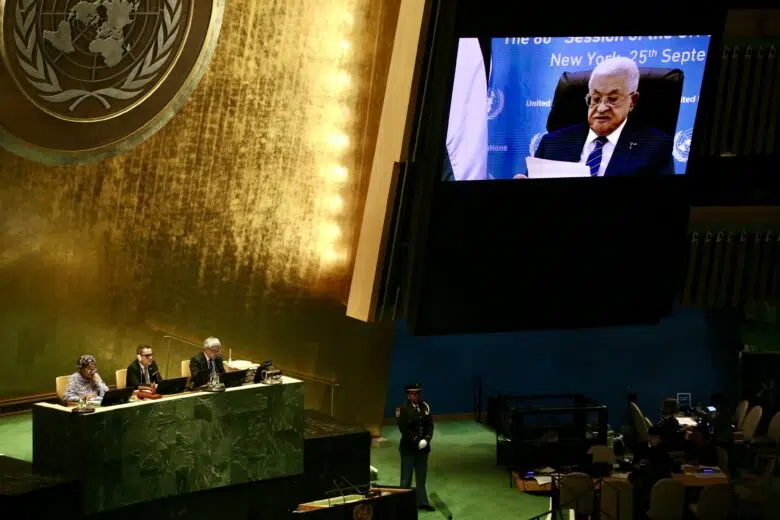
PARIS — Mahmoud Abbas, the president of the Palestinian Authority, addressed the United Nations General Assembly on Thursday. A symbol of his fragile political standing, however, he did so by videoconference from his office in Ramallah, in the West Bank, rather than from the grand hall of the glass tower in Manhattan. The Trump administration had denied him a U.S. visa — frustrating UN officials who found themselves debating Palestine in Manhattan without the participation of those most directly involved.
For the latest news & views from every corner of the world, Worldcrunch Today is the only truly international newsletter. Sign up here.
Abbas is a president full of contradictions. For two decades he has presided over the Palestinian Authority — the last remnant of the Oslo Accords — yet both his authority legitimacy are severely constrained. As Yasser Arafat’s successor at the head of the PLO, long the embodiment of Palestinian nationalism, he finds himself sidelined by Israel’s hostility to any Palestinian entity of substance and by the disillusionment of his own people, many of whom now regard him, at 89, as an aging leader who failed to safeguard their rights. On top of this, corruption persists and no elections have been held in 20 years.
And yet, Abbas remains central to the Franco-Saudi peace initiative. In fact, he is the closest thing the Palestinians have to a semblance of legitimate leadership. It may seem surprising, but the political landscape in Palestine is nearing desolation.
Fatah, the movement founded by Arafat and now led by Abbas, has been drained by 30 years of Oslo’s failures and is now locked in rivalry with Hamas, which drove it out of Gaza.
The October 7, 2023 massacre in Israel further discredited Hamas in the eyes of the international community: the Franco-Saudi framework adopted at the UN excludes the Islamist group from the elections meant to determine the new Palestinian leadership. Abbas also used his speech to strongly condemned the attack.
Lack of a better alternative
The Israeli occupation and inter-Palestinian struggles have left little room for alternative candidates. Prospective figures are either confined to civil society or imprisoned — as in the case of Mahmoud Barghouti, the most popular Palestinian leader, who has been behind bars for more than 20 years.

If the Franco-Saudi plan moves forward, Abbas could serve as a transitional figure, and he has stated that he is ready to do so. But Israel rejects the idea, while the United States remains cautious, as the visa incident clearly demonstrates.
The crisis must first come to an end before anyone can even consider who will govern the ruins.
Instead, the Americans are pursuing a different plan, floating an unexpected name to manage the “aftermath” in Gaza: that of Tony Blair, the former British prime minister. Blair has attended meetings at the White House and met with Emmanuel Macron in Paris last week. Under the American proposal, he could lead a transitional authority in Gaza, while the Palestinian Authority would be relegated to a very limited role.
This choice may seem surprising: Tony Blair was widely discredited for his support of the 2003 invasion of Iraq and later proved largely ineffective as an envoy to the Middle East. His legitimacy is virtually nonexistent.
Meanwhile, the tragedy in Gaza continues, with hundreds of thousands fleeing and dozens dying every day. For Palestinians, the war must first come to an end before anyone can seriously consider who will govern the ruins.