-OpEd-
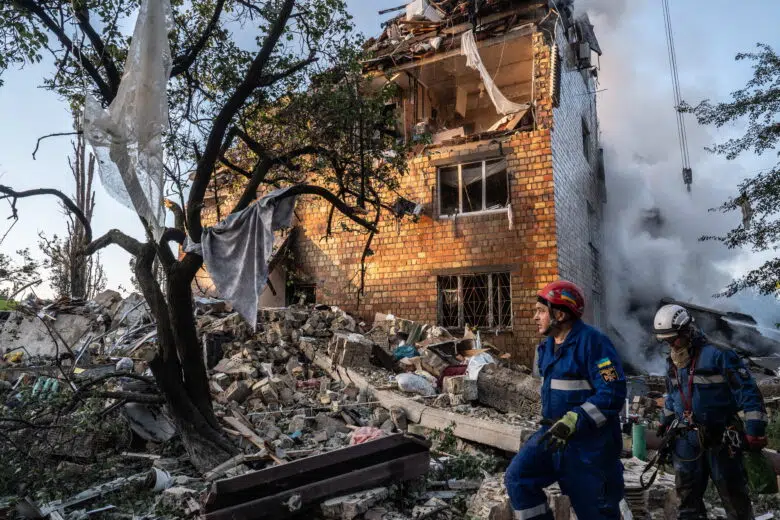
TURIN — The effect of the red carpet rolled out beneath Russian President Vladimir Putin’s feet in Alaska didn’t even last two weeks. 598 drones, 31 missiles, 19 civilians dead and dozens wounded in Kyiv: Aug. 28, 2025, is now etched as another dark date in the history of the Ukrainian capital. But this was not just another routine bombing, like the many endured by nearly every Ukrainian city over the past three and a half years. Not only because the Russian military this time defied several restrictions it had more or less respected until now, such as avoiding strikes in central Kyiv and near Western embassies, or sparing civilian trains, with the railway depot in Vinnytsa destroyed.
For the latest news & views from every corner of the world, Worldcrunch Today is the only truly international newsletter. Sign up here.
The airstrike ordered from Moscow, considered by some military commentators to be the second most serious since the invasion began, was a direct response to Western diplomacy, a rejection of peace initiatives and of the very prospect of negotiations between Russia and Ukraine.
Those drones and missiles were being prepped for launch at the very moment Donald Trump was dismissing Russian Foreign Minister Sergey Lavrov’s bellicose statements as “nonsense,” brushing them off with the comment that “everyone is talking to raise their voices.”
Imposing rationale
The U.S. president knows this game well, and in his businesslike pragmatism he likely cannot fathom that anyone would torpedo the possibility of an agreement, especially one to his own advantage, with missile fire. Yet one has only to watch Kyivans digging through the rubble in search of survivors to see the message the Kremlin is intent on sending to all those still puzzling over what is going on in Putin’s head, and what sacrificial offer might persuade him to ease his invasion.
The Russian dictator has had countless opportunities to end this war with extremely favorable terms.
A leader who “wants peace,” as Trump keeps insisting, does not bomb in the midst of negotiations. A dictator newly welcomed back onto the international stage does not launch missiles at the European Union embassy. And since the Russian Defense Ministry never fails to brag of its “high-precision” strikes, that attack could only have been deliberate. A supposed “grand master of geopolitics” does not ignore a journalist’s question, “When will you stop killing civilians?”, only to answer with missiles aimed at residential towers, while his spokesman claims they were actually “military factories.”

It is natural to try to impose some rationale on Putin, to assume there must be some calculation, however ruthless: If he is defending “Russia’s interests,” if he wants to preserve some of his reputation, if he is searching for an “exit strategy,” then surely some compromise must be offered.
No intention of stopping
The Russian dictator has had countless opportunities to end this war with extremely favorable terms. He has never taken them, because he has no intention of stopping. His economy now turns on the machinery of war, and his power feeds on the cult of war.
Beginning Sept. 1, “Important Conversations,” weekly propaganda classes, will be extended to every child from the age of 3, before they can even read. The list of recommended songs for elementary schools is made up entirely of hymns to war and victory. Anyone who dares say that Russian bombs in Kyiv hit bookstores and restaurants risks five years in prison for “discrediting the armed forces.” No one willingly relinquishes such terrifying and absolute power, nor the chance to “punish” enemies, real or imagined.
Alongside the EU mission, targeted for siding with Ukrainian President Volodymyr Zelensky, the Azerbaijani embassy in Kyiv was also struck yesterday. President Ilham Aliyev has become the Kremlin’s latest object of scorn after criticizing the Russian regime and expressing support for Ukraine. Putin will not accept a red carpet in exchange for peace. The red carpet he is looking for is the runway of the victor in war.