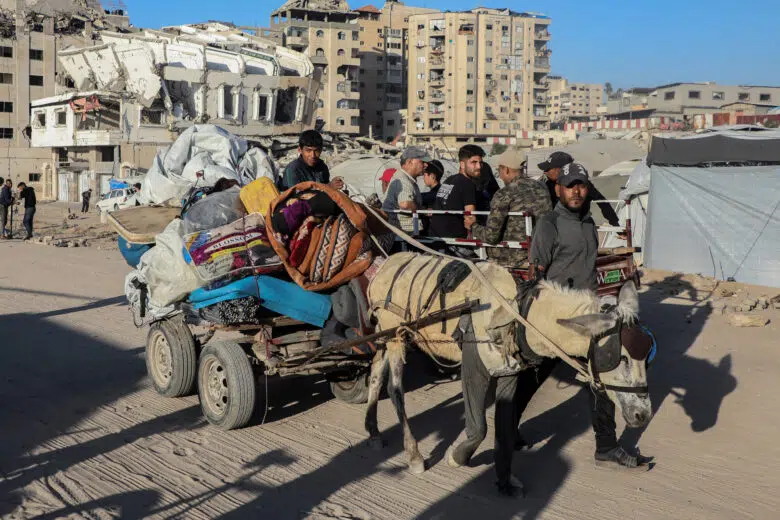
RAFAH — The area where the city would be established tells you what you need to know. It will rise on the ruins of thousands of homes in Rafah, after the Israeli army fully “cleanses” the southern Gazan city.
The area overlooks the Mediterranean, and is directly adjacent to Egypt — which means the next step could be pushing hundreds of thousands of Gaza residents into Sinai.
For the latest news & views from every corner of the world, Worldcrunch Today is the only truly international newsletter. Sign up here.
The Israeli army is believed to be poised to soon start forcing hundreds of thousands of displaced people from Gaza into Rafah. The city, which borders Egypt, is currently being emptied of residents, as the army has been stationed there since May 2024, in preparation to move them into what is being called the “humanitarian city.”
Residents of Gaza, who will be forcibly sent to this city surrounded by barbed wire and soldiers, await entry into something resembling detention camps, where they will not be allowed to leave, and will be forced to live under military rule after each individual undergoes a security screening.
Israeli Defense Minister Yoav Gallant revealed details of this city during a recent press briefing. “It is based on establishing a closed zone in the south of the Gaza Strip from scratch, during a potential 60-day truce,” he said.
“Humanitarian City”
In the first phase of the plan, the Israeli army will transfer around 600,000 displaced Palestinians to this area, with the establishment of four aid distribution centers run by international organizations — with all Gaza residents to be transferred there later, according to Gallant’s statements.
Gaza’s residents will undergo security vetting in the “humanitarian city,” to ensure they have no affiliation with Hamas, and once they enter the area, they will not be allowed to leave.
The United Nations Relief and Works Agency for Palestine Refugees (UNRWA) described the project as a “detention camp,” while Amnesty International warned that the plan amounts to a war crime.
The city — resembling the new Nazi-style camps for Palestinians — will be established in an area between the Philadelphi Corridor (the border strip adjacent to Egypt) and Morag (the boundary between the cities of Rafah and Khan Younis) in southern Gaza.
As famine spreads
On the ground, as observed by a Daraj correspondent in Gaza, Israel has set up all the conditions necessary to begin forcing Palestinians into this city, having squeezed all Rafah and Khan Yunis residents — estimated to be more than 600,000 people — into the narrow Al-Mawasi area.
At the same time, as residents of southern Gaza are squeezed into Al-Mawasi, famine has intensified, with people seen collapsing in the streets from extreme hunger. Israeli air attacks, meanwhile, continue to escalate.
All of this aims to force southern residents to go anywhere where promises of food, water, and safety are offered — even if it turns out not to be true — as they have no other option but to try to survive death, whether from hunger or Israeli airstrikes.
Daraj asked a number of hungry people in the Al-Mawasi area west of Khan Yunis about their willingness to go to Rafah’s “humanitarian city” if ordered by the Israeli army, and the responses ranged between acceptance and hesitation.
The most important lesson is to obey the Israeli army’s orders
From his displacement tent in Al-Mawasi, Mohammed Imran said he was willing to go to Rafah if ordered by the Israeli army, citing the inability to endure more bombs and killings.
“I’ve learned a lot from this war, and the most important lesson is to obey the Israeli army’s orders and not stay anywhere we’ve been asked to leave,” Imran said, speaking in a low voice. “Families that insisted on staying were killed — and to this day, they haven’t been buried and remain under the rubble.”

Tents in Sinai
Imran has no choice but to comply and search for any source of food, especially since his tent has been out of flour for more than three months, and more than 17 of his relatives have been killed in their displacement area in Al-Mawasi.
Next to Imran’s tent, Ahmed Al-Sheikh expressed hesitation about following Israeli army orders if they’re issued and residents are asked to move to Rafah.
Al-Sheikh’s hesitation stems from his belief that this step will be the beginning of forced displacement and the building of more tents inside Egypt’s Sinai — leaving Gazans there for many years without a solution.
Al-Sheikh told Daraj: “The scene has played out in front of me, and it will happen as follows: the Israeli army drops leaflets telling all the displaced in Al-Mawasi to move to Rafah,” he predicted. “Then they open up fire, and after staying in Rafah for a short period, we’ll be forced to migrate outside Gaza.”
Israel’s displacement plan will be disguised as “voluntary migration.”
Displaced resident Ahmed Sadeq said he would not hesitate to follow Israeli army orders to go to Rafah — fleeing hunger and death in the Al-Mawasi area, where killings occur daily.
Sadeq has no options except to move wherever the army directs, fearing being bombed and killed inside his displacement tent.
Systematic genocide operation
Salah Abdul Ati, head of the International Commission to Support the Palestinian People’s Rights, believes the ongoing Israeli plan aims to gather and transfer Gaza’s population into closed zones run like detention camps under the occupation army’s control — by forcing them into displacement from their original areas through systematic policies of starvation, chaos, and massacres.
Abdul Ati told “Daraj”: “What is happening is part of a systematic genocide operation, aimed at destroying what remains of buildings and civilian infrastructure in Gaza, and wiping them out completely — as happened in Rafah, which was almost entirely destroyed.”
He affirmed that this plan goes hand in hand with dismantling social structures: spreading chaos, destroying the foundations of civil peace, and supporting gangs that steal humanitarian aid. It is part of colonial control policies of exploiting the catastrophic conditions caused by genocide and starvation. Ati said that Israel’s displacement plan will be disguised as “voluntary migration,” offering financial incentives of up to $9,000 per person.