-Analysis-
BARCELONA — The far right feeds on fear, precariousness and expulsion from neighborhoods. In the midst of a housing crisis, its hate speech is finding fertile ground on social media, among young people who cannot leave home and working families trapped by impossible housing prices. This is no coincidence: It is a consequence.
For the latest news & views from every corner of the world, Worldcrunch Today is the only truly international newsletter. Sign up here.
A 26-year-old man, working part-time in the hospitality industry is unable to become independent. A single woman with two children receives an official notice from her landlord announcing a 40% rent increase. A working-class family that has run its business in the neighborhood for generations has to close because it cannot afford the rent, while tourist apartments and businesses for the wealthy flourish. None of these people have anything to do with the far right, but many are beginning to buy into its narrative.
In Spain and wider Europe, housing has become one of the major axes of inequality and democratic disaffection. And that abandonment, that lack of prospects, is becoming one of the main allies of the far right’s advance. It is not just a case of elections: It is a case of public mindset, and that mindset is being reconfigured by precariousness and dispossession.
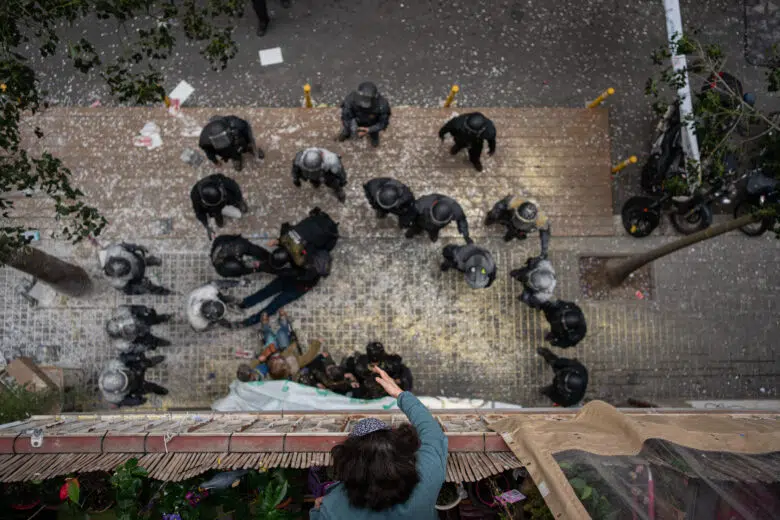
Every day, more than 90 evictions are carried out silently in Spain. Most of them are not shown on television and don’t go viral. There are no cameras, no trending topics. They are routine, almost administrative evictions. Meanwhile, videos in which an ultra-right influencer “denounces” that “outsiders receive aid and you don’t” get over 400,000 views in an afternoon. It doesn’t matter whether it’s true or not, what matters is that it fits with a shared feeling of abandonment.
The far-right discourse has not invented precarity; what it has done is learn to capitalize on it. Where institutions no longer reach, where left-wing parties have lost their grassroots presence, where unions are fading away, there is a gap, and that gap is not being filled by feminism, environmentalism or militant unionism. It is being filled by the far right.
When housing becomes a political fault line
For decades, having a roof over one’s head was synonymous with stability. Today, it is a daily battle. Access to housing has become a maze of obstacles for millions of people: skyrocketing rents, invisible evictions, investment funds buying up entire neighborhoods, banks that wash their hands of the matter and governments that legislate late and poorly or do not legislate at all.
The housing crisis is not just an economic problem: It is a democratic fracture, the tip of the iceberg. In the past 10 years, rents have risen by 55%. The minimum wage has gone up, but it is not enough to cover housing costs and fill shopping carts. Working-class neighborhoods are being devastated by gentrification and surges in tourism. In cities such as Madrid, Barcelona and Palma de Mallorca, thousands of public housing units were sold off to vulture funds that now manage them as financial assets. Meanwhile, public housing accounts for barely 2.5% of the total, while countries such as Austria and the Netherlands allocate between 30% and 40%.
The far right has not invented discontent, it has simply learned how to interpret it.
It is not just a housing crisis, it is a social divide that expels, fragments and creates precariousness. Here, those who cannot pay are evicted. Those who stay survive, and those who survive begin to ask questions. Why do I have no future? Why can’t I become independent even though I work? Why am I being kicked out of the neighborhood where I grew up? Why is no one doing anything? If no one answers, someone will take matters into their own hands.

Again, the far right has not invented discontent, it has simply learned how to interpret it. While the major parties turn their backs on the working classes, far-right rhetoric fills the void with simple, emotional, and falsely “rebellious” messages. It is useful to have someone to blame, someone who is different, poor, or a migrant, and to use identity and fear as tools to hold someone other than oneself responsible for these crises. It’s useful because it’s quick and convenient.
Algorithms of anger
On social media platforms such as X, TikTok, Instagram and YouTube, ultra-right ideology profiles connect with disenchanted, vulnerable young people who are fed up with having no future. They use memes, short videos, colloquial language and a clear narrative. The far right has understood that it does not need newspapers or debates. All it needs is a front-facing camera, a simple slogan, dramatic background music and a well-defined enemy. “The left has abandoned you.” “Immigrants receive aid, but you don’t.” “Your people are on the streets, while unaccompanied minors have apartments.” “If you leave your house, someone will squat in it.” It’s a lie, but it’s emotional. And it works!
The algorithm does not punish hate: It rewards it and turns it into a trend. It is not a neutral algorithm; it is orchestrated by CEOs and companies who benefit from this narrative. What goes viral is what angers, what simplifies, what divides. Meanwhile, progressive discourse is complex, technical, or institutional. It arrives late. It fails to excite. Instead of naming those responsible — vulture funds, banks, real estate elites — they dilute themselves in good intentions or technocracy. What should be education becomes condescension, and in this battle for the narrative, the far right is several steps ahead.
But why would a working person vote for a party that defends those who exploit them? The answer is uncomfortable: because it challenges them. It is not just a matter of manipulation; it is the result of a political and cultural defeat. The institutional left has lost its presence in neighborhoods, on the streets and in everyday life. It no longer represents or offers prospects to a large part of the working class.
It is in the community fabric that authoritarian drift can be stopped
In this vacuum, the far-right discourse enters as a magic solution. It names the discontent, even if it attributes it to false causes; it offers community, even if it is an exclusive community; it provides answers, even if they are authoritarian.
The housing crisis is not only economic, it is also a crisis of belonging, of identity, of horizon. And when there is no horizon, the person who shouts the loudest wins. Because when unrest cannot find a real cause, it looks for a scapegoat. And the far right offers it wrapped in patriotism.

In this narrative, those truly responsible do not exist. The paradox is cruel: While the far right points to the poor as enemies, those truly responsible remain in the shadows, unpunished. No one calls them by name. No one stands up to them from within the institutions. Blackstone, Cerberus, Lone Star, Apollo, Haya Real Estate, Caixabank, BBVA, Santander, La Sareb… these names don’t appear in speeches. There are no viral videos pointing to the investment funds that own tens of thousands of homes. There are no digital protests against the banks that evict people. Hatred needs visible and vulnerable targets: migrants, poor families, single women, social organizations. Anything that challenges the order becomes a threat.
Housing as the basis of democracy
But there is resistance. Often invisible, sometimes exhausted, but alive. The Platform for People Affected by Mortgages (PAH) and housing unions that organize family by family, block by block, citizens who stand at their neighbors’ doors in the face of judicial delegations and law enforcement, collectives that recover empty buildings or set up cooperatives in transfer of use. Social movements and organizations that rescue and sustain lives where the state arrives with evictions, repression, fines and no solutions. It is in the community fabric that authoritarian drift can be stopped. Not with moralizing, but with action. Not with speeches from above, but with organization from below.
Those who want to stop fascism must start by guaranteeing the most basic thing: a roof over people’s heads. But also a voice, a network, a community that does not leave anyone alone to face the algorithm. Because if we don’t occupy that space, they will. Fascism is not fought with tweets, headlines, or symbolic gestures; it is fought by guaranteeing rights. It is fought by ensuring decent work, housing, healthcare and public education, roots, and community.
The battle for housing is not only social, it is also cultural and political. It determines not only where we live, but also what kind of society we want to build. Defending the right to housing is not just a social issue: it is a democratic urgency. Because without a home, there is no citizenship. Without roots, there is no community. And without community, what remains is fear. And fear, if not transformed into dignity, turns into hatred.
To conclude, a reinterpretation of Martin Niemöller’s poem “First they came…”, a classic of anti-fascist thought:
First they came for the working families,
and we said they must have done something wrong.
Then they came for the houses,
and we thought it was someone else’s problem.
Then they came for the neighborhoods,
and we said it was because of the market.
Then they came for the youth,
and we thought they would wake up.
Then they came for democracy,
and we were already without a home, without a neighborhood, and without a voice.