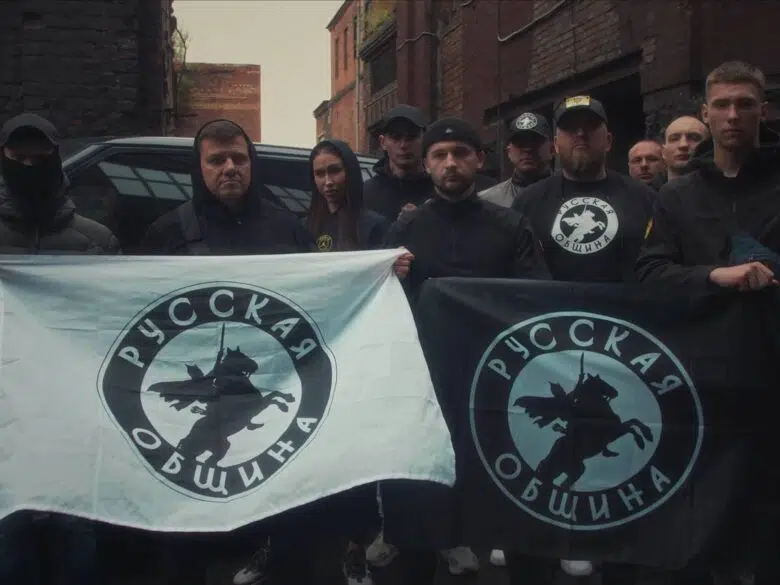
SAINT PETERSBURG – On a stage set up in a suburban park just outside of Saint Petersburg, artists in traditional costumes entertain families while pop music plays in the background. Surrounding the stage is a group of men in black — some of them equipped with guns and bulletproof vests. Many wear symbols featuring the black-and-white silhouette of the medieval prince Alexander Nevsky, emblem of Russkaya Obshchina (Russian Community), currently the largest far-right movement in Russia.
For the latest news & views from every corner of the world, Worldcrunch Today is the only truly international newsletter. Sign up here.
“I want law and order in our country,” says a man in his thirties wearing dark glasses and a black hat, who asks to stay anonymous. “Many men went to war, so Russkaya Obshchina was created to maintain order here.”
Sergey Ognerubov — the coordinator of the group — is the head of the local volunteer patrol, a structure that allows regular citizens to assist the police in maintaining public order. Ognerubov first encountered Russkaya Obshchina’s activists a year ago, when some elderly women in the district called him, concerned about masked men patrolling the area. He went to verify what was happening.
“I told them ‘we live in a state governed by the rule of law. You must respect the law if you want to do these things’,” he says. Since then, Ognerubov integrated the group in his patrol, after they all submitted an official request and underwent a trial period.
The group’s origins
Since the outbreak of the war in Ukraine, Russkaya Obshchina has acquired a more prominent role in maintaining public order, working alongside the police in street patrolling and conducting raids targeting irregular migrants. Some observers say this is due to a shortage of law enforcement agents: official data show that 50% of experienced Russian neighborhood police officers resigned in 2024. According to Russian investigative outlet Vazhnie Istorii (Important Stories), many agents quit to go to the front, where they can find much higher salaries.
Founded in 2020 by anti-abortion activist Evgeny Chesnokov, former deputy chairman of the Omsk City Council Andrey Tkachuk, and journalist Andrey Afanasyev, Russkaya Obshchina’s stated goal is to unify the “Russian people.” They use the term “russky,” which refers to ethnic Russians, instead of “rossiysky,” used to refer to the citizens of the Russian Federation.

The organization has about 150 sections scattered throughout Russia and millions of followers on social media, where it promotes “traditional values”, spreads religious and anti-abortion propaganda and collects funds for the Russian army. It also runs an app that allows users to request assistance from nearby Russkaya Obshchina members for everyday emergencies: One video published on their channels shows a mother thanking the group for finding her missing teenage son; in another video, activists chase a group of rowdy drunks out of a courtyard.
Anti-migrant sentiment
Many members consider themselves to be defenders of the “internal front” against what they perceive as a growing menace represented by Muslim migrants coming from Central Asia.
We are not nationalists, we are simply Russians
“People are afraid to go to the malls and in those neighborhoods with a higher share of migrants,” states Andrey Tkachuk, one of the co-founders of the group. “The more migrants there are, the more crimes there are.”
According to some Russkaya Obshchina members, it is not ethnicity or nationality that determines who can be part of the group, but values and the Orthodox Christian faith. “Anyone who is Russian at heart and wants to contribute is welcome,” says Sergey Zudnev, a long-bearded activist who gathers members for weekend mass.
“We are not nationalists, we are simply Russians,” says Artur, 36, a burly former hooligan active in raids against migrants, who claims to be part of the special forces of Russkaya Obshchina. “We help Russians whenever non-Russians offend them: we show up, we chat and we solve the problem.”
Following a 2024 terrorist attack carried out at the Moscow Crocus City Hall by Tajik citizens affiliated with the Islamic State, anti-migrant sentiment has grown stronger in the country, and migration laws have become harsher. Russkaya Obshchina often criticizes authorities for not doing enough on the topic.
Tkachuk, the co-founder, believes that the West is orchestrating a plan to replace the Russian population with Muslim migrants, with the help of “traitors” within the country’s élite. “They are agents of the West operating inside Russia. We know them, who they are, what they do and why they do it,” he says.
Extremist ideology
Yet Tkachuk also stresses that Russkaya Obshchina stays outside of politics. “We exclude the possibility of going against the government,” he says. “It would be against God’s will.”
For Vera Alperovich — a member of Sova Center, an organization monitoring extremism in Russia — the stated “apolitical” nature of the group is part of a secret agreement with the authorities: “They fear that they could no longer be tolerated or dismantled at any given moment.”

In practice, explains Alperovich, Russkaya Obshchina is integrating law enforcement agencies more and more, bringing a far-right ideology to these institutions: “Whenever those moved by an ideology receive an official mandate, law enforcement agencies start imposing the vision of the world of a group of nationalists — their idea of what is good and bad, fair or unfair.”
In a video published on Telegram, Evgeny Chesnokov — the group’s coordinator — invites supporters to “buy weapons and join the citizen patrols.” “We have to be ready, to coordinate and train,” he warns, against “hordes of people who want nothing to do with Russian culture.”
Clashing with institutions
Although the organization cooperates with the police, on several occasions it has appeared to be beyond government control. In May, during a Russkaya Obshchina raid in the small town of Vsevolozhsk, close to Saint Petersbourg, a fire broke out, killing a man and injuring a woman. The activists are currently listed as witnesses in the ongoing trial. In another instance, three members have been arrested for kidnapping and torturing a man in a forest.
Those who return from war suffer from psychological trauma, which manifests itself as a need to seek justice.
There have also been conflicts with some Russian ethnic minorities. Mansur Soltaev, the Commissioner for Human Rights of the Chechen Republic, which is Muslim majority, has accused the group of “inciting ethnic hatred” after some of its members allegedly stopped people with a non-Slavic appearance to ask for their documents. The assistant to Chechen leader Ramzan Kadyrov, Ahmed Dudaev, called them “Nazis” after an incident in which they allegedly detained Chechen children in a Moscow courtyard.
Ognerubov, who leads the local volunteer patrol, says he considers these to be isolated cases. “Nazism is forbidden in Russia. If they were Nazis, they would be banished immediately,” he says.
Ognerubov claims that most of the patrol’s new recruits come from Russkaya Obshchina, and he foresees a wave of new arrivals once the war in Ukraine will be over, when the veterans will return home. “Those who return from war suffer from psychological trauma, which manifests itself as a need to seek justice,” he says. “The patrols will give them this opportunity.”
In a video sent from the front line, a soldier wearing a mask with a Russkaya Obshchina flag behind him sends a greeting home: “Brothers and sisters, once we have finished fighting here, we will return and continue to restore order in our hometown, Saint Petersburg. Glory to Russia!”

