
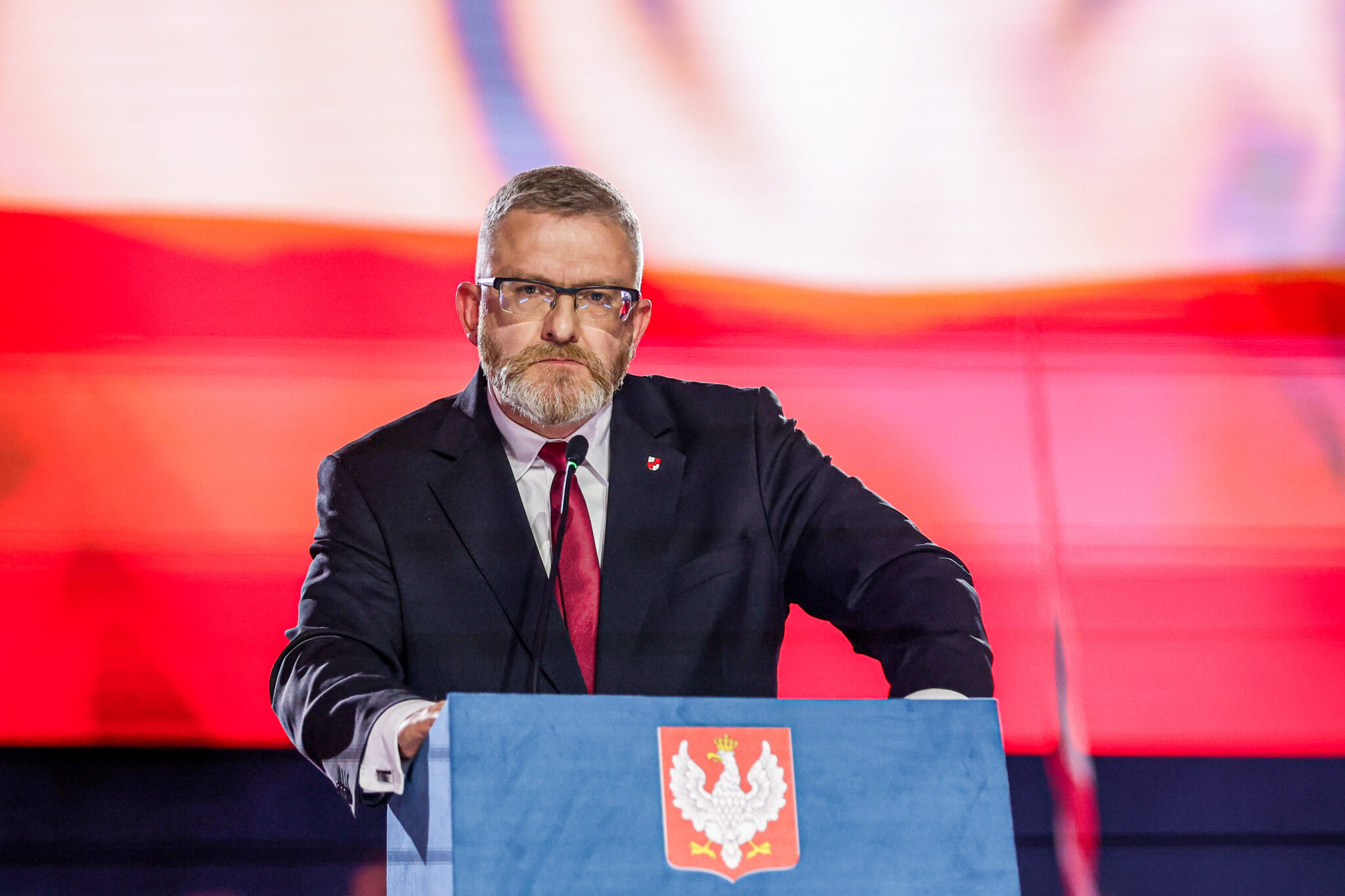
WARSAW — At the beginning of the year, Grzegorz Braun and his Crown party parted ways with their fellow far-right Confederation party, which wound up finishing third in this year’s presidential elections. The main reason? Confederation had already chosen a presidential candidate, TikTok star Sławomir Mentzen. And Braun also wanted to run for president.
The split was politically beneficial for Confederation, which like many far-right parties in Europe, wanted to shed its more “extreme” image and appeal to a wider audience. Without extreme figures like Braun, whose presence the party was already trying to justify, the party was able to focus on their laissez-faire economic approach while simultaneously arguing that Braun and his supporters were “too much” for them.
Thus, Confederation began to appeal to not only the hard right but also the center, and Braun attracted the most radical right. Although he seemed to be politically insignificant at first, his influence only continued to grow.
Braun’s campaign, mired with scandals and outcry, much like the rest of his political career, was nevertheless relatively successful. His campaign logo was a fire extinguisher, explicitly referencing a 2023 incident where Braun extinguished a menorah during a Hanukkah celebration in the Sejm, the lower house of the Polish parliament.
Yet he and his party were by no means marginalized. In the first round of this year’s presidential elections, which took place in May, Braun won 6.34% of the vote, finishing fourth — the biggest surprise of the first round.
And since then, Braun’s party has been further rising in the polls. In one poll, conducted in mid-June, it had 6.9% support, ranking fourth among all the parties listed — after Prime Minister Donald Tusk’s center-right Civic Coalition, the right-wing Law and Justice (PiS), and Confederation.
For his part, Braun is very pleased with his election result and reiterates that it was so good that “some people were surprised.” Although he also admits that “the fire extinguishing front isn’t yet as broad as he would like.”
Family picnics, youth groups
After its surprising result in the presidential elections, Braun’s party is focusing on expanding its structures. On social media, it’s appealing to supporters to join the party. It’s building new districts. It’s appealing for donations to the party account. It’s organizing “family picnics with Braun’s team.” Finally, it’s enrolling new members in its youth group, the Young Crown.
The party has also made its first political transfers. MP Sławomir Zawiślak joined the party, leaving the Law and Justice party (PiS), allowing it to form a three-person parliamentary group.
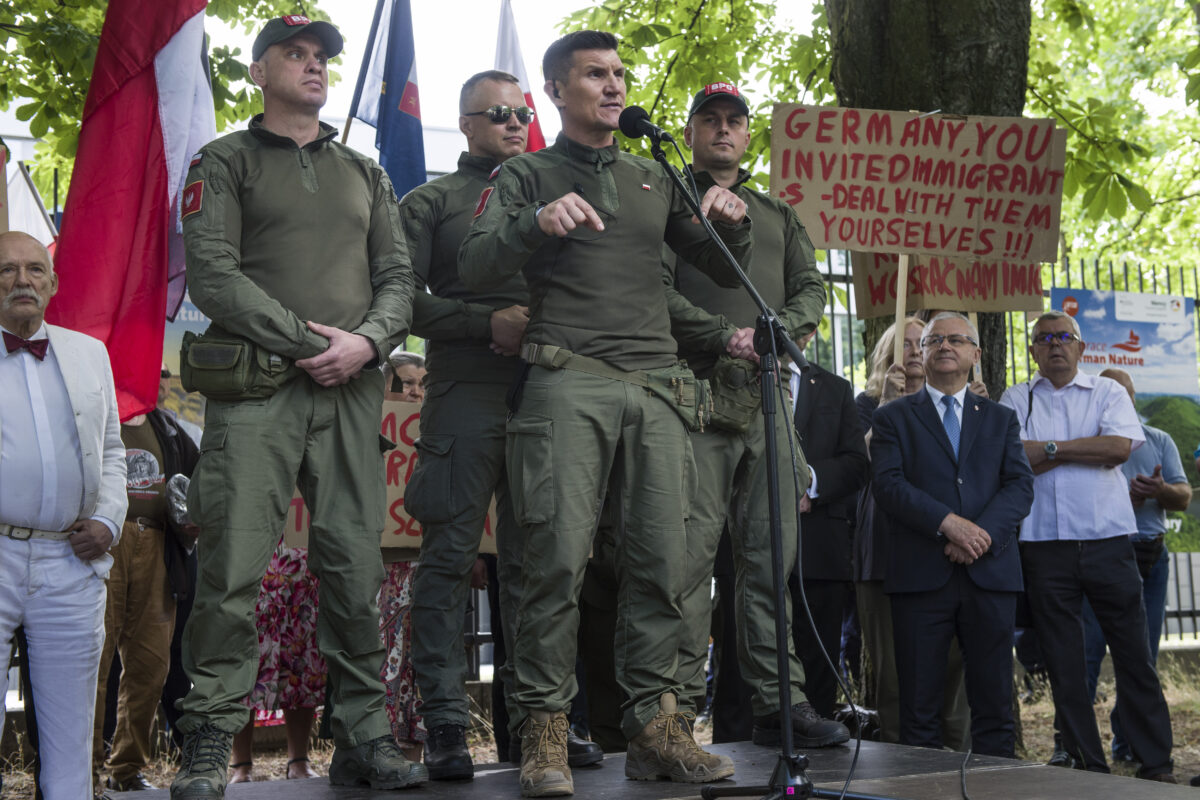
During a June meeting with far-right activists, Braun said that his party “is no longer an informal club but a political party, a tool for gaining and maintaining power.” He argued that it is necessary to move from the level of “anti-system” to the level of professional politics. The plan is to increase its holdings in the Sejm and perhaps tip the scales after the elections.
Worldcrunch 🗞 Extra!
Know more • Grzegorz Braun’s controversial politics have drawn widespread criticism and could lead to potential legal consequences: On July 14, Polish prosecutors opened a criminal investigation after he described the gas chambers at the Auschwitz death camp as a “fake.” Speaking to Poland’s Wnet radio on July 10, Braun, who is a Member of European Parliament, said that “ritual murder is a fact, and such a thing as Auschwitz with its gas chambers is unfortunately a fake,” news agency PAP reported. The reporter then ended the interview.
According to the prosecutor’s office, Braun denied — “in public and contrary to established facts” — the genocide the Nazis carried out at Auschwitz; Holocaust denial is a crime in Poland, punishable by up to three years in prison. The decision to launch the probe followed formal complaints from several public institutions and figures, including the Auschwitz Museum. Prime Minister Donald Tusk described Braun’s words as “a disgrace.” — Katarzyna Skiba (read more about the Worldcrunch method here)
In the context of the next parliamentary elections, Braun argued that “we need to roll up our sleeves for the next battle” and that “we need to multiply all the efforts we’ve made so far.” “The point is for us to have larger parliamentary representation. Parliamentary elections, then local elections, then the euro. We have to be ready for all of this,” Braun told his activists.
At the end of June, the Crown party held a congress, which passed a resolution allowing it to run independently in the 2027 parliamentary elections. But at the same time, Braun openly stated that the party is already considering post-election scenarios.
“The party leadership does not rule out entering into various operational dialogues and political alliances. This resolution does not rule out cooperation, collaboration, even coalitions. However, the entire reality must first become reality through the election process that lies before us. We must allow ourselves to be weighed and measured,” Braun explained.
He argued: “Whenever these elections take place, whether in two quarters or two years, as the calendar predicts, let’s face them with the best possible attitude. The best is yet to come. We are strong, united, and ready.”
Divisions on the far-right
For now, Braun and his party are trying to present themselves as the true “ideological right” — in contrast with Mentzen’s ideologically devoid Confederation. It argues that Poles must fight for the “security” of their identity. Like PiS and Confederation, it uses anti-immigrant slogans and highlights the situation on the “porous Polish-German border.” Its activists, like Confederation supporters, informally “police” the border. The party talks extensively about Ukraine and the denial of benefits to Ukrainians in Poland.
Supporters of both far-right parties argue over which immigrants should be allowed to come to Poland. Braun’s party doesn’t want migrants at all. But Confederation MEP Ewa Zajączkowska-Hernik says that Poland needs foreign workers and has nothing against “the intellectual elite coming to us and building our prosperity with us.” Braun’s supporters criticize her for this and label her a member of the “Civic Platform-PiS” duopoly.
On July 3, the prosecutor’s office brought amended charges against Braun, including for extinguishing Hanukkah candles in the Sejm building in December 2023. The charges cover a total of seven offenses. In early May, the District Prosecutor’s Office in Warsaw received consent from the European Parliament to prosecute Braun.