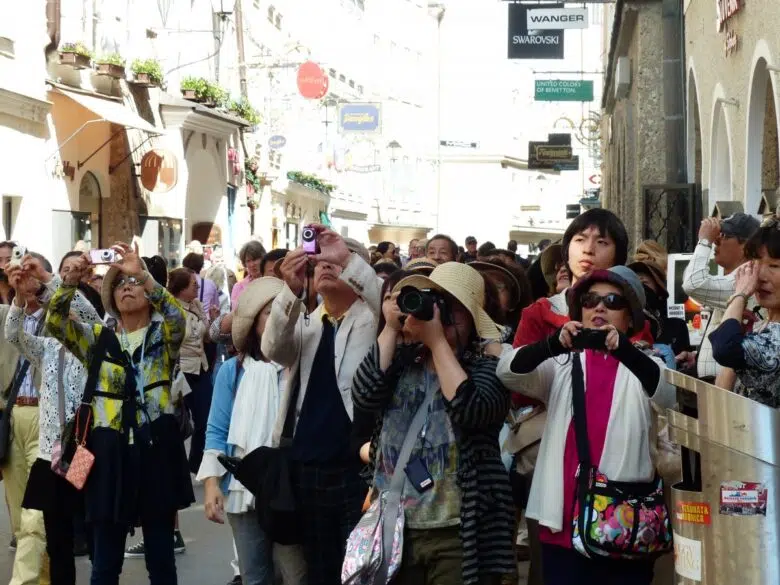
PARIS — Things look very different now from the France that Hirotaka Imanishi once knew. This lively Japanese executive headed the Paris branch of Nippon Travel Agency (NTA) — one of Japan’s largest tour operators — during the golden years of 2012 to 2016, when France was at the height of its appeal among Japanese travelers. “At the time, they still came in organized groups, through agencies like ours,” he recalls with a touch of nostalgia.
For the latest news & views from every corner of the world, Worldcrunch Today is the only truly international newsletter. Sign up here.
Back in Paris, he now has to resort to creativity to attract customers in a radically different context. “After the COVID episode, the Japanese are hesitant to leave Japan,” he worries. His competitors and colleagues around the world concur — seeing this as the end of the golden age for Japanese tourism.
Travel agents, guides, hoteliers, and taxi drivers around the world agree on one thing: Japanese tourists are becoming scarce. This clientele, once highly prized for its courtesy, purchasing power, curiosity and loyalty, has deserted the world’s tourist hotspots. Ten years ago, tourists were the symbol of the archipelago’s integration into globalization, transported by bus as they were from one point of interest to another, in between meals. Between 1973 and 2019, the number of Japanese citizens travelling abroad rose from 2.2 million to 20.1 million; in 2024, that number had fallen to just 13 million. Other figures point to the same downward trend. According to the Ministry of Foreign Affairs, only 17% of Japanese citizens now have a passport.
Japanese customers are facing “headwinds” that discourage them from traveling abroad. The COVID period, during which their government adopted a very strict border control policy, has left a lasting impression. Global crises (war in Ukraine, Gaza, etc.) have fuelled their reluctance to engage with the rest of the world, explains one tour operator. “When I was young, I was very drawn to foreign countries. But the younger generation is no longer like that; they have so many opportunities to experience things virtually that they don’t feel the need to cross borders,” says Hirotaka Imanishi sadly.

A consolation for the economy is that Japanese citizens are spending their disposable income at home, on trips within Japan or on other items (luxury goods, restaurants), boosting the domestic market. When they do venture abroad, it is to neighboring Asian countries (Thailand, South Korea, Taiwan, etc.), where they retain relatively high purchasing power, even if it is declining. Faraway destinations, on the other hand, are being neglected.
The weakening of the yen, which is at its lowest level against the dollar and the euro since the late 1960s, combined with 25 years of deflation (in Japan) and inflation (in the West), has produced a “scissor effect” that is strangling Japanese tourists. “I remember my student life in Paris 30 years ago; I felt so rich! Now, it is foreign tourists who are rich in our country,” laments Yuko, a French-speaking Japanese executive.
While Japanese tourists are withdrawing from the world, in a stunning reversal of fortunes, foreign tourists are flooding into Japan. The curves of the two migrations intersected for the first and last time in 2015. Since then, the gap has widened: there have been three times more (foreign) tourist arrivals in Japan than (Japanese) departures: 13 million versus 37 million. “A few years ago, the proportion of locals to foreigners was 40/60; now, it’s 86/14 for us,” explains the co-director of the Kansai Airports complex (Osaka region), Benoît Rulleau.
For the first time ever, more French tourists visited Japan than Japanese tourists visited France.
As a result, foreign and Japanese tourist flows now mix on Japanese soil: behind the “overtourism” talked about daily by the local media, there is also the invisible pressure of Japanese visitors. In 2024, Kyoto welcomed 11 million foreign travellers… but 45 million Japanese visitors.

60% drop in overnight stays in France
France is particularly affected by this decline in Japanese tourism. It remains the leading destination in Europe, according to Atout France, the agency promoting France as a tourist destination. The agency is constantly shining the spotlight on new French regions and new themes, but there is only so much it can do. In 2019, Atout France counted 600,000 Japanese stays in France. Since then, it has stopped reporting figures, citing the difficulty of collecting such data. However, it does publish an estimate of the economic importance of Japanese tourists, which is currently valued at 618 million euros.
Paris Je t’aime, the Paris tourism office, publishes very precise monthly figures on Japanese hotel stays: between 2014, at their peak, and 2024, the latter fell from 628,149 to 255,095, a 60% decrease. With 380,000 French arrivals recorded in Japan in 2024, it is likely that, for the first time ever, more French tourists visited Japan than Japanese tourists visited France.