

-Analysis-
ROME — “If you see this video, it means I have been detained or arrested by Israeli forces against my will.”
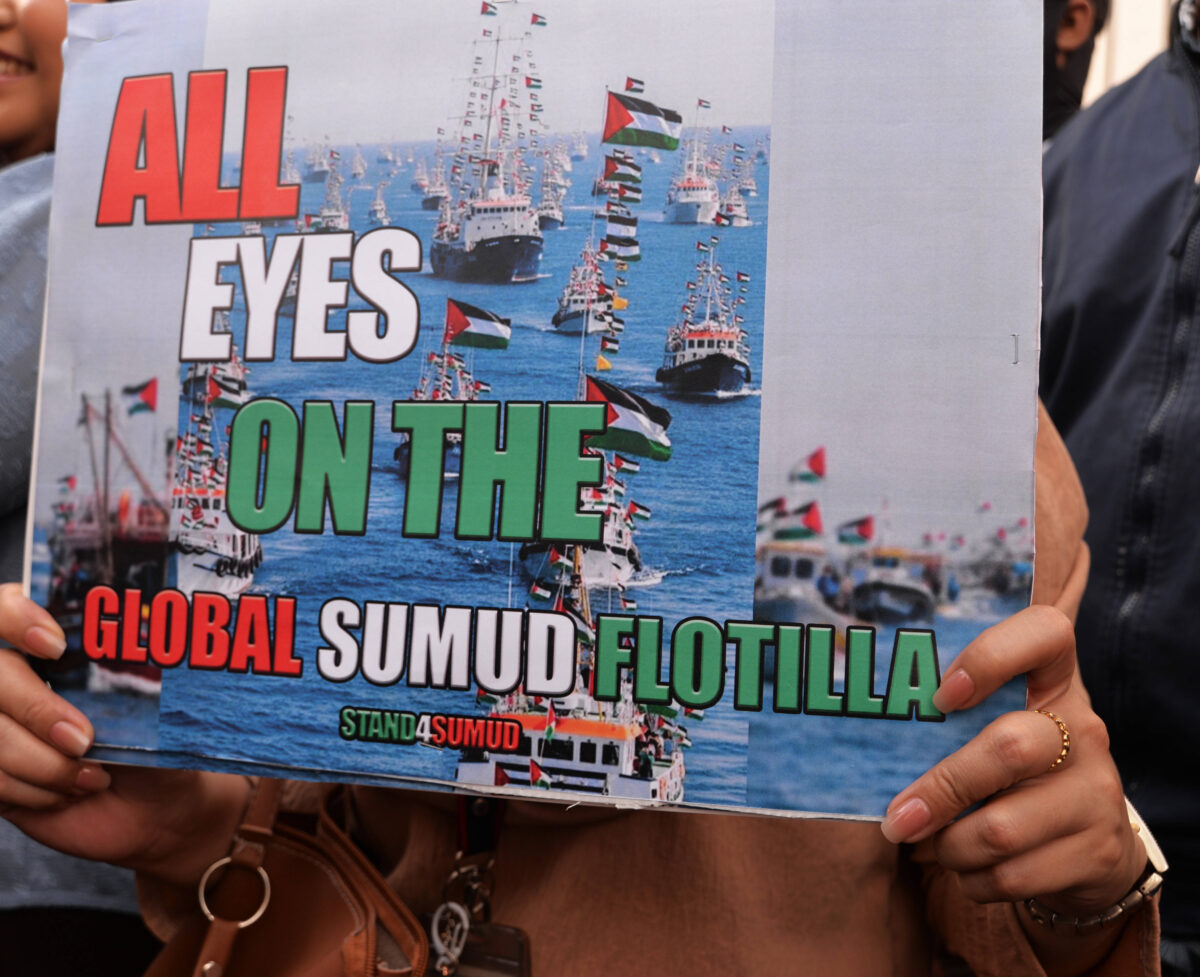
The same sentence was uttered in Spanish, Polish, Portuguese, Swedish, Arabic, and English by different faces: boys, girls, men, women — who on Wednesday, at around 10 p.m., delivered the Global Sumud Flotilla‘s message to half the world via social media.
Are these, then, the closing credits of the open-air film that has been broadcast in recent weeks, keeping the public and governments around the world in suspense?
No, the Flotilla’s exploits don’t end here, judging by the public outcry that accompanied the hours in which the crews were intercepted by the Israelis and taken to the port of Ashdod, 40 kilometers south of Tel Aviv.
Peace and provocation
Never before have so many private sea vessels been in the spotlight, and given the particularly delicate situation — with a peace plan hanging on tenuous hopes, and a cascade of ultimatums waiting to expire — any excesses and abuses by Israel, even in the coming days, could backfire. The activists know this, promising peace, but it’s not out of the question that some provocations deviate from the Gandhian line envisaged in the rules of engagement.
The humanitarian tragedy in Gaza is a political fact, and a humanitarian response is therefore political.
The foreign ministers of major European countries have mobilized to ensure no incidents occur. One can imagine the arguments they presented at meetings with Israeli authorities, from requests for leniency towards the mostly young (and some elderly) passengers to warnings of reputational damage. There’s no denying it: in the widening Middle Eastern crisis that began on October 7, there is a before-and-after Flotilla, at least as far as public opinion’s perception of this war is concerned.
Was it a humanitarian mission or a political one? And which of the two missions can be considered the greater failure? This seems to be the debate at the dawn of what will be remembered among the most spectacular activist demonstrations of recent times.
Not just an adventure
The distinction is both specious and insufficient to convey the meaning of what happened. Indeed, the Flotilla’s novelty was precisely that it merged the two motivations to the point of making them indistinguishable: the humanitarian tragedy in Gaza is a political fact, and a humanitarian response is therefore political. The fact that no government has made a similar connection — “a humanitarian disaster is unfolding, therefore initiatives must be taken to stop it” — sadly says a lot more about the fragility of governments than the Flotilla’s motivations.
The route exists, change is possible.
So it wasn’t just an adventure, as those who have focused on the “futurist” aspects of the undertaking would have it. Some have even evoked Winston Churchill’s Operation Dynamo to evacuate Dunkirk.
From today, the prospect of opening a humanitarian channel to bring aid to the tormented population of Gaza has gained ground in terms of reality: the route exists, change is possible, and continuing to keep our eyes closed is now much more difficult — and a tragic embarrassment.