-Essay-
There is something undeniably magnetic about intercultural relationships. I haven’t quite been able to pin down what it is, but they’ve always inspired immense curiosity. Some see them as exotic, others as poetic. They are often linked to joy, vitality, and adventure. Yet these impressions are largely superficial. The deeper emotional labor required to sustain an intercultural relationship is rarely visible on social media or in conversations about diversity.
For the latest news & views from every corner of the world, Worldcrunch Today is the only truly international newsletter. Sign up here.
As a Latina who recently married an Indian man, I can say with certainty that love alone has not been enough. We have had to work hard to bridge two very different worlds. Doing so has required patience — essential to understanding each other’s ways of thinking; courage to weather the emotional storms that arise from time to time; inner work to accept our choices and act with clarity; and, above all, an unwavering commitment to the relationship.
I came to that realization on the day of our first wedding ceremony in India this past April. As the stifling heat crept under my skirt, my nervous smile gave way to a tear I barely managed to hold back, my eyes locked on those of my husband-to-be.
His gaze spoke not only of the deep and beautiful love he feels for me, but also of a quiet relief only someone who has waited so long can know. And it was no wonder: after so much effort, we were finally recognized as a couple in the eyes of the world. Sam and I had fallen in love in Argentina, in the middle of the pandemic, uncertain if we would make it through.
Falling in love and taking risks
His nearly two-meter height caught my attention, but it was his calm presence, thoughtful ideas, and humor that truly drew me in. Despite our differences, we always found ways to connect, and I knew he was the one when I felt equally loved and admired.
We hadn’t even been together a year when we decided to move to Canada. It was a risky choice, but after living through a pandemic, I had learned not to postpone my dreams. One of them was to start a family.
Our relationship was public to my circle and secret to his.
I soon came to understand that in his culture, it is not customary to “introduce your girlfriend to the family,” as we tend to do in Latin America. Our relationship was public to my circle and secret to his. Talking to other people from India, I learned that hiding me was not synonymous with running away from commitment; most likely, he was avoiding an argument with his family that would put him in an even more vulnerable position.

On a personal level, things were going very well. We lived with our dog Casilda in a cozy Toronto apartment, surrounded by friends who offered guidance on work and life, supporting the dream we never stopped talking about: expanding our family. One of the things that ultimately convinced me to choose Sam as my partner was that he wasn’t afraid of fatherhood.
But our conversations rarely translated into concrete plans. As a woman over thirty, the pressure of the so-called biological clock was weighing heavily. It was no longer enough for him to say he wanted to be a father “someday”; I needed to see action toward that dream. Yet something in him was holding everything back, and it affected me profoundly.
Each period reminded me another month had passed. Every social media post on the topic tightened my chest, and even witnessing friends get married and become mothers stirred a mix of joy and frustration. I began to feel an urgency that went beyond emotion — physical, concrete, hormonal. I was trapped in a lull that wasn’t mine, and I needed to move forward to satisfy it.
I had to be firm, and together we took the first step in the form of my first trip to India.
Cultural expectations and family pressure
In his culture, arranged marriages remain a valid and common practice. He had already told me how some women’s “resumes” had passed through his mother’s hands, and I had familiarized myself with the topic by watching Indian Matchmaker on Netflix and following related content on social media. In his family, no one had ever had a romantic relationship with someone from outside the culture; it was considered inappropriate.
I thought introducing me to his family would ease the pressure from his environment — a way to let them know I existed and to begin preparing for a wedding. But the day before my arrival, everything he had kept quiet for three years finally came to the surface. The situation became even more complicated when I arrived, suitcases in hand, at his mother’s house. Amid glances filled with surprise and the inevitable cultural clashes, he finally told his family that I was his girlfriend.
Navigating that world for the first time was challenging. I didn’t understand the language, and the customs were so different that I remained on constant alert. It was equally difficult for his family to come to terms with the leap their eldest son wanted to take — in India, you only introduce the person you intend to marry.
Emotional labor
When we returned from the trip, all the discomfort, strangeness, and anxiety we had experienced led us to try couples therapy. That first encounter had uncovered wounds and issues we hadn’t anticipated. In each session, misunderstandings and differences surfaced, but so did our shared desire to build a family. It was strange to me — I already felt we were a family — but I came to understand that Sam didn’t see it that way.
He struggled under the weight of expectations and pressure.
I soon came to understand the weight he was carrying: the social, family, and cultural pressure to prove that his happiness could lie with a foreigner. I realized that his sense of security meant that he could only see us as a family after marriage. For that reason, even though all the conditions were already in place for me to pursue our dream, for him we still had to “take the plunge,” as we say in Latin America — get married.
Our therapist guided us step by step, celebrating our victories and supporting us through the gray days. My periods and social media triggers continued to affect me, but at least I could see a plan gradually taking shape. I also witnessed how he struggled under the weight of expectations and pressure.
It wasn’t easy. There were days of tears and shouting, of frustration and the urge to give up. Yet we always returned to what united us: our plan to build a family and our deep desire to be together.
The timeline we had set at the start didn’t unfold as planned, and many days left me breaking down inside. When I reached my limit, I told him. Under a New Year’s Eve sky lit with fireworks, Sam knelt and asked me to marry him — and to step into the next stage of our life together.
Celebration, reflection, and new beginnings
We were only engaged for a few months. The urgency that had always been present pushed us to plan everything for the first half of the year. Days before traveling to India for our wedding celebration, we quietly got married in Toronto. It was a small ceremony — just the two of us, two witnesses, and a party with close friends to mark the occasion.
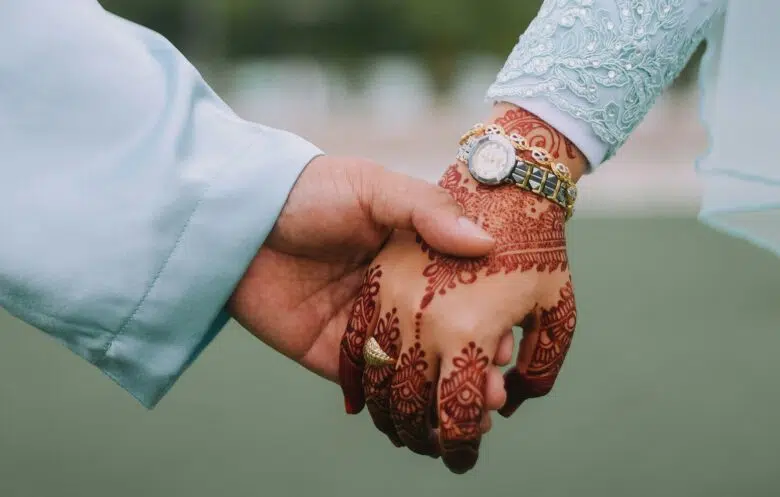
I arrived in India with high expectations and a touch of anxiety. In that culture, marriage is one of life’s most significant ceremonies. Families often save for years to host grand celebrations — multi-day events filled with color, music, and gatherings of extended family, all coming together to celebrate.
But I never dreamed of a big wedding, I never even imagined myself in a white dress when I thought about my future. I had to come to terms with the idea of having a lavish wedding and not sharing it with my circle of friends because we were doing it on short notice and in a remote location. I had to negotiate some things, but for the most part I just went with the flow. And that was harder than I ever thought it would be. In my culture, weddings are done by and for brides, and I was immersed in a wedding that someone else had planned for me and that I didn’t understand at all.
At the end of the first ceremony, with the rings already on our fingers, I broke down before I could recite the speech I had written with all the love in the world. And I cried my eyes out, draining all the pressure I had felt for so many months, letting go of all the frustration and feeling, in contrast, a deep gratitude for being there, with my family, my best friends, and the love of my life.
I embraced the idea that I will probably never fully understand many things about him.
That night, in the midst of my second crying fit, I remembered the shining eyes of my love when we exchanged rings. I remembered his feeling of relief, freedom, and lightness. And I wanted to adopt that feeling, I wanted him to convey it to me in those long hugs. But only sleep calmed me down.
Days later, alone on a plane to Toronto, I began to write about everything we had experienced. And I wondered if it had been too much, if I had suffered too much… But that feeling of peace that his eyes conveyed when we exchanged rings came back to me, and I knew that all the pressure was over, that we had already won the battle, and that from then on, it was us against the world.
So I embraced the idea that I will probably never fully understand many things about him; that I may feel uncomfortable again in the future; that I may have to let go of things and expectations. But I also opened myself up to the future we dream of together. Because, even though it has been so difficult, here we are. And we are together.