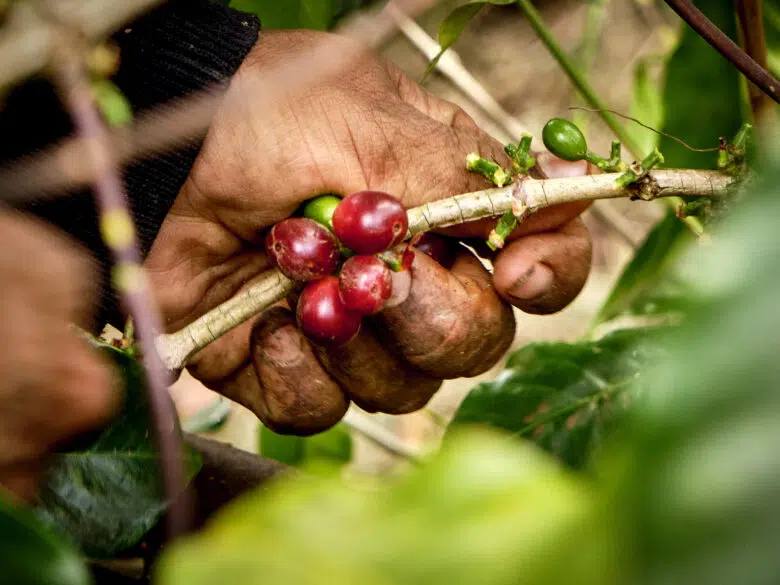
SAN JOSE — John Jairo Guerrero Brenes was about 15 or 16 years old when he arrived in Costa Rica with his family to harvest coffee. He used to live in Nueva Guinea, a municipality in the southern Caribbean region of Nicaragua, and traveled more than 300 kilometers to settle on a mountain near a volcano in a country he didn’t know. Ten years have passed. Now he is 26 and in charge of the greenhouse at La Hilda farm, located in San Pedro de Poás, Alajuela.
For the latest news & views from every corner of the world, Worldcrunch Today is the only truly international newsletter. Sign up here.
It is May 2025. Harvest time ended months ago, and now there is a standstill until September. The farm is quiet, silent, damp from the rain. If I had come in January, they tell me, there would be more than 300 people here. This time of year there are about 33, “the regulars.”
John Jairo is one of “the regulars.” Every day he gets up at 4 a.m., before the sun rises. After breakfast, he prepares water, food and everything else he needs to work in the fields; because once he is there, he will not return home until 1 p.m., when he finishes. At 5 a.m., he arrives at the warehouse, where he receives instructions on what he will do that day. At 6 a.m., he starts work: weeding, applying herbicide or spraying fertilizer. Around 10 a.m., he has lunch. This is his routine from Monday to Saturday, a kind of ritual.
“It’s different during harvest season,” he says. “I haven’t picked coffee in three years, but I do help with the measurement — counting the total amount of coffee picked daily by each person. We can finish at 7 or 8 p.m., and they pay overtime. It’s tiring, but it’s good because you earn more.”
Jairo is one of more than 45,000 Nicaraguan migrants who support the coffee harvest in Costa Rica. According to official data, they represent more than 60% of the workforce in the sector, which, according to reports from the Costa Rican Coffee Institute (ICAFE), generated more than $350 million in foreign exchange for the country between 2022 and 2023. This figure represents 2% of total national exports and 9.6% of foreign exchange earned by the agricultural sector, which also includes fishing.
Like Jairo, entire families from inland Nicaragua have left their country, where they see no future, to cross the border with the promise of finding something better for their children. Upon arriving in Costa Rica, they face the reality of the coffee industry: demanding work sometimes done under the sun, sometimes in the rain, with generally precarious wages and living conditions, which Costa Ricans do not want to endure. Their rights are often violated. But returning to a country that is falling apart is not an option either.
An exceptional coffee farm
La Hilda Farm, on the slopes of the Poás Volcano, is owned by the Vargas family and is part of the Santa Eduviges Group. It covers an area of approximately 450 hectares, making it one of the largest coffee farms in Costa Rica.
Agricultural engineer Daniel Ramírez Valerio, agricultural director of La Hilda, arrived at the farm in August 2024, less than a year ago. He prides himself on having a good relationship with the workers. “I’m not the kind of boss who’s going to yell at them. There’s open communication.”
“There are about 33 permanent workers, and about 22 are Nicaraguan migrants,” he says. “At harvest time, we have around 300 to 350 people. Of those, 95% are migrants. Their work is extremely important. That’s where the farm’s income comes from.”

Indeed, like Jairo, most coffee workers in La Hilda and the rest of the country are migrants— although there are also indigenous populations from the southern border on other farms— many of them Nicaraguans who came to Costa Rica in search of a better life. Ingrid Brenes, 24, Jairo’s sister, and Marisela del Carmen González, 28, are among these migrants. Although each has two young children, they both wake up around 4 a.m. to go to work.
During harvest time, Brenes is in charge of the nursery. The rest of the time, like now, she works as a mower. At 5:30 a.m., she is at the warehouse to pick up her tools and go to the field. The work is hard, especially when rain surprises them in the middle of the forest. “Sometimes we are far away and have to wait out the rain there. If a storm with lightning is expected, they send us back because it is very dangerous, especially with the machinery we walk with.”
Del Carmen Gonzalez, who comes from Muelle de los Bueyes, on Nicaragua’s southern Caribbean coast, agrees that it is not an easy job. “It’s hard work during harvest season. This year, I was given the opportunity to be a cutter. That means I’m one of the people in charge of telling the pickers which rows they have to work on. On harvest days, we leave late, at 6 p.m.” Yet both Brenes and del Carmen Gonzalez agree that returning to Nicaragua is not an option.
There are farms that take advantage of people.
“I went back about two years ago to show my children,” Brenes says. “I came back feeling crazy. There was food, but not in the afternoon, especially where we live, which is a rural area. I didn’t want to be there anymore.”
“It’s a privilege to work here,” del Carmen Gonzalez says. “During harvest season, they give us a fixed salary that is quite good.”
Indeed, compared to other farms in the country, La Hilda has exceptional characteristics in terms of wages, working conditions, and living conditions. According to the Ministry of Labor and Social Security (MTSS), in 2025 the minimum wage in Costa Rica for an unskilled worker is 367,000 colones ($734), and the coffee basket must be paid at 1,165 colones ($2.3). This year, La Hilda paid 1,500 colones per basket, almost a dollar more than the minimum price set.
“The salary is good,” Jairo says. “Here we are at 2,000 colones (about $4) per hour and 3,000 colones for overtime.” He says that all migrant workers who are permanent employees live in assigned spaces on the farm. He, for example, lives in a four-room house that he shares with his brothers and, sometimes, with his mom when she comes to visit. They only have to pay for electricity.
“Most of the workers have good houses. If a house is in poor condition and a worker asks the administrator to send someone from the workshop to check it out, they don’t charge us. For the pickers, there are dormitories with bunk beds. It’s more complicated for them because they take in 15 or 20 people, so they have to make do.”
Ramírez Valerio mentions other basic working conditions offered there: social security payments, accident insurance through the National Insurance Institute (INS), and a daycare center for children — one of the few on a coffee farm in the country. “In terms of conditions, I think we’re doing well. Insurance has been very important. Someone who catches a cold or twists their ankle can get treatment at the Costa Rican Social Security Fund (a network of public hospitals),” La Hilda’s agricultural director says.
The more common scenario
Yet this is not the situation of most migrants who work in Costa Rica’s coffee industry. According to Coffee Watch, a non-profit organization that acts as a watchdog for the global coffee sector, coffee workers in Costa Rica and around the world are affected by extreme poverty.
Coffee Watch Founder and Director Etelle Higonnet says that in Costa Rica, a coffee-producing country recognized for its efforts in rural development, an estimated 25% of coffee farmers live below the extreme poverty line. “We know that most Costa Rican coffee farm workers earn much less than what the Global Living Wage Coalition (GLWC) recommends for a rural worker, which is $928 per month,” she says.

This is something Jairo knows well. The La Hilda worker explains that the common scenario on other farms is that employers do not pay health insurance, do not offer housing, and that wages are very low.
“There are farms that take advantage of people,” he says. “At one where I worked previously, they paid 1,300 colones an hour and you had to leave 300 as a deposit, as if to tie the worker down. If you left before the harvest season was over, you lost all that money.”
According to several inquiries by Distintas Latitudes, there is currently no trade union organization in the coffee sector to defend the rights and interests of its workers, including migrants. And in general, migrants cannot hold leadership positions in trade union organizations. Article 60 of the Constitution expressly prohibits “foreigners from exercising leadership or authority in trade unions.” Meanwhile, Article 345 of the Labor Code states that on trade union boards of directors, “members must be Costa Rican or foreigners married to a Costa Rican and have at least five years of permanent residence in the country.”
I don’t feel that there are conditions for undocumented migrants to claim their rights.
According to lawyer Obeth Morales Barquero, secretary of education for the National Union of Agroindustry and Related Workers (SINATRAA), “it’s a very clever move, because it prevents class unity. This means that in a sector such as coffee, where most workers are migrants, they cannot organize.” He adds that “the system has designed a perfect mechanism, tailored to its needs, to protect the employer.”
On the other hand, Jouseth Chaves Rodríguez, general secretary of the Private Sector Workers’ Union (SITRASEP), points out that migrants can join existing unions, although in practice few do so for fear of reprisals based on their legal status, among other factors. “I don’t feel that there are conditions for undocumented migrants to claim their rights. It’s part of this business model of exploitation and ensuring maximum profits by keeping people without rights,” he says.
Regarding working conditions in the sector, Morales Barquero adds that there is no systematic inspection by the Costa Rican government on coffee farms, which makes it difficult to file complaints. “It is almost impossible for a migrant who is unfamiliar with our legislation to file a complaint about the working conditions they suffer.”
At the time of writing, the MTSS had not responded to a request for information related to complaints from coffee workers.
Furthermore, coffee farms generally do not have an Occupational Health and Safety Council, which leaves workers more vulnerable, Morales Barquero says. The Council establishes that employers must comply with specific standards for hygiene, health and risk prevention, as well as maintain records and statistics on occupational illnesses and accidents. Its absence in the agroindustry can lead to a lack of control and transparency regarding these conditions.
The scourge of child labor
In 2025, child labor remains a reality in Costa Rica. The agricultural sector, including coffee farming, is one of the most affected by this scourge. In Costa Rica, the law completely prohibits employing children under the age of 12 for any type of work. The Labor Code states that minors aged 15 and over are allowed to do light and occasional work, provided that it does not interfere with their education, that they have authorization from the Council for Children and Adolescents and their employer, and that the work is not dangerous or unhealthy.
But the reality is quite different. According to the 2016 National Household Survey (ENAHO), a total of 30,369 children and adolescents aged between 5 and 17 were engaged in economic production, a third of them in agriculture, livestock farming, forestry and fishing. The 2011 ENAHO, meanwhile, indicates that at least 1,422 children between the ages of 5 and 14 were working in the coffee sector at that time.
Ramírez Valerio says here is no child labor at La Hilda. “We have several certifications, such as Rain Forest, Nespresso, and others that prohibit it. There is no child labor here, either in the fields or anywhere else. The children stay in daycare, a model that few farms have.” But he acknowledges that this scenario may vary across the country. “There are farms where staff management is different and there may be child labor in some of them.”

“I was once shocked. Eight- or nine-month-old babies with their mothers there, in the fields, and it was raining. I told the manager, and he said it was orders,“ says a worker at a coffee farm who asked to remain anonymous for fear of reprisals. ”I think they make the parents sign a letter saying they will be responsible for the children who can pick coffee but not measure it. Children over 13 are allowed to do the latter.”
Another anonymous source said that where they work, children over the age of 15 are allowed to pick coffee.
According to the report “Child Labor in Costa Rica,” published in 2023 by the U.S. Department of Labor, children living in coastal provinces such as Limón, Puntarenas and Guanacaste are at greater risk of working in agriculture, including coffee production. The most vulnerable are Afro-descendants, migrants and indigenous people.
When people come to pick coffee, it’s for a reason.
ENAHO emphasizes that these jobs have a negative impact on their education, as they reduce school attendance and increase the gap between them and children who are not employed.
A 2023 Costa Rican directive requires the agricultural sector to comply with the Inter-institutional Coordination Protocol for the Care of Working Minors, with the aim of preventing child labor and ensuring compliance with regulations related to adolescent workers.
However, the U.S. Department of Labor warned that since the minimum working age in Costa Rica is lower than the compulsory schooling age, children could be encouraged to drop out of school before completing their compulsory education.
Returning or staying
After 1 p.m., when work is done, Jairo sometimes hangs out and plays soccer with his brothers and coworkers from the farm. Much of his life takes place in this green and sunny landscape that is La Hilda. He is building a home there. The imposing Poás volcano is nearby, but he tells me he has never been there. He used to ride his bike through the villages. He knows the beaches of Costa Rica and some nearby viewpoints. He can’t imagine living anywhere else.
“I haven’t been back to Nicaragua in four years, and I have no hope of returning. It feels like it’s not the same anymore. Those who come here, the coffee pickers, say that things aren’t so good there. When people come to pick coffee, it’s for a reason. Things are bad there.”
This report was produced as part of the workshop Changing Perspectives: New Narratives on Migration, coordinated by Eileen Truax, in partnership with Factual, UN Human Rights, the Autonomous University of Barcelona, and CER-Migracions.