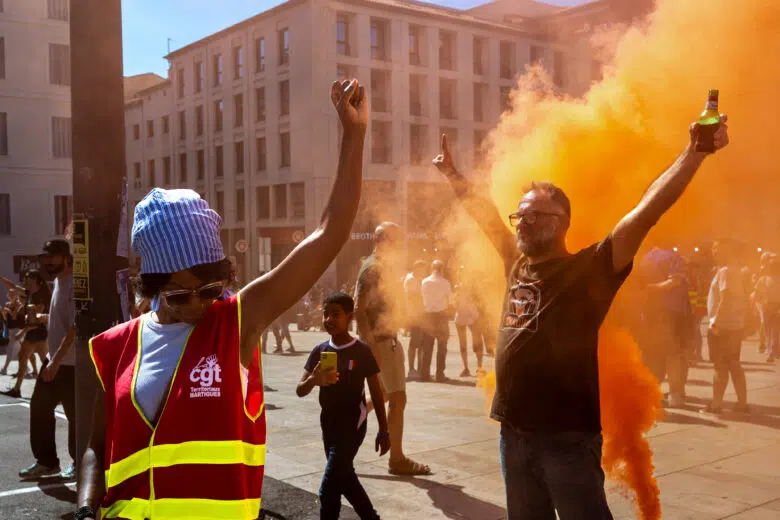

👋 Muraho!*
Welcome to Friday, where the U.S. vetoes for the sixth time a UN draft resolution for a ceasefire in Gaza and the release of Israeli hostages, Russia returns 1,000 bodies to Ukraine in latest exchange and today’s quiz question comes from Ig Nobel Prize, the annual spoof of the Nobel Prize. Meanwhile, Álex Mesa for independent Catalan media Catalunya Plural, asks fundamental questions about today’s politics of resistance.
[*Kinyarwanda, Rwanda]

✅ SIGN UP
This is our daily newsletter Worldcrunch Today, a rapid tour of the news of the day from the world’s best journalism sources, regardless of language or geography.
It’s easy (and free!) to sign up to receive it each day in your inbox: 👉 Sign up here
🗞️ FRONT PAGE
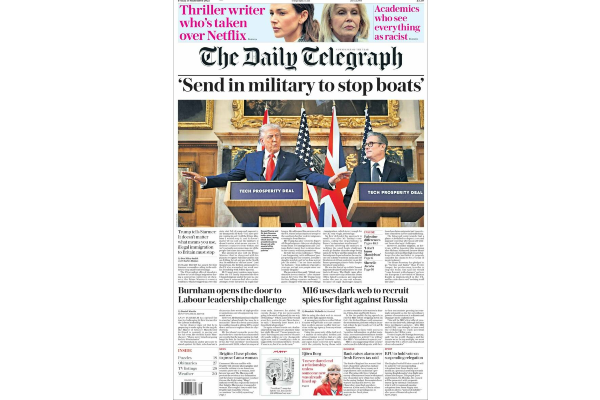
British daily newspaper The Telegraph dedicates its front page to the meeting between U.S. President Donald Trump and UK Prime Minister Keir Starmer. Trump suggested Starmer could use the military to stop illegal migration. The U.S. president talked about his policies to secure borders in the U.S. and said the UK faced a similar challenge with migrants crossing the English Channel in small boats.
🌎 7 THINGS TO KNOW RIGHT NOW
• U.S. vetoes UN Security Council resolution demanding immediate Gaza ceasefire. The U.S. has for the sixth time vetoed a draft resolution at the United Nations Security Council that would have demanded an immediate and permanent ceasefire in Gaza and the release of hostages. Meanwhile, all 14 other members of the Security Council voted in favor of the draft resolution, which described the humanitarian situation in Gaza as “catastrophic”.
• Ukraine says Russia returns 1,000 bodies in latest exchange. The vast majority of the bodies were received by Ukraine from Russia, while the bodies of 24 Russian soldiers were handed over by Ukraine. Kyiv said this latest exchange of bodies comes as Ukraine claims advances in the east of the country.
• UN Security Council plans a vote on Iran “snapback” sanctions ahead of deadline. The UN Security Council is expected to vote on a resolution Friday on whether to reimpose sanctions on Iran over its nuclear program, as European officials warn Tehran that time is running out to come to a diplomatic resolution ahead of next week’s annual United Nations gathering of world leaders.
• Canada and Mexico agree to deepen ties amid Trump trade war. Following a meeting in Mexico City, Canada’s Prime Minister Mark Carney and Mexican President Claudia Sheinbaum also expressed their commitment to a shared partnership with the U.S. Both Canada and Mexico have been hit by U.S. tariffs: 50% on Canadian steel, and 25% on some Mexican pharmaceuticals.
• France kicks out Mali diplomats as tensions rise over arrest of French envoy. France has given two Malian diplomats until Saturday to leave the country, and suspended its counter-terrorism cooperation with the country weeks after a French envoy was arrested in Bamako. Paris is demanding the diplomat’s release, calling the arrest “unjustified,” as Mali continues to accuse foreign powers of destabilizing the country amid its ongoing security crisis.
• Taliban ban books written by women. The Taliban government has removed books written by women from the university teaching system in Afghanistan as part of a new ban which has also outlawed the teaching of human rights and sexual harassment. Some 140 books by women were among 680 books found to be of “concern” due to “anti-Sharia and Taliban policies”. Meanwhile, a British couple who were detained for nearly eight months by the Taliban in Afghanistan have been released.
• News Quiz! A team of Japanese scientists won this year’s Ig Nobel Prize, the annual spoof of the Nobel Prize awarded to quirky studies. What was the topic of their animal-linked research?
A. Painting cows like zebras to keep flies away
B. Teaching goldfish to tell music genres apart
C. Testing the impact of coffee on sloths
D. Training crabs to walk in a straight line
[Answer below]
#️⃣ BY THE NUMBERS
$294,000
Chinese artificial intelligence developer DeepSeek spent just $294,000 on training its R1 model — much less than reported for U.S. rivals. The surprisingly low cost was cited in a paper that is likely to reignite debate over Beijing’s place in the AI race. The rare update from the Hangzhou-based company, the first estimate it has released of R1’s training costs, appeared in a peer-reviewed article in the academic journal Nature. Read more about DeepSeek here.
📰 IN OTHER NEWS
🗯️ Is it possible to think about hatred in terms that do not reject it outright? Are there groups in society who are allowed to hate and others who are not? These are questions fundamental to today’s politics of resistance.
— CATALUNYA PLURAL
💊 Once trapped in bulimia and anorexia, German author Nora Burgard-Arp sees the return of fragile bodies, Ozempic glamour, and weight-loss slogans: it’s threatening teenagers all over again.
— DIE ZEIT
♋ In an age of uncertainty and distrust in traditional institutions, astrology has reemerged as part therapy, part identity language, and part entertainment — a way for many, especially women, youth, and LGBTQ+ communities, to navigate modern life.
— THE CONVERSATION
✍️ Newsletter by Emma Albright
Quiz Answer: A. A team of Japanese scientists was honored with an Ig Nobel Prize for their research on whether painting cows with zebra-like stripes reduced fly bites (it does). Other winners of the 35th edition of this yearly satirical award, held in Boston, included a study on the influence of drinking alcohol on a person’s ability to speak a foreign language, as well as research on the physics of pasta sauce.
Let us know what’s happening in your corner of the world!